Pork belly burnt ends with a mango chutney glaze
- Prep10 min
- Cook6 hr 50 min
- Serves10
- DifficultyMedium
- Temperature110°C (230°F) indirect, deflector in, for both stages. Reheat at about 140°C (284°F).
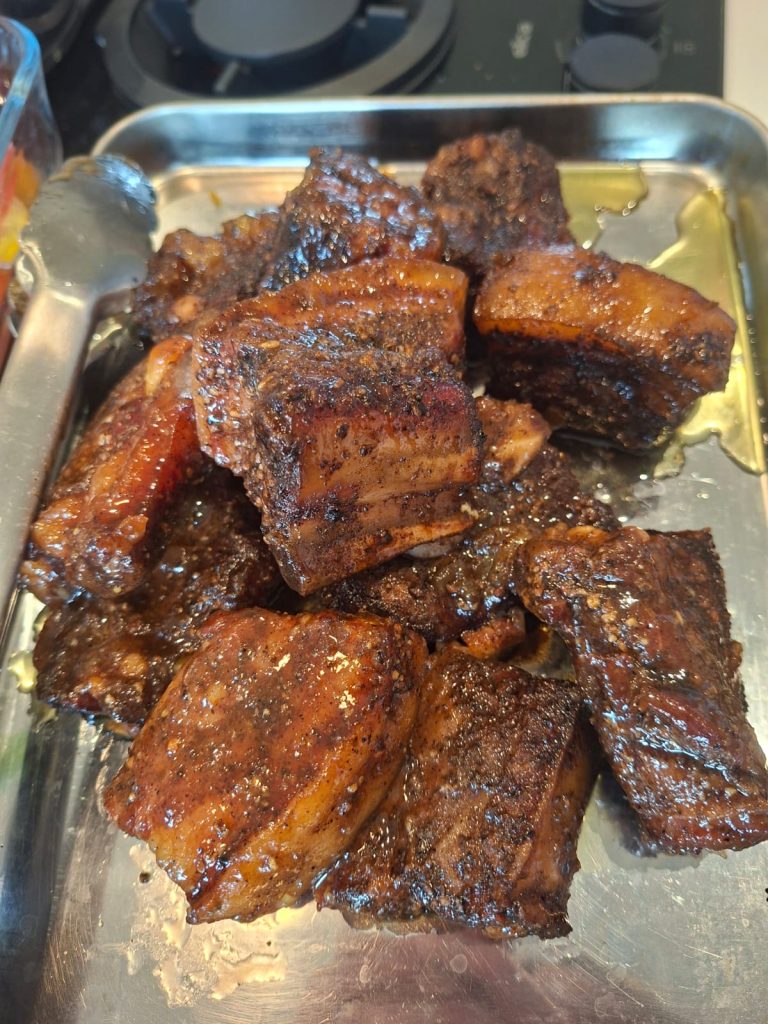
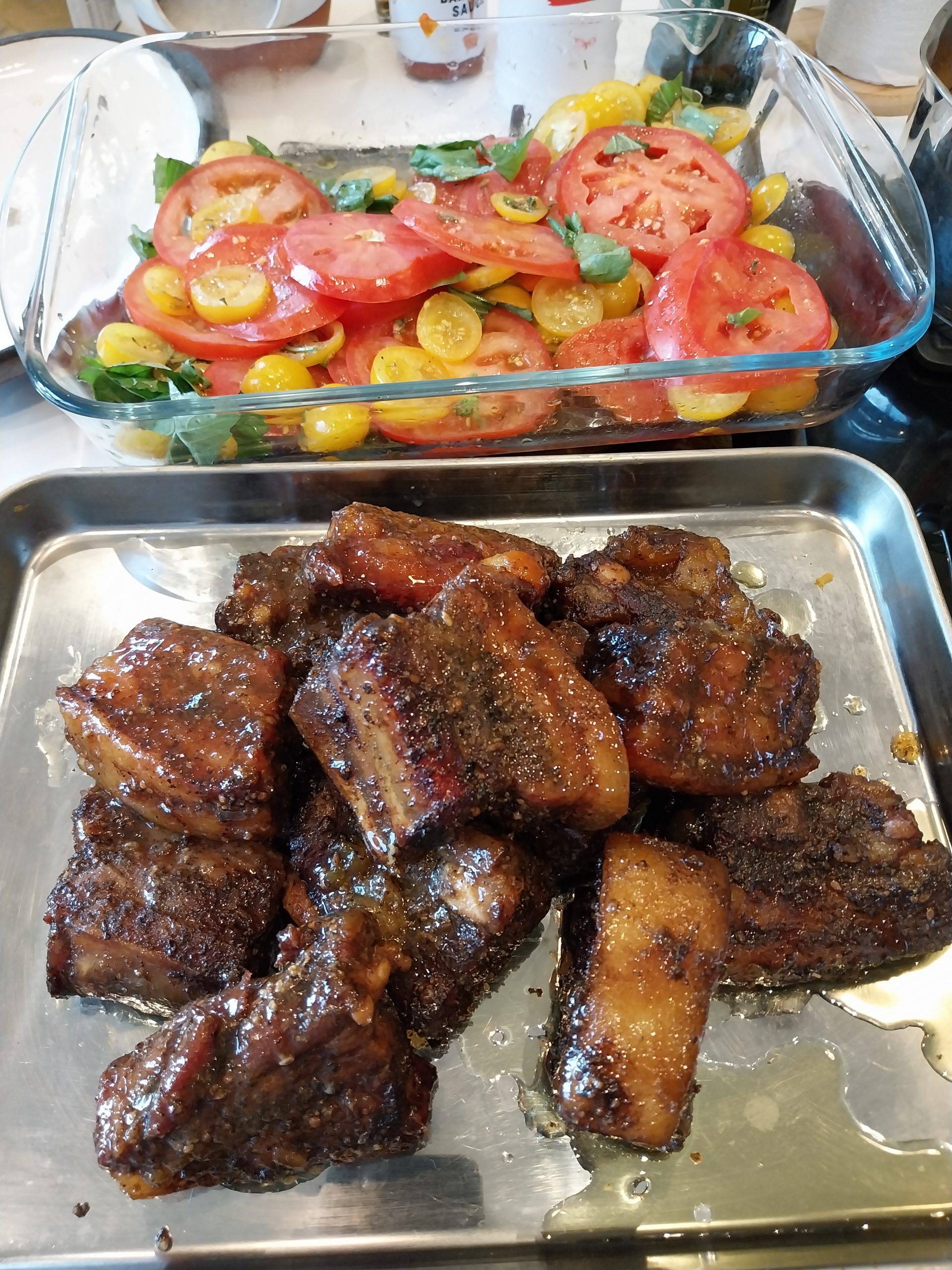
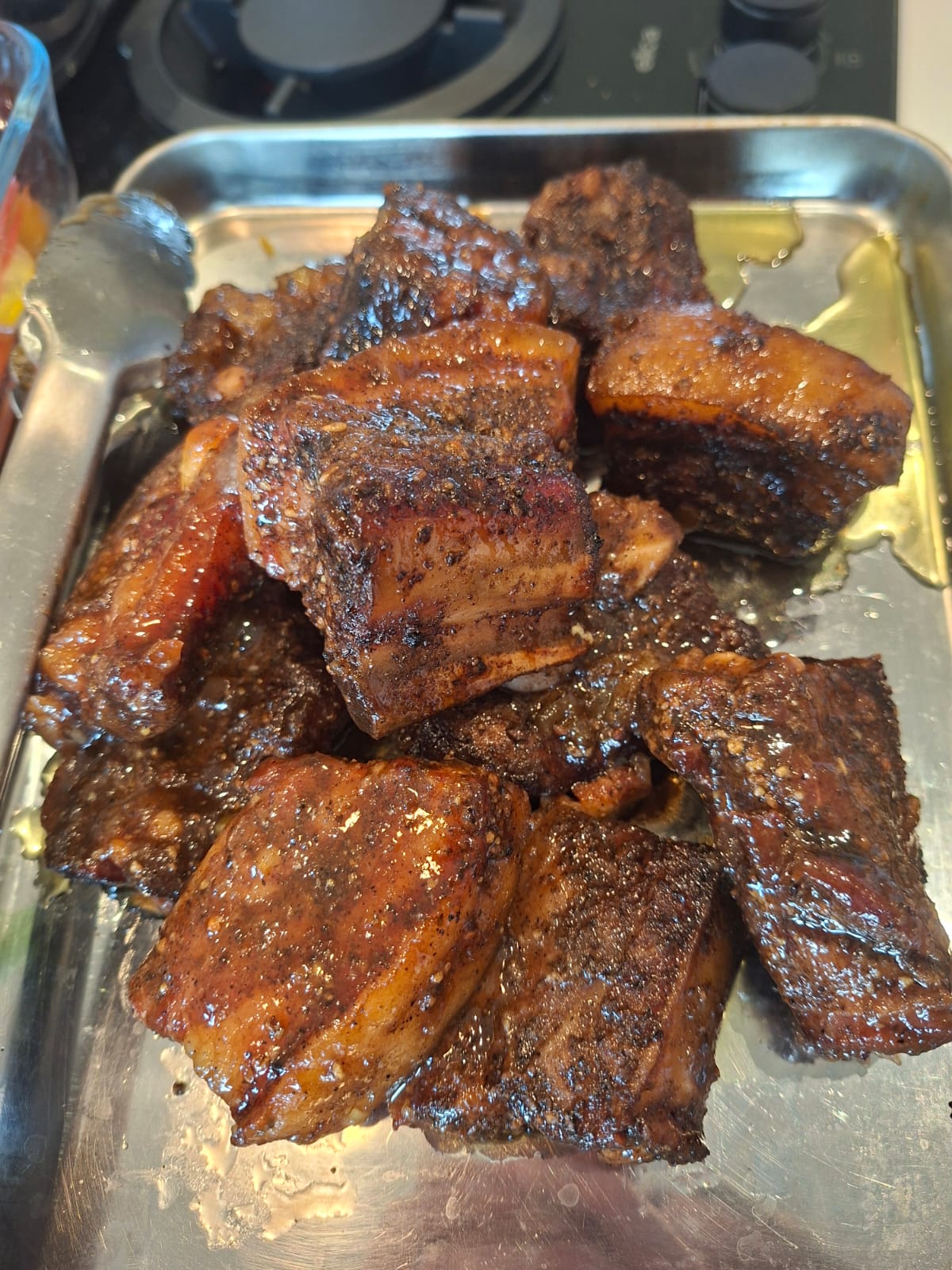
I’ve cooked these pork belly burnt ends twice on my Big Green Egg, in June and again in September. The belly gets a pepper and Ras el Hanout rub, goes on at 110°C (230°F) with the deflector in for about three and a half hours, then finishes in a covered tray with Sharwood’s mango chutney, butter and cider vinegar. The mango chutney idea came from Easy E, a London pitmaster I met at a BBQ event in Surrey.
Ingredients
- 2 kg pork belly, skin off
- SPG rub: 2 parts coarse black pepper, 1 part Maldon salt, ½ part garlic granules
- About 1 tbsp Ras el Hanout
- 1 × 340 g jar Sharwood's mango chutney
- 50 g salted butter
- 1 tbsp cider vinegar
- A splash of boiling water
Equipment
- A barbecue that holds 110°C (230°F) indirect with the lid down for most of a day. I use my Big Green Egg Large with the ConvEGGtor (ceramic deflector) and a drip tray on top of it.
- A pan or tray big enough to hold the cubes in one layer, with a lid or foil over it. I used a cast iron pan in June and a foil tray in September.
- A probe thermometer.
- Lump charcoal, and oak if you want some smoke.
Method
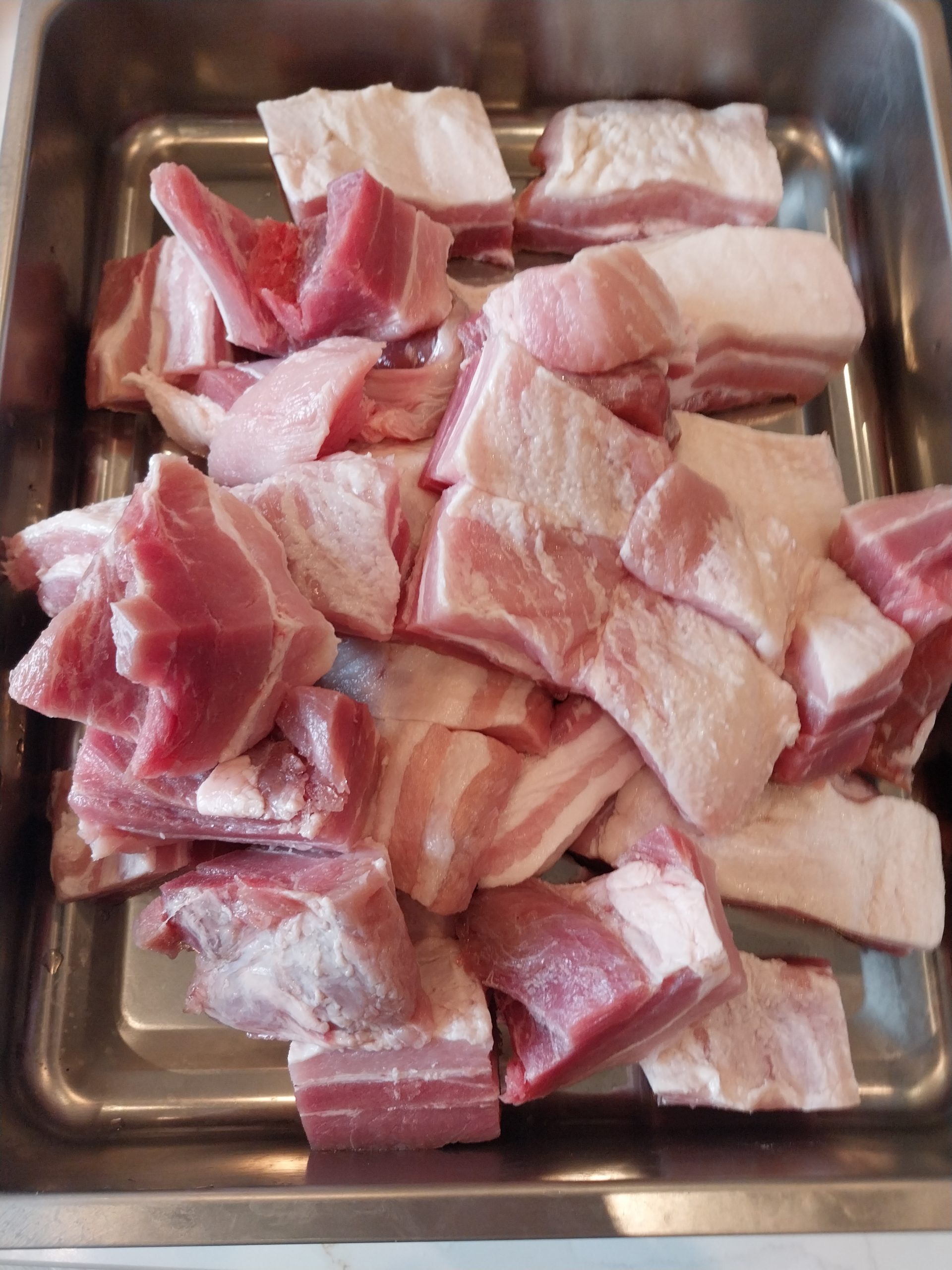
- Take the skin off and cut the belly into big chunks
- Rub the cubes
- Set the Egg up indirect at 110°C (230°F)
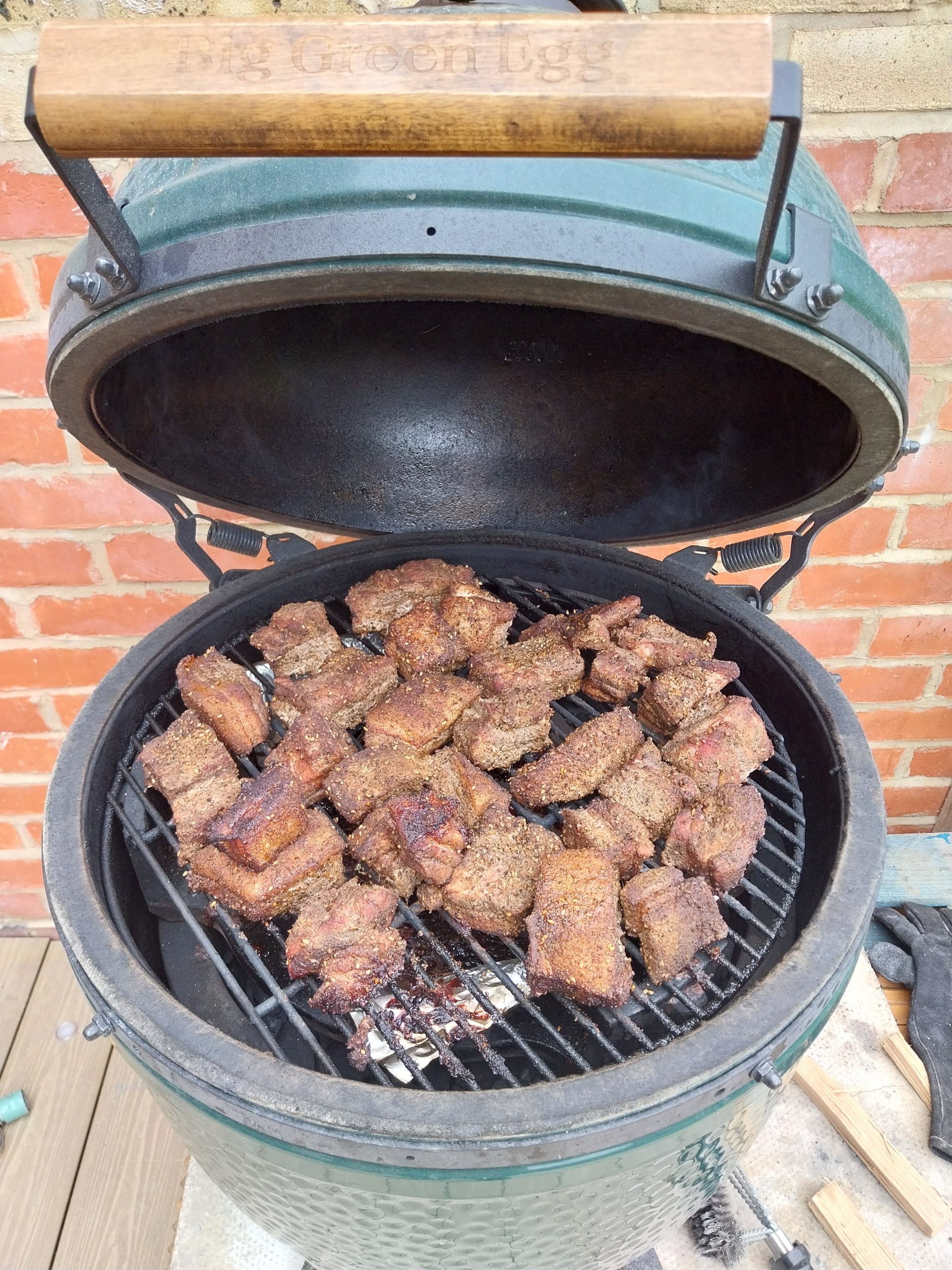
- Cook the cubes on the grate for about three and a half hours
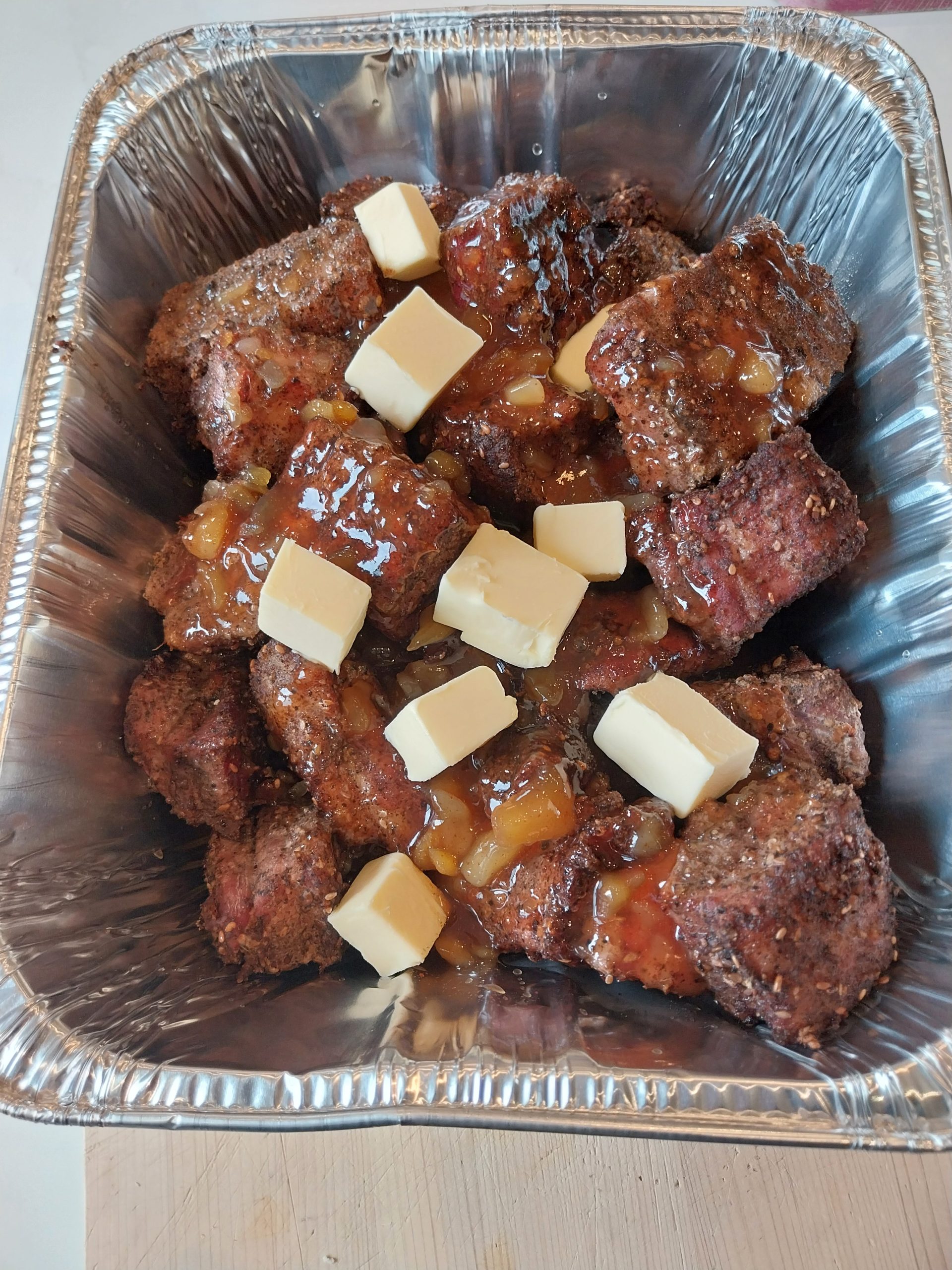
- Put them in a pan with the glaze
- Cook covered until tender
- Serve, or chill and reheat
Key takeaways
- Go by touch and feel, not a set temperature. In June I took them off at about 96°C (205°F). In September the ones sitting in the glaze were at 94–95°C (201–203°F). Both times it was the feel that told me they were done.
- Pork belly doesn’t shred. It goes tender and you can bite straight through it, but it won’t fall apart like beef chuck does.
- Keep the cubes in the glaze. The cubes sitting in the liquid came out more tender than the ones poking out of it, so use a pan big enough to hold them in one layer.
- They reheat well. In September I cooked them the day before, and they were great reheated on the Egg the next day.
- Cut them big. I’d go for chunks of about two to three inches (5–7.5 cm). Bigger is better here.
The cook, in full
I’ve done this twice. The first time was 21 June, with 2 kg of belly from Leopold’s Butchers near Wimbledon, cut at the counter. The second was 19 September, with a whole 4.1 kg belly I ordered online from HG Walter and cut up myself. The recipe here is written for 2 kg.
Both times the butcher took the skin off for me, and I made crackling with it separately.
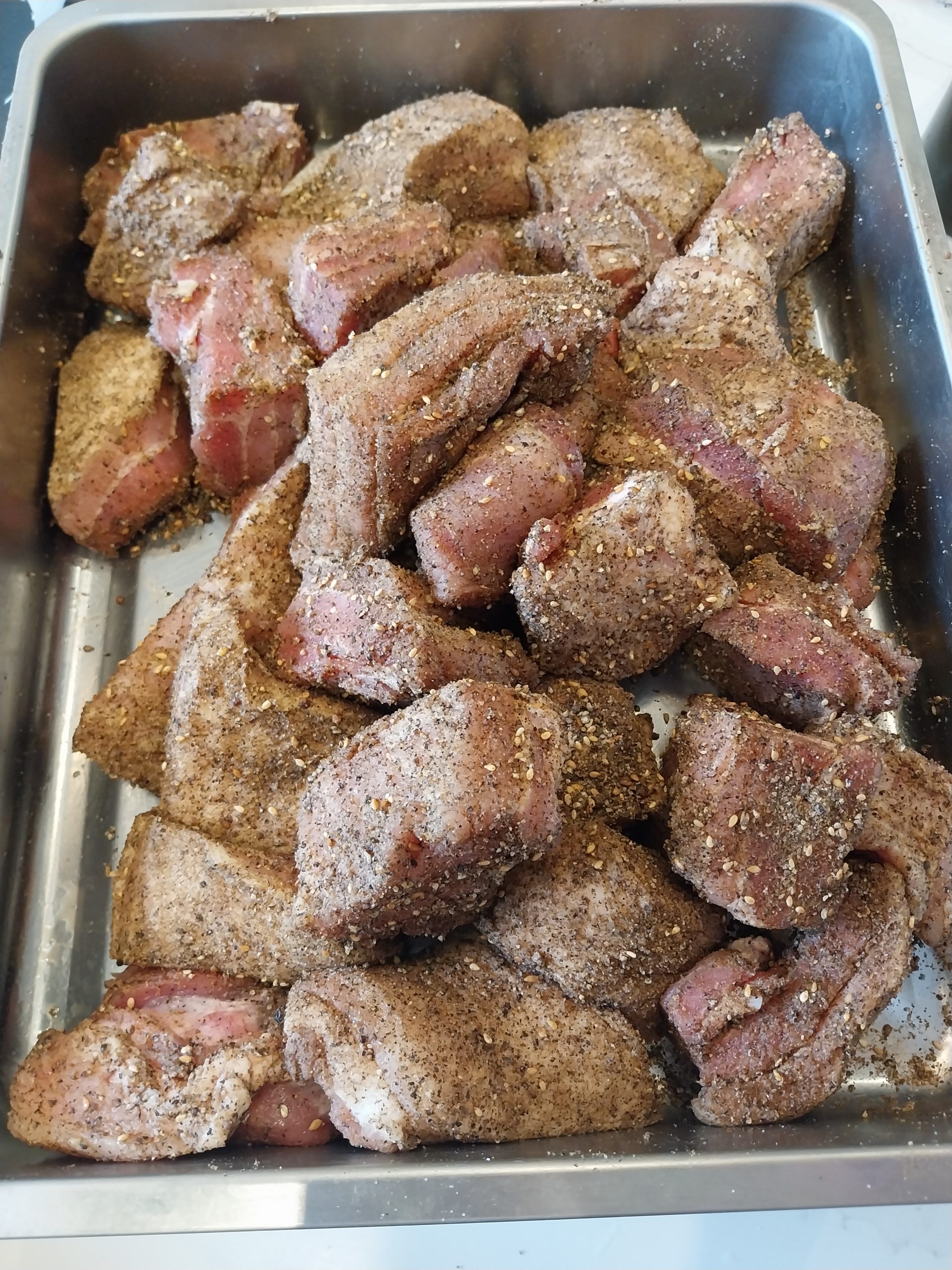
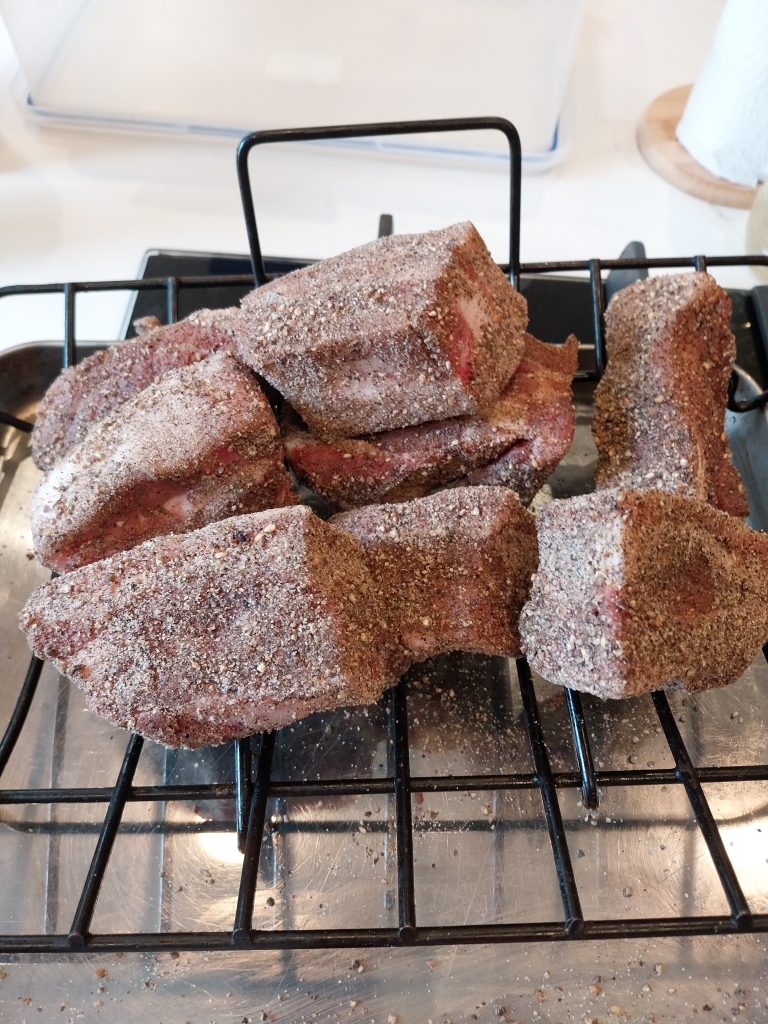
The rub is my usual SPG, which is two parts coarse black pepper, one part Maldon salt and half a part garlic granules, with about a tablespoon of Ras el Hanout mixed through. In June I left the cubes bare in the fridge overnight to dry off and rubbed them the next morning. In September I rubbed them and they were on the Egg a few minutes later.
The Egg was at 110°C (230°F), set up indirect with the ConvEGGtor (ceramic deflector) in and a drip tray on top of it. In September I had oak on as well. The cubes go straight on the grate, and the fat drips into the tray instead of sitting round them. I keep that fat for roast potatoes.
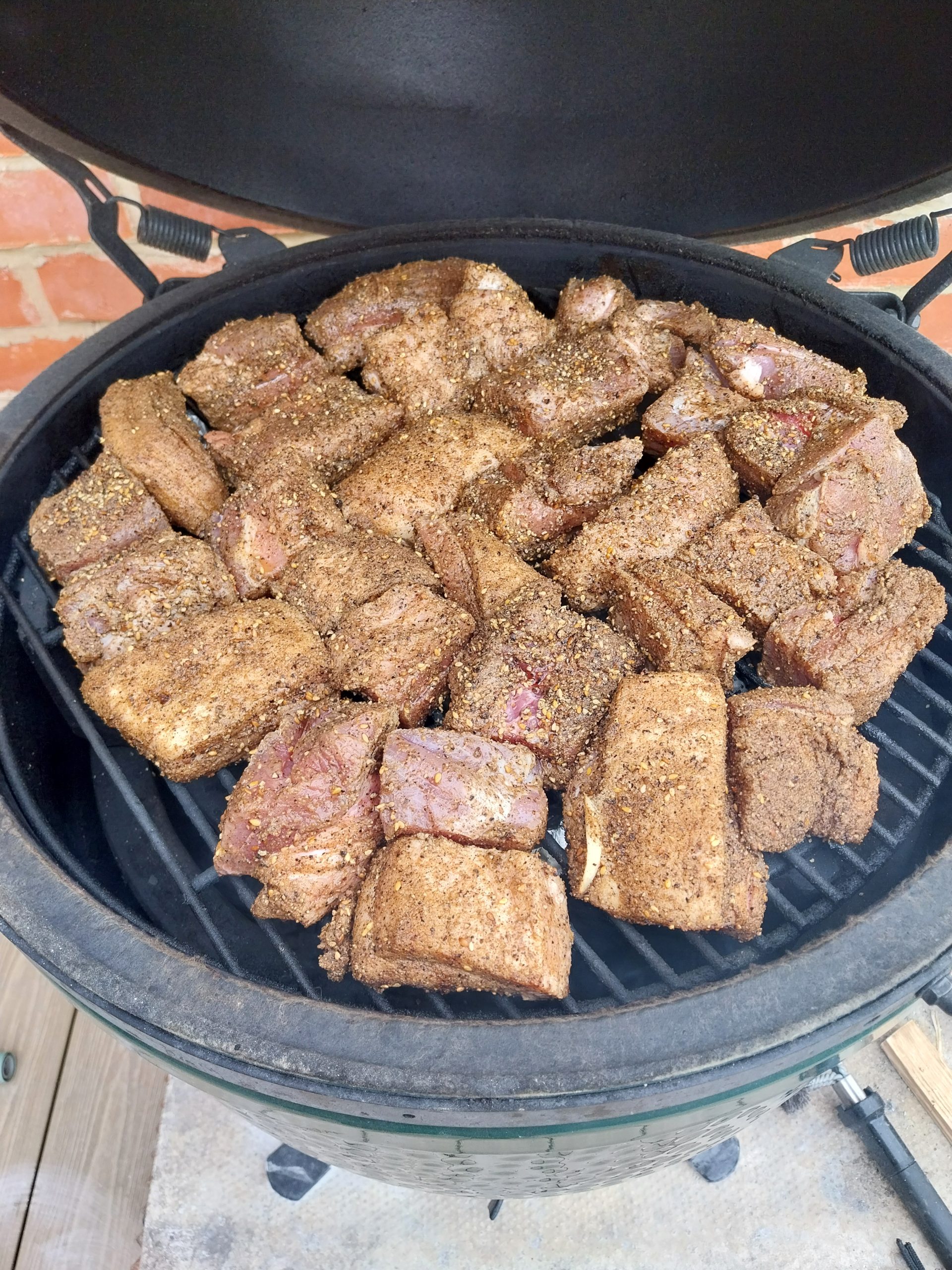
The first stage is about three and a half hours. In June the cubes were at 80–85°C (176–185°F) by then and felt soft when I probed them. In September the chunks were much bigger and they stalled at about 74°C (165°F). I moved them into the tray anyway, after nearly four hours, and they finished in there.
For 2 kg, the glaze is one 340 g jar of Sharwood’s mango chutney, 50 g of butter and a tablespoon of cider vinegar. In September I also swirled a splash of boiling water round the empty jar to get the last of the chutney out, and tipped that in too. In June I used a cast iron pan with a lid. In September I used a big foil tray with foil over the top. Either way it goes back on at the same 110°C (230°F).
In June, with 2 kg in one layer, this stage took about three hours with the lid on, then 20 minutes with it off to thicken the glaze. In September I had nearly twice as much meat, so the cubes were piled up. After five hours the ones in the liquid were at 94–95°C (201–203°F) and the ones above it were only at 87–88°C (189–190°F). I gave them a good stir and took them off.
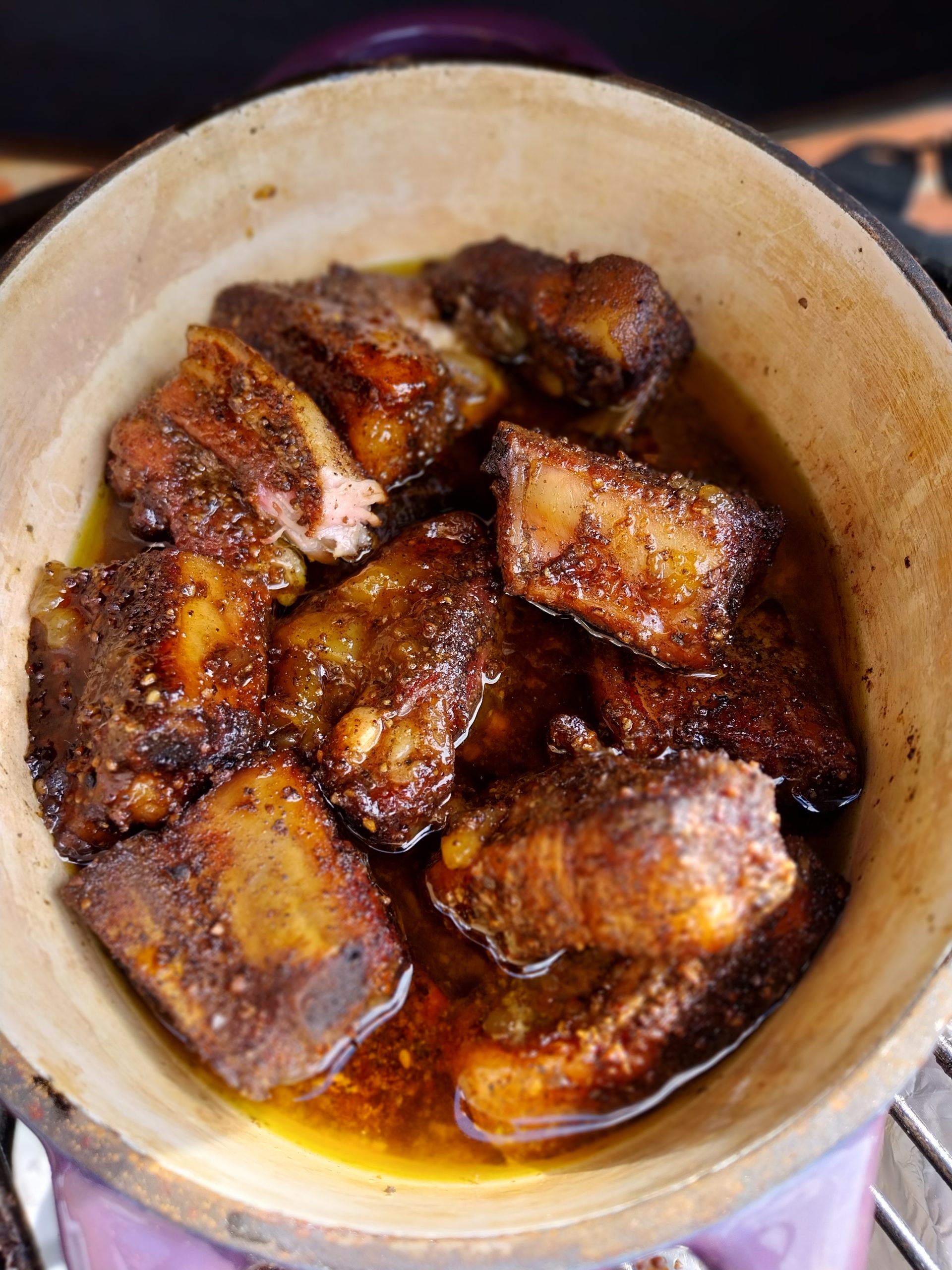
In June I served them the same day. I put the lid back on the pan, shut the vents nearly all the way, and they sat on the Egg for three and a half hours until we ate at eight.
In September I cooked them the day before. They went in the fridge overnight, then back on the Egg at about 140°C (284°F) for an hour or so, with a stir after 15–20 minutes. I only took the foil off for the last 15–20 minutes, and the glaze didn’t really need more than that. They were great, and not much more broken down than the night before.
What to serve it with
They’re rich and quite sweet, so they want something sharp next to them. In June I did a heritage tomato salad, quick-pickled red onions and a rice with turmeric and peppers. In September there was a tomato salad and pickles on the table again.
What I learned
Pork belly isn’t going to fall apart. After June I thought they should have broken down more, so in September I gave them a lot longer in the tray. They still didn’t shred. They were tender, you could bite through them, and they tasted great. There’s no point chasing it.
A lot of the advice online says not to submerge the cubes. I found the ones sitting in the liquid came out more tender. I wouldn’t leave them in too long, though, or they start going towards a casserole. Next time I’m going to submerge the lot and see what happens.
I used too much butter in June, 150 g for 2 kg. In September I used 100 g for 3.6 kg, which works out at about 50 g for 2 kg, and that was right.
Variations
I’d cut them smaller, about 2–3 cm, if I were serving them as canapés.
Related
- Beef chuck burnt ends on a kamado — the beef version.
- Pork crackling on the kamado — what to do with the skin.
- Basque cheesecake on a kamado — baked on the same fire in September.
- Big Green Egg Large review — the unit this was cooked on.
FAQ
How long do pork belly burnt ends take?
Plan for most of a day. For 2 kg, the first stage on the grate is about three and a half hours at 110°C (230°F), then about three hours in the covered pan and 20 minutes uncovered. With nearly twice the meat in September, the pan stage took five hours.
Is pork belly the best cut for burnt ends?
For pork, yes. I enjoy it more than beef chuck, which I’ve also done. I haven’t done brisket burnt ends, which I think are the Rolls Royce version, so I can’t compare those.
What’s the difference between pork belly burnt ends and normal burnt ends?
Normal burnt ends come off a brisket, as a side dish or a chef’s treat from that big cook. These are made from cubes of pork belly instead.
What mistakes should you avoid with pork belly burnt ends?
Chasing fall-apart, and pulling at a set temperature. Pork belly won’t shred, so go by touch and feel. In the second stage, keep the cubes in the glaze, and use a pan big enough to hold them in one layer.
Should I marinate pork belly for burnt ends?
I don’t. In June I left the cubes bare in the fridge overnight to dry, then rubbed them in the morning. In September I rubbed them and they went straight on.
Can you make pork belly burnt ends the day before?
Yes. In September I cooked them on the Saturday, kept them in the fridge overnight and reheated them on the Egg on the Sunday at about 140°C (284°F) for an hour or so. They were great, and not much softer than the night before.
Disclosure and provenance
I cooked this on my own Big Green Egg Large and paid for the pork both times, from Leopold’s Butchers near Wimbledon in June and HG Walter in September. The mango chutney idea came from Easy E’s BBQ London. Smoke and Lump has no commercial relationship with any of them and earns nothing from this recipe.
Sourced from the 21 June and 19–20 September 2026 cook logs — two cooks of pork belly burnt ends on the Big Green Egg Large, the second cooked a day ahead and reheated.