Burnt ends recipe — beef chuck on a kamado

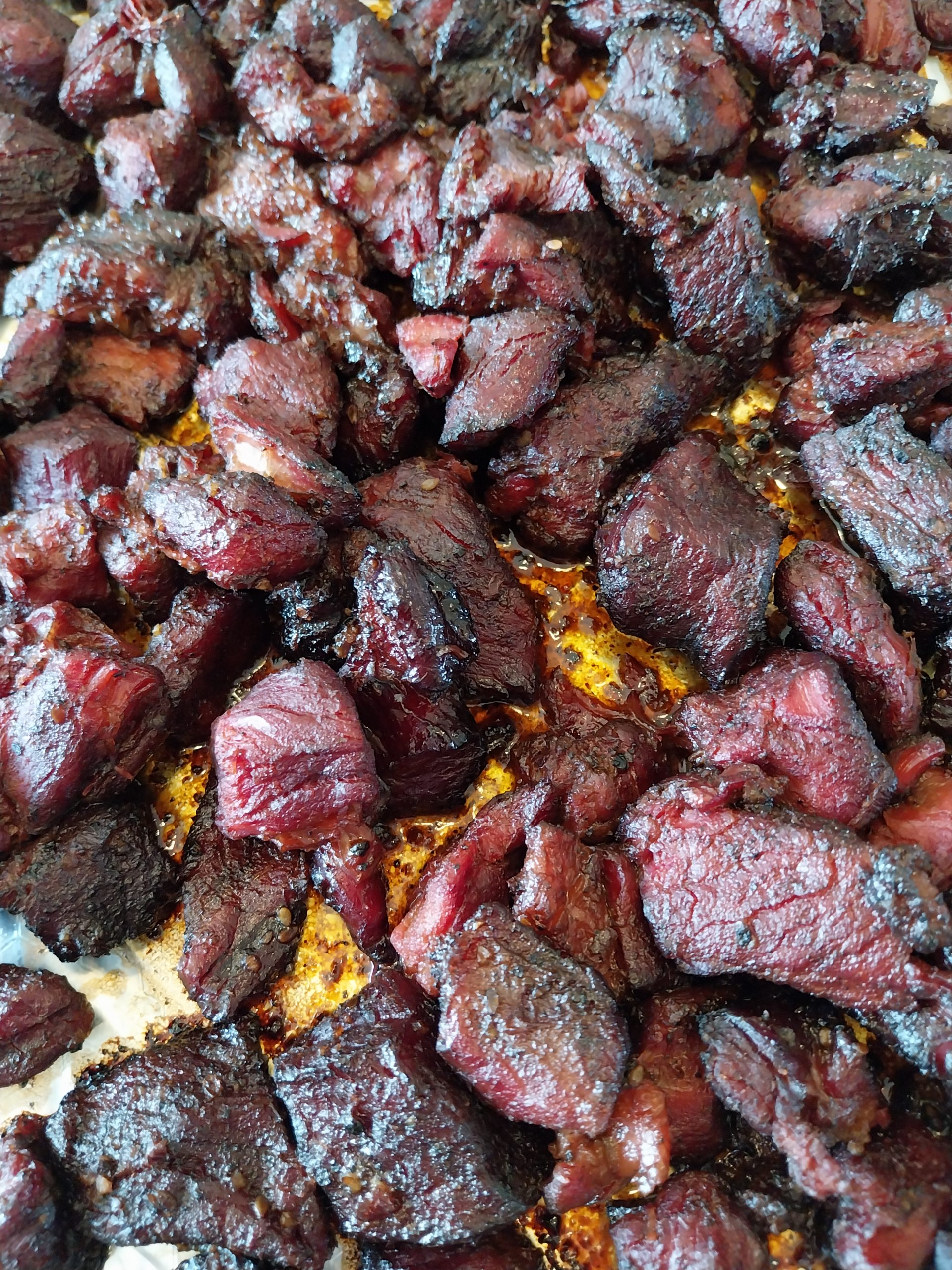
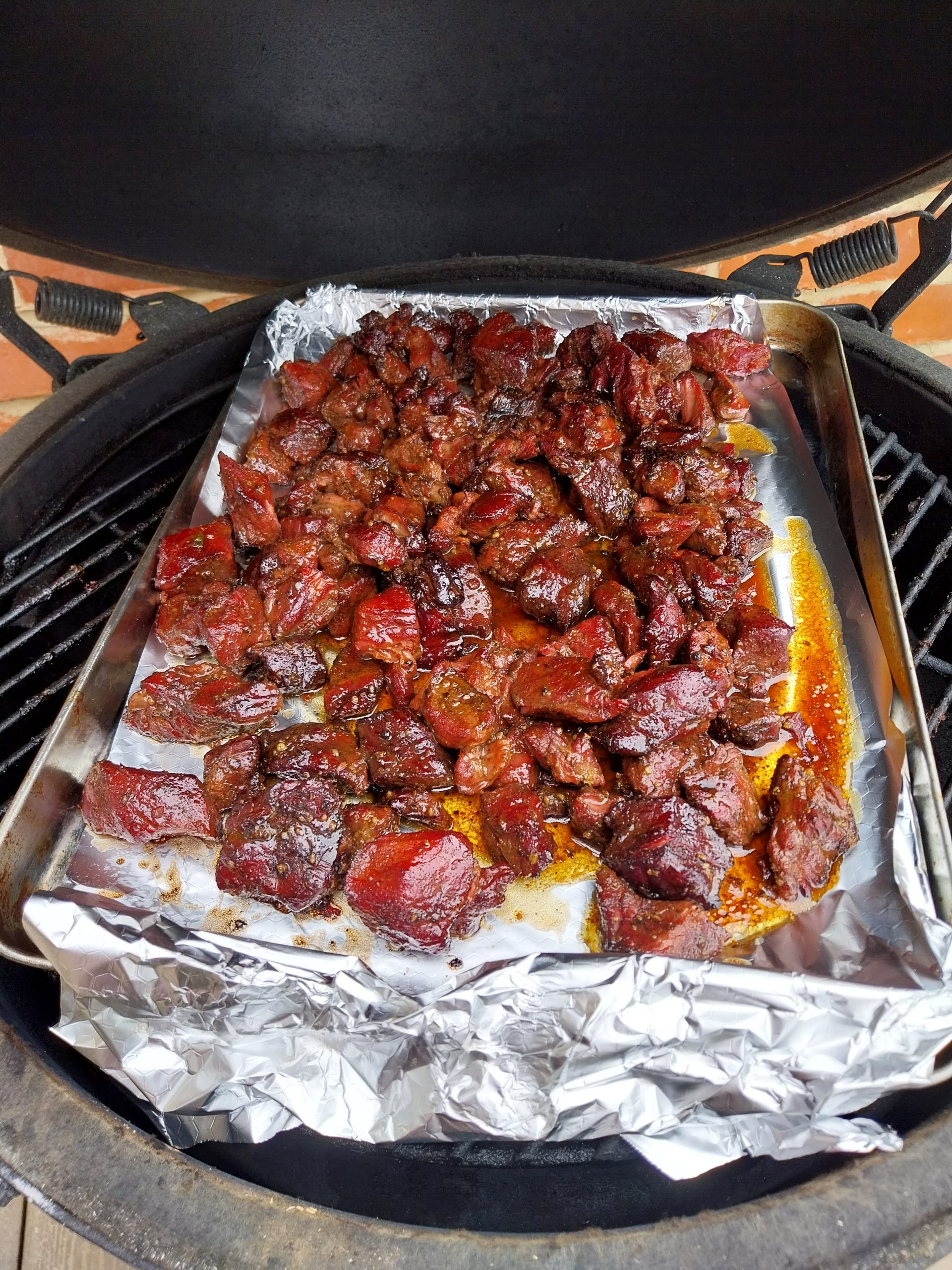
Poor man's burnt ends of beef chuck coming off the kamado, dark and glossy with glaze, in a foil-lined tray

Published 22 August 2026 · Last updated 22 August 2026 · Tested by Ben Austen · Affiliate disclosure

Two kilos of diced beef chuck, cooked on my Big Green Egg Large on a Tuesday in August. Poor man’s burnt ends, if you have seen them called that. I bought it from HG Walter, through my sister’s trade account but with my own money. The dice was too small for burnt ends, under an inch a side at a guess, and it needs cutting bigger than that. Next time I’d go to a butcher and have them cut it to size. It went on at 130°C dome indirect with the ConvEGGtor (ceramic deflector) in, an hour and ten minutes naked to get some bark on. Then into the Le Creuset with a whole 500ml bottle of hoppy IPA. The spring onions went in underneath whole, a trivet to hold some of the cubes clear of the liquid, lid on. Off the fire four hours and thirty-five minutes after it went on.

At the first check, an hour and ten into the braise, the cubes read 94–95°C and were still firm. On most beef cooks that number means done. These were closer to a tough stew than to short rib, and I put it down to the dice being too small to ever give me the texture I was after. That turned out to be wrong. Another hour and a quarter in the same covered pot and they had broken down properly. Small cubes come up to temperature quickly, so the thermometer runs a long way ahead of the meat.

The braise liquid was one 500ml bottle of hoppy IPA, straight from the bottle, and no stock went in at any point. What you usually hear is that you should not reduce a hoppy beer, because the bitterness concentrates as the water goes and leaves you with something harsh. The 500ml came down to about 150ml over the braise and I reduced that by half again for the glaze. It was not bitter, and it did not taste of beer either — by then it had reduced to a beef glaze. One cook is one cook, but I would use an IPA again without thinking about it.

Key takeaways

  • Chuck gets you beef burnt ends for much less than brisket. Burnt ends normally come off the point end of a brisket. Chuck is a braising cut going into a covered pot anyway, so there is no fat cap to render and nothing to carve.
  • Any barbecue that holds 130°C indirect with the lid down will do this. I used the BGE Large with the deflector in. You also need a lidded cast-iron pot that fits on the grate, a foil-lined tray for the glazing stage, and an instant-read. No leave-in probe — I hand-probed at the two points where it mattered.
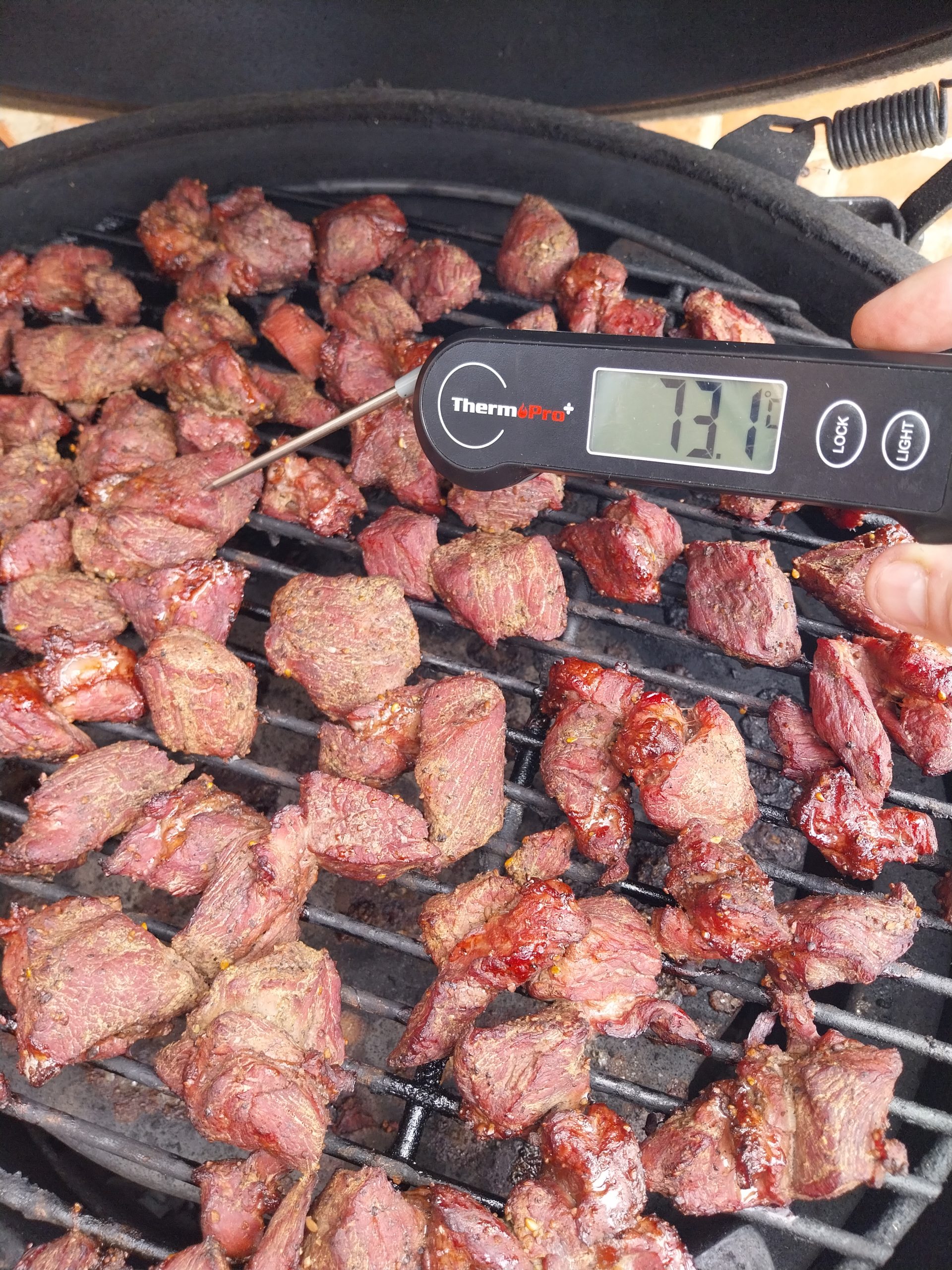
  • Come off the naked phase on the look of the bark, not on a number. I moved mine at 73.1°C, where the chuck recipes online say 65–70°C. At 130°C dome those numbers arrive before any bark has formed, and a probe will not sit centred in a cube that small anyway.
  • The glaze gets balanced, not measured. The reduced liquor comes out salty and flat — mine was the SPG rub concentrated about five times over. Treacle first, then brown sugar because it still needed sweetness, about 50g of butter, then a good slug of cider vinegar. Taste at each step.
  • 2kg does about ten as part of a spread, not as a meal on its own. Mine went out with bacon jam, candied bacon, a baked potato and salad.

At a glance

SpecDetail
Cut2kg diced beef chuck. Dice under an inch a side — smaller than I would choose
Prep time~10 min (rub the cubes)
Cook time4 hr 35 min, cubes on the grate to off the fire
Total time~5 hr 40 min from lighting the charcoal
Servings~10 as part of a spread
Cooking methodIndirect on a kamado, then a lidded pot on the same fire, then back on uncovered to glaze
Pit temperature130–140°C dome indirect throughout
Transition73.1°C off the naked phase, pulled on the look of the bark
FinishOn texture, not a number — 94–95°C is not the finish line on dice this size
DifficultyEasy — long, but only about 30 min of active attention
EquipmentBarbecue holding 130°C indirect lid-down + lidded cast-iron pot + foil-lined tray + instant-read thermometer
CuisineBritish BBQ

What you’ll need

Equipment

The cook needs a barbecue that will hold 130–140°C indirect with the lid down for about four and a half hours, and take a lidded cast-iron pot on the grate. I used my BGE Large. Any kamado, a charcoal kettle set up for indirect, or a pellet smoker will do the same job. Nothing here needs a ceramic.

  • A deflector or heat shield for the indirect setup. My ConvEGGtor (ceramic deflector) goes in once the charcoal has caught and is starting to come up, and it stays in for the whole cook.
  • A lidded cast-iron pot big enough to take 2kg of dice without stacking it too deep. I used a Le Creuset. Anything with a heavy base and a tight lid works — the lid is the part that matters, because the braise has to hold its own steam.
  • An instant-read thermometer. I hand-probed twice, coming off the naked phase and at the first braise check. No leave-in probe went near this cook, because you cannot get one to sit centred in a cube this small. If I ran it again on cubes cut properly big, I would put a leave-in in one of them.
  • A saucepan. The liquor comes off the fire and reduces indoors on the hob, where you can watch it.
  • A baking tray, and foil to line it. The glazed cubes go back on the fire in the tray rather than on the bars — sticky dice will weld to a grate and the small ones fall through it.
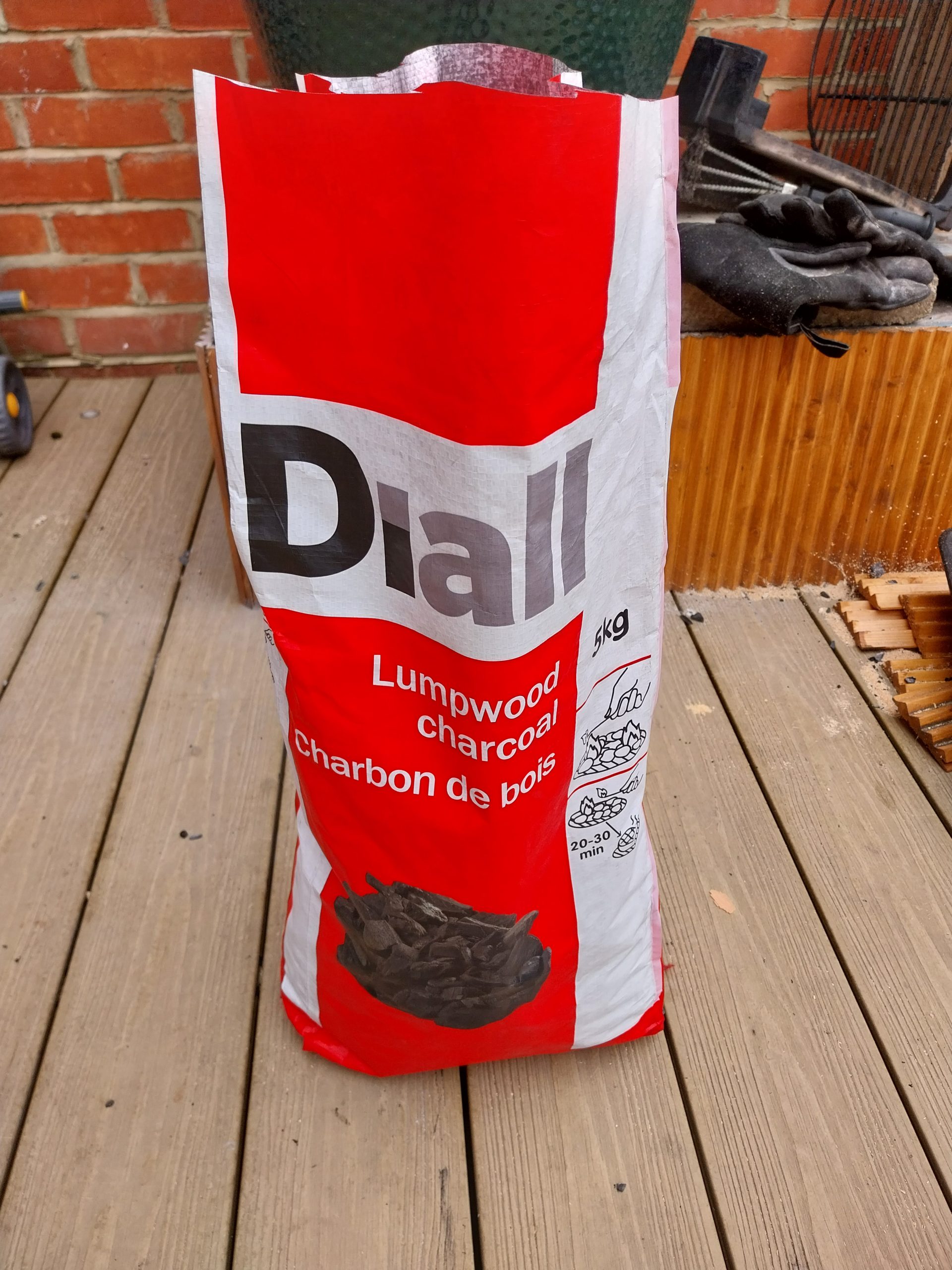
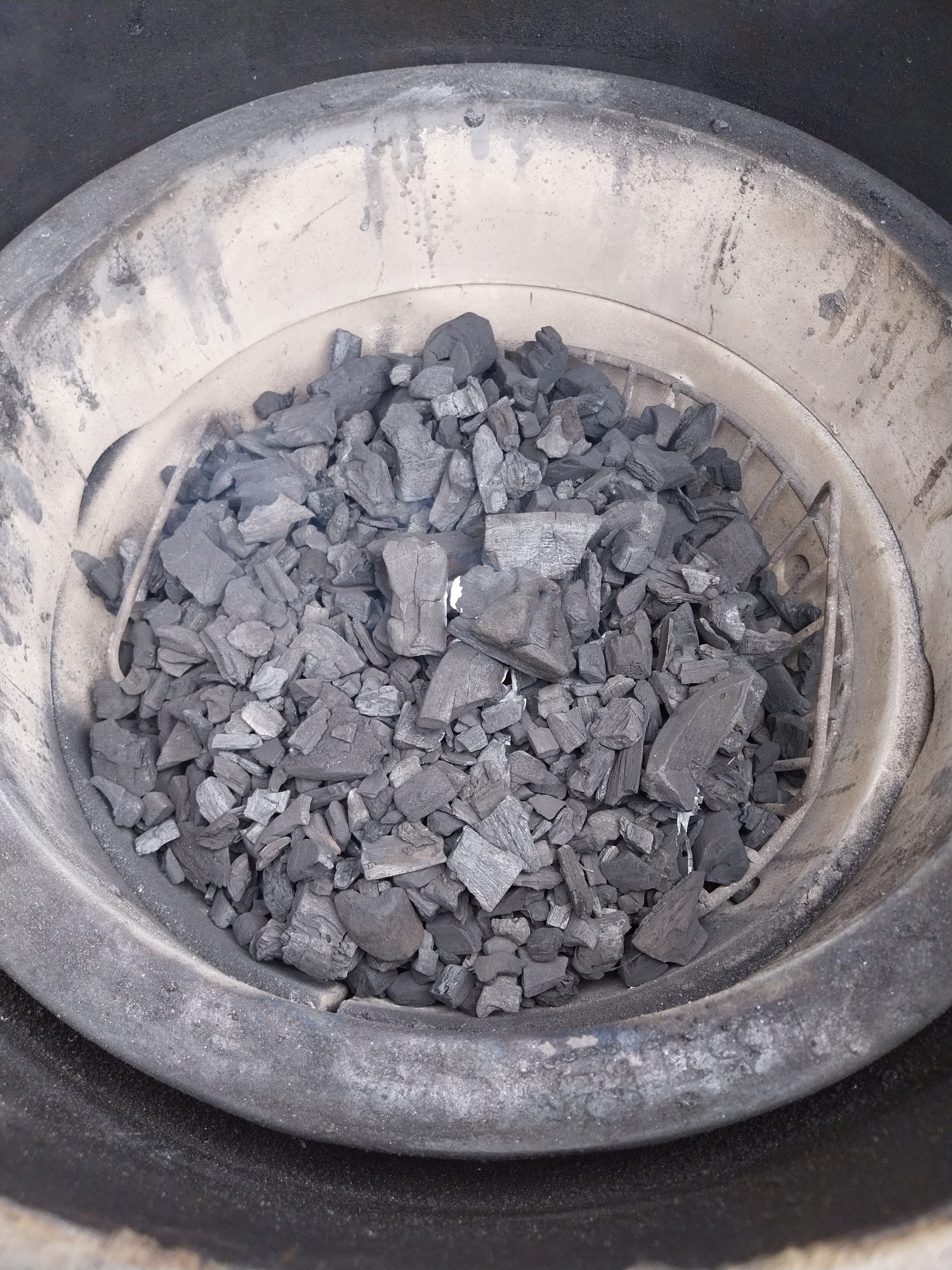
  • Lump charcoal, and enough of it for four and a half hours. Mine was a 5kg bag of Diall lumpwood from B&Q, and I would not buy it again — very small lumps, and fifteen minutes after lighting it had barely caught. It got there in the end and the cook was fine, but I spent longer than I wanted to waiting on the fire. See the charcoal guide for what I would use instead.
  • A couple of oak chunks. Oak is my default and it is all this needed.

Ingredients

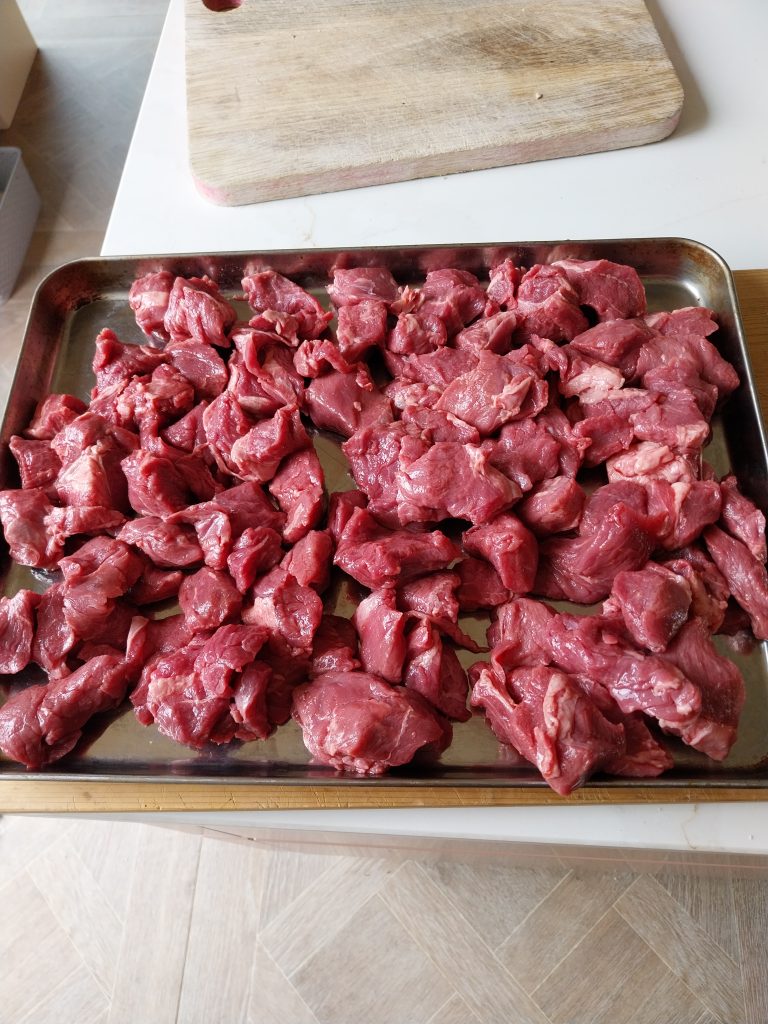
  • 2kg diced beef chuck. Mine came from HG Walter, bought through my sister’s trade account with my own money. Their retail packs are 250g and 500g at £11 for 500g, so 2kg is four packs. The dice arrived under an inch a side, which is what it is sold as — a stewing dice, cut for even cooking in a pot. Ask for it cut bigger if you can. Burnt ends want a cube you can still see on the plate.
  • My normal SPG rub, mixed through the cubes. This was the only salt that went into the cook from start to finish, which matters later when the liquor reduces.
  • One 500ml bottle of hoppy IPA. Mine was Harper’s Brewing Co “A Proper Hoppy IPA”, an Aldi own-brand. Straight from the bottle, not simmered off first.
  • A bunch of spring onions, left whole. They sit in the bottom of the pot and hold some of the cubes clear of the liquid.
  • Black treacle. Lyle’s, out of the tin.
  • Brown sugar.
  • About 50g of butter.
  • Cider vinegar.
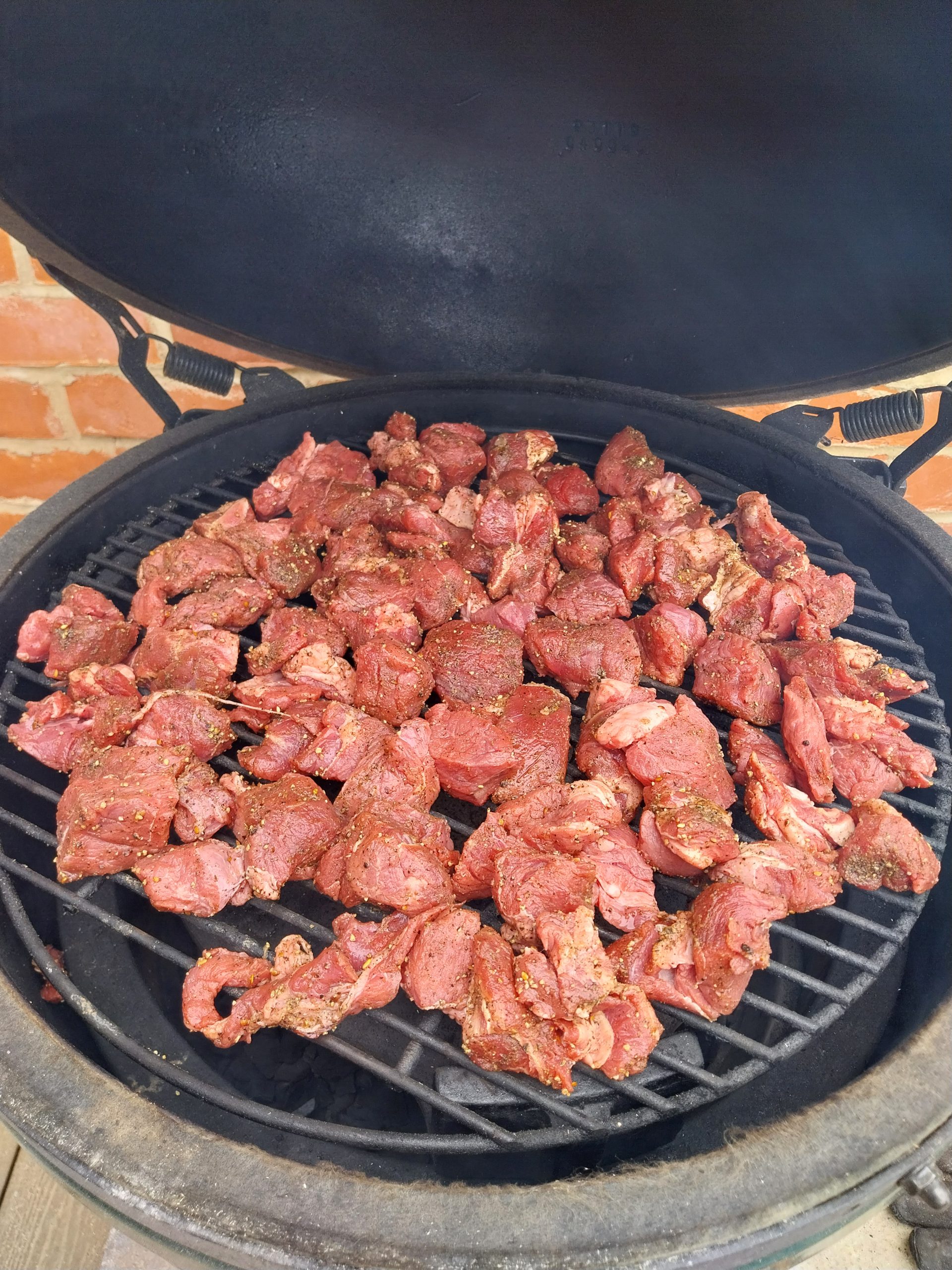
Two kilos of raw diced beef chuck spread on a metal tray, cut to a small stewing dice

No stock, and no salt beyond the rub. Both are worth saying because the liquor ends up concentrated to about a fifth of what went in, and anything salty you add early arrives five times over at the end.

The cook

  1. I light the charcoal first, and put the deflector in once it has caught and started to come up — not before. I bring the dome toward 130°C and let it settle so I can see what the fire is actually doing.
  2. I add the oak once the dome has settled, then give it five or ten minutes until the smoke goes from white to blue. White smoke on the meat is how you get a cook that tastes of ash.
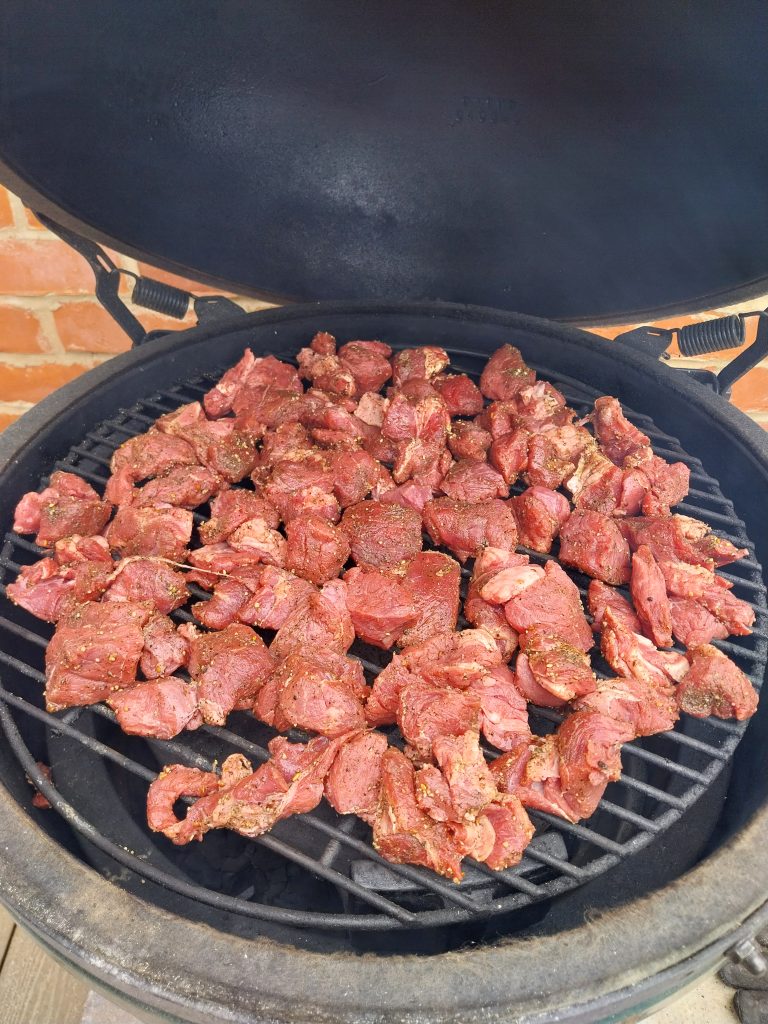
  3. I mix the SPG through the cubes in a tray until every face has something on it. No oil, no binder, no resting time — the rub goes on and the beef goes out.
  4. I put the cubes straight onto the grate, indirect, and leave them naked for an hour and ten, dome running 130°C and drifting up toward 140°C. This is the only part of the cook where smoke gets into the meat.
  5. I take them off on the look of the bark, not on a number. I probed at this point out of interest and it read 73.1°C, but that is not what I moved them on — the bark had set and gone the colour I wanted, and I could see they would dry out and go jerky if I left them much longer.
An instant-read thermometer reading 73.1°C in a cube of beef chuck on the kamado grate, bark set and dark after an hour and ten of smoke
  1. I put the spring onions in whole underneath, the cubes on top of them, and pour the whole 500ml bottle of IPA over. Lid on, pot onto the grate, dome back to 130°C.
  2. I braise it with the lid on for an hour and ten. Nothing to do here. The liquid should be moving but not galloping.
  3. I check it, and I expect it not to be ready. Mine read 94–95°C and was still firm — a tough stew rather than a burnt end. On most beef cooks that reading means done. On dice this small it means the outside of the cube got to temperature long before the collagen had time to go anywhere.
  4. I put the lid back on and give it another hour and a quarter, same pot, same liquid, same temperature. This is where the texture arrives, and it is also where it is easiest to stop too early, because the thermometer has been telling you it is done for the last hour.
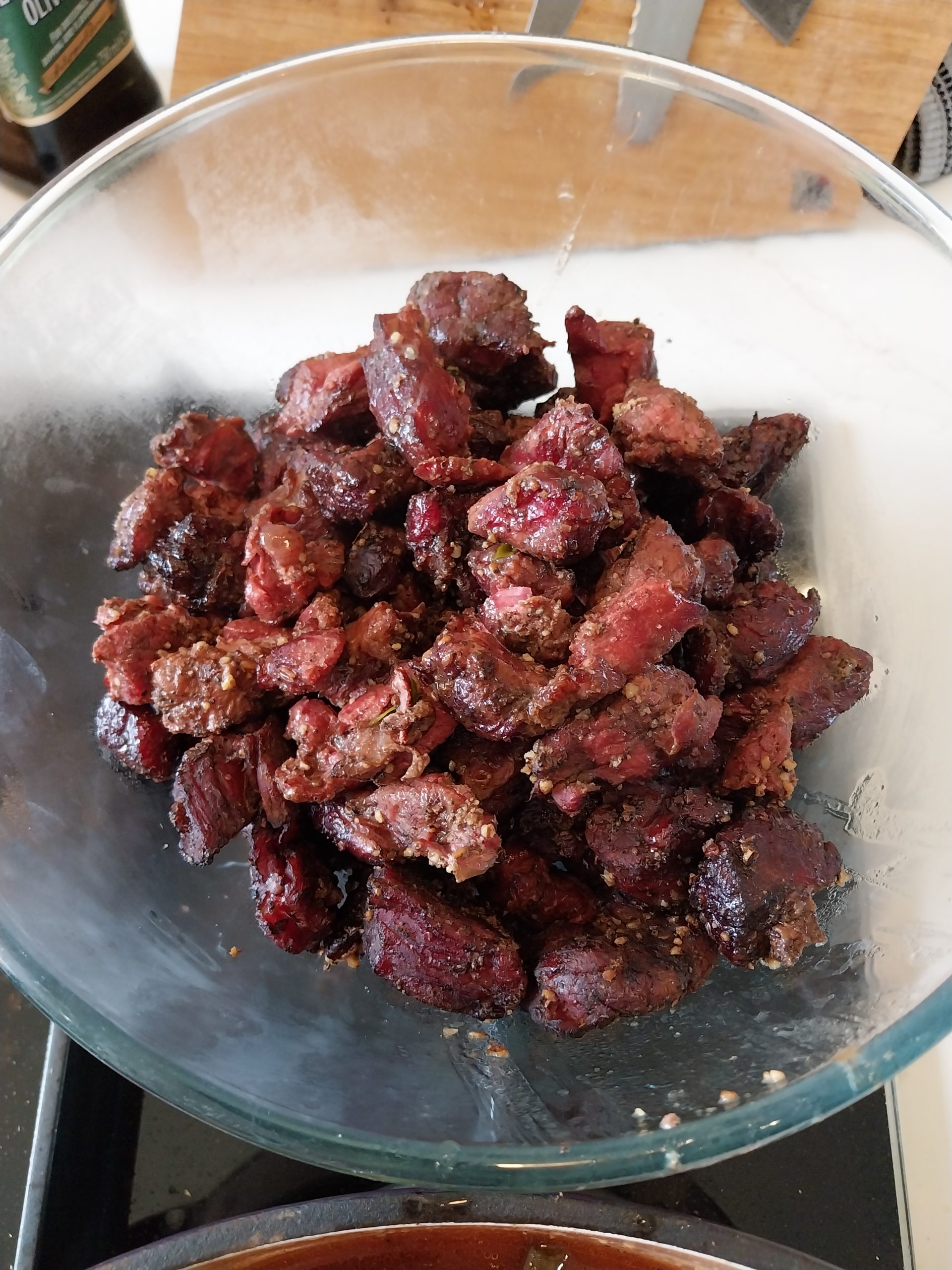
  5. I separate the meat from the liquor, cubes into a bowl and liquor into a saucepan. The 500ml has already come down to about 150ml in the pot on its own, without me doing anything to it.
A glass bowl of braised beef chuck above the cast-iron pot, spring onions still whole in the reduced ale liquor
  1. I take that 150ml down by about half again on the hob, where I can watch it, until it coats a spoon. I taste it here: mine was salty and not remotely sweet, which is the rub arriving all at once.
  2. I put the black treacle in first, then brown sugar because it still needed sweetening, then about 50g of butter, then a good slug of cider vinegar to cut it. I taste between each one. There are no quantities because I did not measure any of it — the liquor tells you what it needs, and how salty yours is depends on your rub.
  3. I stir the glaze through the beef, tip it into a foil-lined tray and put the tray back on the grate uncovered, 28 minutes with the dome down to set it. Then off. Don’t put glazed cubes straight onto the bars — they stick, and the small ones drop through.
A foil-lined tray of glazed beef chuck cubes going back onto the kamado grate for the final twenty-eight minutes, dome open

What worked and why

I put the whole bottle in and left it there. I didn’t pour any off and I didn’t top it up. Over the two and a half hours in the pot the 500ml came down to roughly 150ml by itself, with the meat sitting in it the whole time, and that is where the glaze came from. If you drain a braise and reduce the liquid separately you get a sauce; if you let it reduce around the meat you get something that tastes of the beef as much as of what you poured in.

The IPA did not turn bitter, and I went in expecting it to. The usual warning is that hop bitterness concentrates as the water leaves. What I ended up with was not bitter and did not taste of beer at all. I can think of three reasons and I cannot separate them on one cook: a pot full of dissolved beef protein and rendered fat is good at binding up bitter compounds, hop aroma is volatile and two and a half hours of heat will see most of it off, and my liquor was salty, which flattens bitterness anyway. What I would not do is tell you beer choice does not matter — I ran one beer, once. A brown ale in a second pot on the same fire is the way to find out, and I did not do it.

The spring onions held. I only used them because I had no brown onions in, and I expected them to collapse into the liquid within half an hour. They stayed whole for the entire braise and did the job a trivet does, keeping some of the cubes up out of the liquid so they were steaming rather than stewing. They went in the bin afterwards — they are structure, not an ingredient.

Twenty-eight minutes uncovered set the glaze without drying anything out. Long enough to go tacky and take on the last of the fire, short enough that the cubes did not tighten up again.

What to serve it with

This is not dinner on its own. Mine went out as part of a spread with bacon jam, candied bacon, a baked potato, salad and mayonnaise, and that is about the right company for it. The glaze is sweet, salty and sticky, so what it needs alongside is something plain and starchy to carry it and something sharp to cut through. A baked potato does the first job better than anything else on the table. If you are building a platter around it, put the acid somewhere — pickled onions, a sharp slaw, tomatoes with vinegar — because four or five cubes in, sweet and rich starts to sit heavy.

What I learned and what I’d do differently

Get the cubes cut bigger, and go to a butcher to do it. Under an inch a side is a stewing dice and it behaves like one. Bigger cubes hold their shape through a long braise, they give you something that reads as a burnt end on the plate rather than as a chunk of stew, and — the practical bit — they are big enough to take a leave-in probe. I would put one in next time. On this cook I could not, and hand-probing a cube that small is guesswork about where the centre is.

Budget for the extra time, because the thermometer will lie to you. I checked at 94–95°C, found it firm, and my first thought was that the dice was too small to ever get there. It needed another hour and a quarter in the same pot at the same temperature. Collagen turning to gelatine is time at temperature and there is no way to hurry it — the small cubes just got to the number early.

I would not buy the Diall again. Fifteen minutes in it had barely caught, and small lumps meant I was managing the fire more than I wanted to on a cook that should have been hands-off.

Variations

On a kettle or a pellet smoker. Nothing about this needs a ceramic. You want 130–140°C indirect held for about four and a half hours and a lidded pot that fits — a kettle with a deflector and a managed fire will do it, and a pellet smoker will do it without you thinking about the fire at all. You will get less of the fire’s character on a pellet, and that is the trade.

Bigger cubes, which is how I would run it. Two inches or so a side. Expect the naked phase to run longer before the bark sets, and expect the braise to want more time again rather than less.

The traditional cut. Burnt ends normally come off the point end of a brisket, which will give you a richer result than chuck because there is far more fat running through it. Chuck is a great deal cheaper, which is most of the reason to cook it this way.

Frequently asked questions

Are chuck burnt ends the same as poor man’s burnt ends?

Yes, and the “poor man’s” part is about the cut rather than the method. Proper burnt ends come off the point end of a brisket; these use diced chuck, which is much cheaper and easier to get hold of. The cook is the same shape either way.

What internal temperature are chuck burnt ends done at?

Mine read 94–95°C after an hour and ten of braising and were still firm, which on almost any other beef cook would mean done. They needed another hour and a quarter at the same temperature. Go by texture: a cube should give when you press it and come apart without effort.

How big should the cubes be for burnt ends?

Around two inches a side. Mine came under an inch, which is a stewing dice rather than a burnt-end cube, and they read as stew on the plate. Bigger cubes hold their shape through a long braise and are big enough to take a leave-in probe.

Do I need to sear or brown the chuck first?

No. The hour and ten on the grate before anything else happens does that job — that is where the bark forms and where all of the smoke goes in. Come off it when the bark has set and gone the colour you want rather than at a temperature.

How long do chuck burnt ends take on a kamado?

Four and a half hours on the fire for 2kg, and about five hours forty from lighting the charcoal. That splits as an hour and ten naked, roughly two and a half hours braising with the lid on, and 28 minutes uncovered at the end to set the glaze.

How many people does 2kg feed?

About ten as part of a spread, rather than as a meal on its own. It is rich and sweet enough that nobody eats a plateful — mine went out alongside bacon jam, candied bacon, a baked potato and salad, and that is about the right company for it.

Should I use chuck, or brisket?

Burnt ends normally come off the point end of a brisket, which has far more fat running through it and will give you a richer result. Chuck is a great deal cheaper and it will do the job if you cut it big enough and give it the time.

I paid for the meat, the charcoal and the ale myself, and the Egg was a gift from my sister. Full disclosures.

Final verdict

It worked, and I would cook it again with the cubes cut properly. What chuck gives you is beef burnt ends for a fraction of what a brisket costs, out of a cut most people only ever put in a stew, and the braise is forgiving enough that the fire does not need watching for most of the day. What it asks in return is that you ignore the thermometer at the point where it tells you to stop.

Sourced from the 18 August 2026 cook log — 2kg of diced beef chuck from HG Walter, ale-braised on the BGE Large and served as part of a platter with bacon jam and candied bacon.