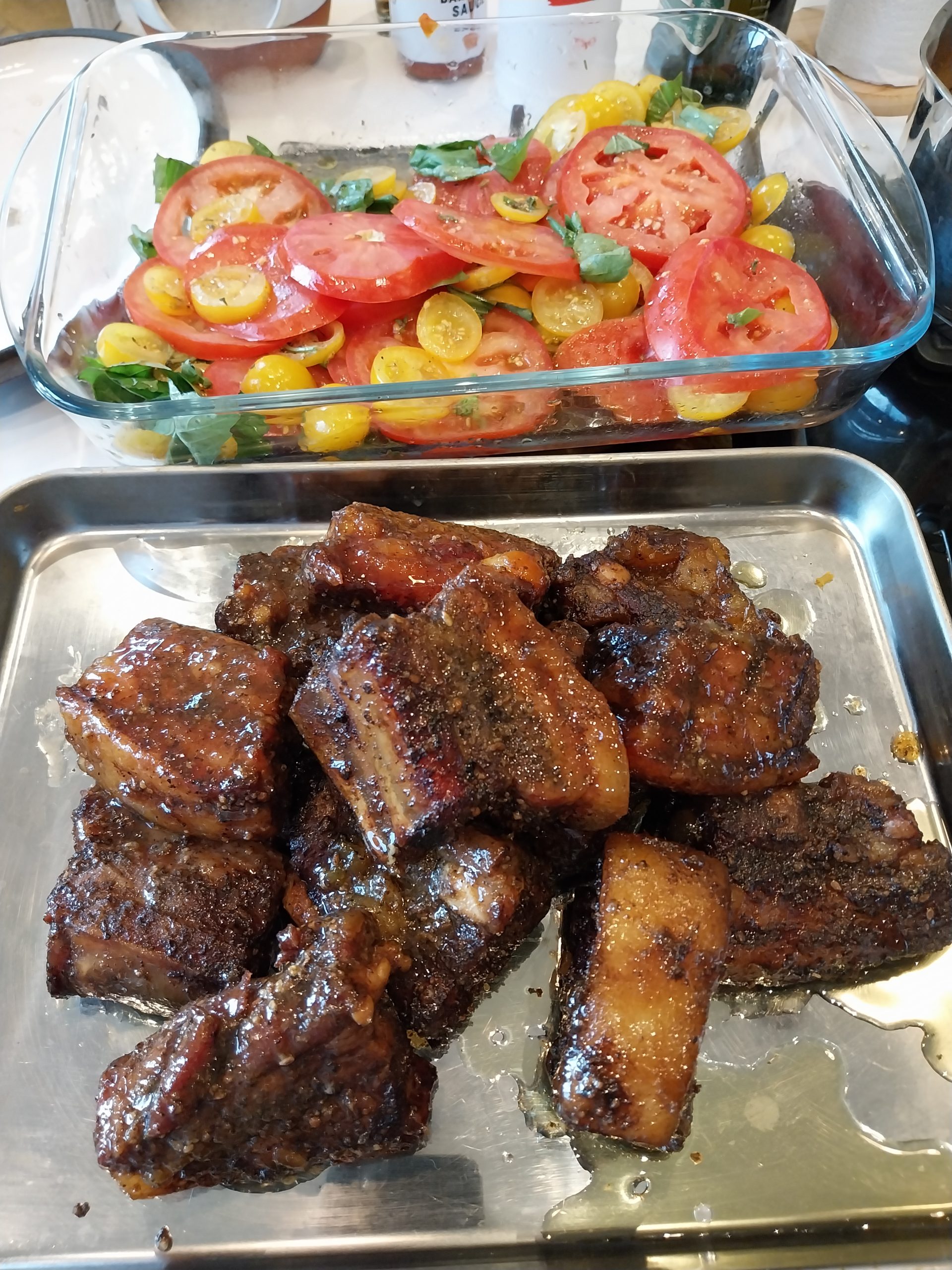
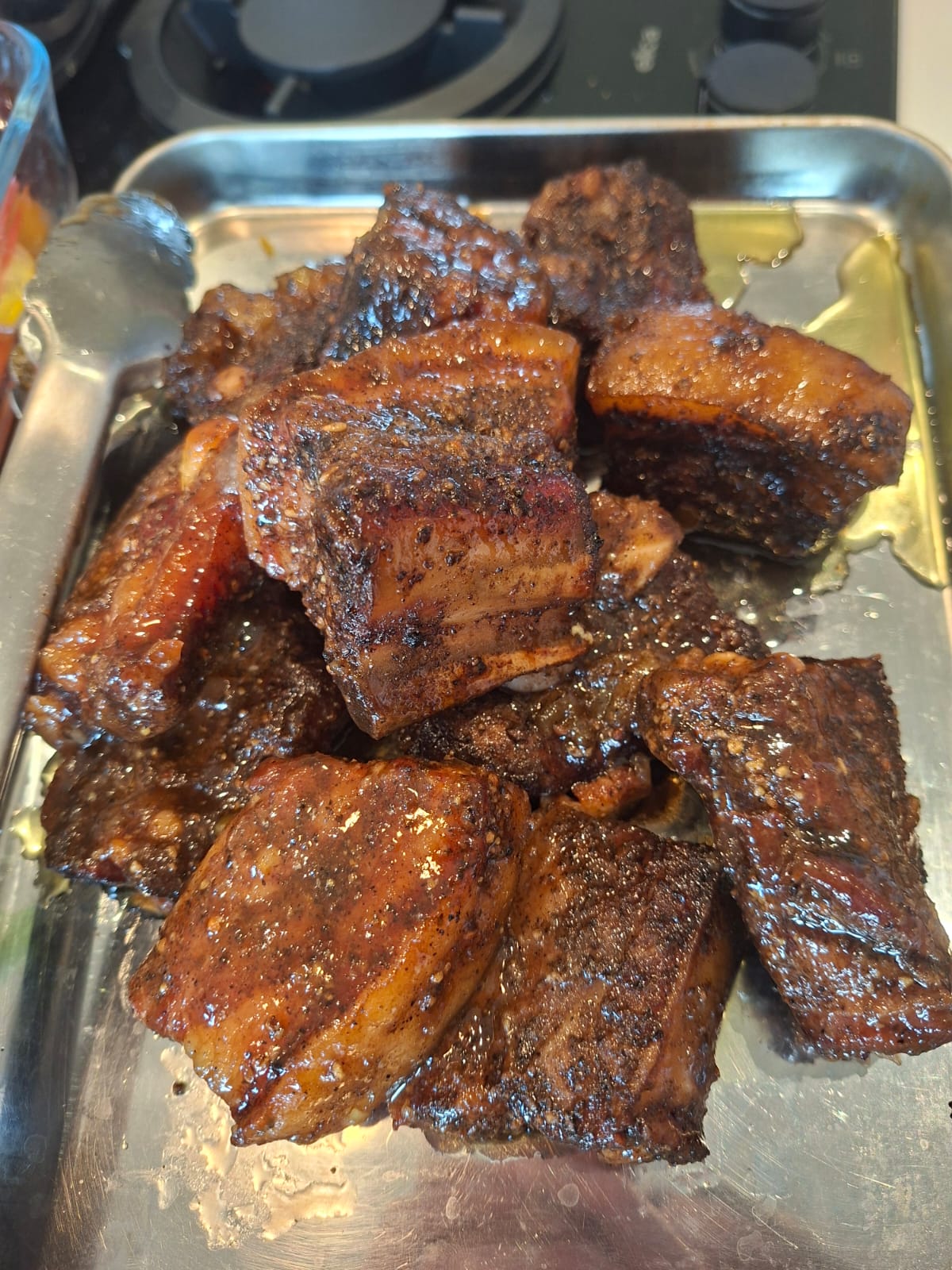
Pork belly burnt ends with mango chutney glaze — inspired by Easy E’s London

Published 23 July 2026 · Last updated 23 July 2026 · Tested by Ben Austen · Affiliate disclosure
These pork belly burnt ends started early. Two kilos of pork belly from Leopold’s Butchers near Wimbledon, skin off and cubed at the counter — twenty seconds of butcher work saves a fiddly prep at home. Onto the BGE Large at 110°C dome indirect, over Fuel Express Restaurant Grade lump. Ran hands-off until midday, when I lifted the cubes into a cast-iron pan with the chutney glaze and put them back on the kamado. Out for a couple of hours in the afternoon, back for the final reduce, then hot-hold on the kamado while I got the kids fed and the sides going. Adults sat down to eat at eight that evening. Eleven hours between cubes-on and plate.
Two spice layers, one warm-spice family running through both. The rub — my standing pepper-forward SPG plus a generous spoon of Ras el Hanout with cumin, coriander, cinnamon and warm paprika — mixed straight through. The glaze — a jar of Sharwood’s mango chutney with butter and a splash of cider vinegar. Cumin, coriander and cinnamon turn up in the Ras el Hanout AND in the chutney, so the meat and the sauce come out of the cook talking to each other. Burnt ends, but UK ones.
The chutney glaze idea isn’t mine — I nicked it from Easy E, a working London pitmaster I met at a Surrey BBQ event a couple of weeks earlier. He runs Easy E’s BBQ London and made the case for mango chutney as the obvious UK glaze move on burnt ends — rather than the honey-plus-BBQ-sauce default that gets you an American burnt end on a British Sunday. The skin came off at Leopold’s; I took it home and turned it into the bar-snack crackling I always make two hours into this cook on the same fire. One belly, two outputs, rendered fat for next week’s potatoes.
Key takeaways
- Eleven hours, mostly hands-off. Cubes on the grate at 110°C dome indirect for ~3.5 hours, then into a cast-iron pan with the glaze, lid on, back on the kamado. I went out for ~3 hours, came back, took the lid off for the last 20 minutes to thicken the glaze — done by four o’clock. Sat the cubes on the kamado at hot-hold until adults ate at eight.
- Skin off at Leopold’s, crackling on the side, no waste. The butcher set the skin aside; I took it home and got it on the kamado as bar-snack crackling two hours into the cook. One belly, two outputs, plus rendered fat for next week’s potatoes.
- The kamado is the hot-hold. Adults sat down 3.5 hours after the glaze finished. The kamado held the cubes above 60°C the whole time with the lid down and the vents nearly closed. No oven, no foil, no faff.
- The sides aren’t optional. The dish is rich enough that it needs heritage tomato salad, quick-pickled red onions, and fragrant Middle Eastern rice with turmeric and peppers — acid + fragrant carb against the sweet sticky glaze. Skip them and the dish reads heavy.
- Honest correction: less butter next time. I used about 150 g of butter in the glaze alongside a 340 g jar of chutney. The chutney already carries enough fat and sweetness — the butter made the finished dish heavier than it needed to be. Next time I’ll drop to about 50 g, just enough to bind. The glaze still hits sticky without the surplus.
At a glance
| Spec | Detail |
|---|---|
| Joint | 2 kg pork belly, skin off, cubed 3–4 cm |
| Prep time | ~10 min (rub the cubes — the butcher does the cutting if you ask) |
| Cook time | ~7.5 hours (cubes on to phase 2 complete) |
| Total time | ~11 hours (cubes on to served, including 3.5 h hot-hold) |
| Servings | ~10 portions (the dish is rich enough that portions run small) |
| Cooking method | Indirect on a kamado, then lidded pan on the same kamado, then hot-hold |
| Pit temperature | 110–115°C dome indirect for phase 1; same temp under the lidded pan for phase 2 |
| Pull temperature | ~96°C internal after the glaze reduce |
| Difficulty | Medium — long span, but ~45 min of active attention split across the day |
| Equipment | Kamado capable of 110°C indirect + a cast-iron pan with lid + hand-probe thermometer |
| Cuisine | British BBQ with a British-Indian crossover lean |
How do you cook pork belly burnt ends on a kamado?
Three phases on one fire. Phase 1: rubbed cubes on the kamado at 110°C dome indirect, ConvEGGtor in, no leave-in probe, around 3.5 hours until each cube reads ~80–85°C internal and feels yielding to a hand-probe. Phase 2: cubes into a cast-iron pan with mango chutney, butter and a splash of cider vinegar, lid on, back on the kamado for ~3 hours lid-on, then ~20 minutes lid-off to reduce and stick. Pull around 96°C internal. Hot-hold: lid back on, vents nearly closed, hold on the kamado until you’re ready to plate.
What you’ll need
Equipment
The cook works on any barbecue capable of running 110–115°C indirect with the lid closed for ~4 hours, then holding the same temperature with a lidded cast-iron pan on top of the grate. I cooked this on my Big Green Egg Large. Any kamado, charcoal kettle with a deflector and well-managed fire, or pellet smoker that holds 110°C dome will work the same way. The kamado has the advantage on the hot-hold — its ceramic dome holds heat with the vents nearly closed for hours without burning through fuel — but the cook itself isn’t kamado-locked.
- Kamado / smoker capable of stable 110°C indirect for 4 hours. I used the BGE Large.
- Ceramic deflector for the indirect setup. The BGE’s ConvEGGtor sat in for phase 1.
- Cast-iron pan with a lid big enough to hold 2 kg of cubed belly in a single layer. I used a Le Creuset cast-iron casserole.
- Hand-probe instant-read thermometer. I didn’t run a leave-in probe on this cook — hand-probed at phase endpoints.
- Lump charcoal that holds long-and-low. I used Fuel Express Restaurant Grade — what I’m currently working through. Any restaurant-grade lump that holds 110°C cleanly will work; see the charcoal Buying Guide for the alternatives.
- A sharp knife — for cubing the belly and removing the skin if your butcher hasn’t done it for you.
Ingredients
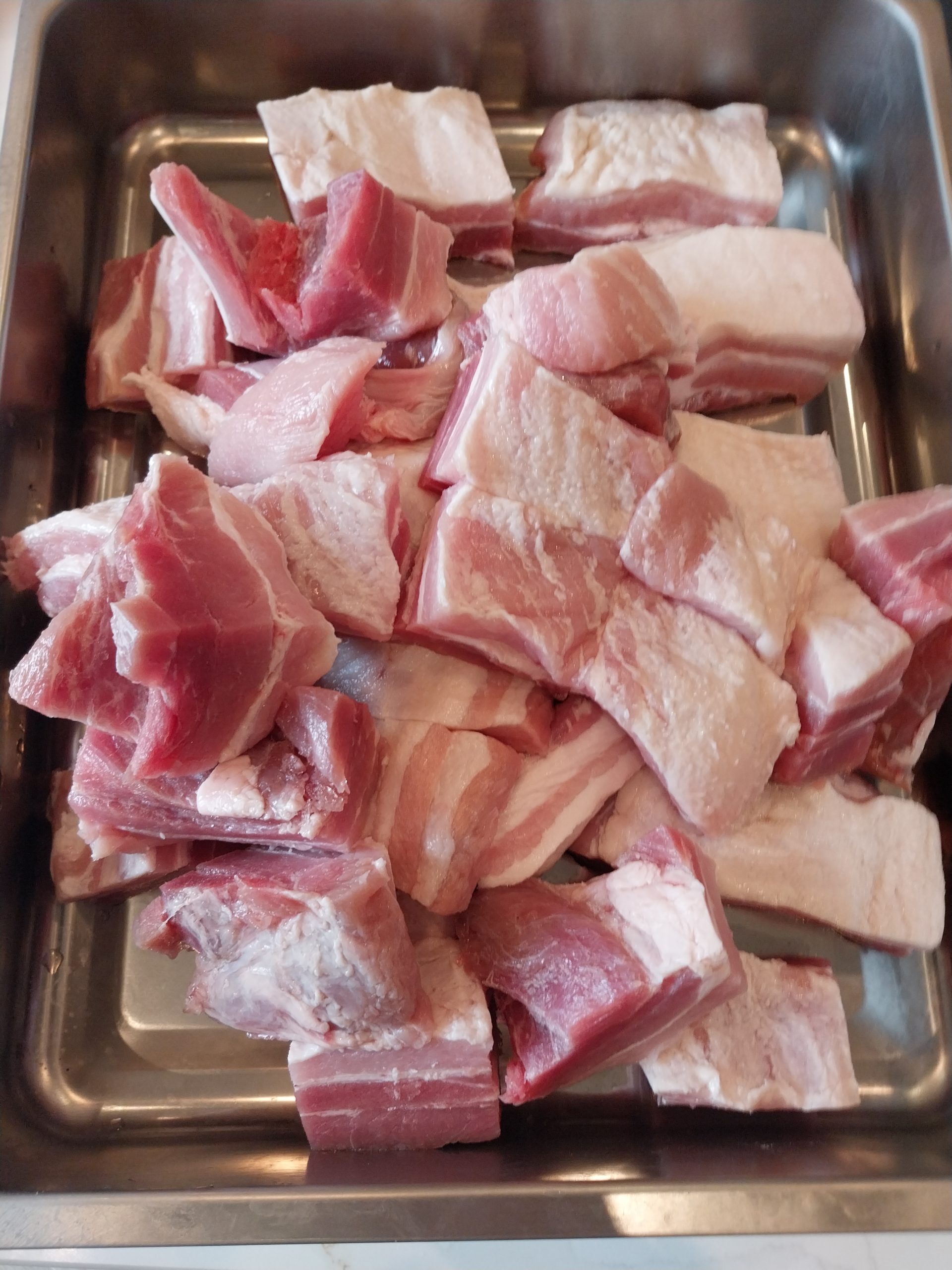
- 2 kg pork belly, skin off, cubed to 3–4 cm. Mine came from Leopold’s Butchers near Wimbledon — they cubed it for me at the counter and set the skin aside for the bar-snack crackling.
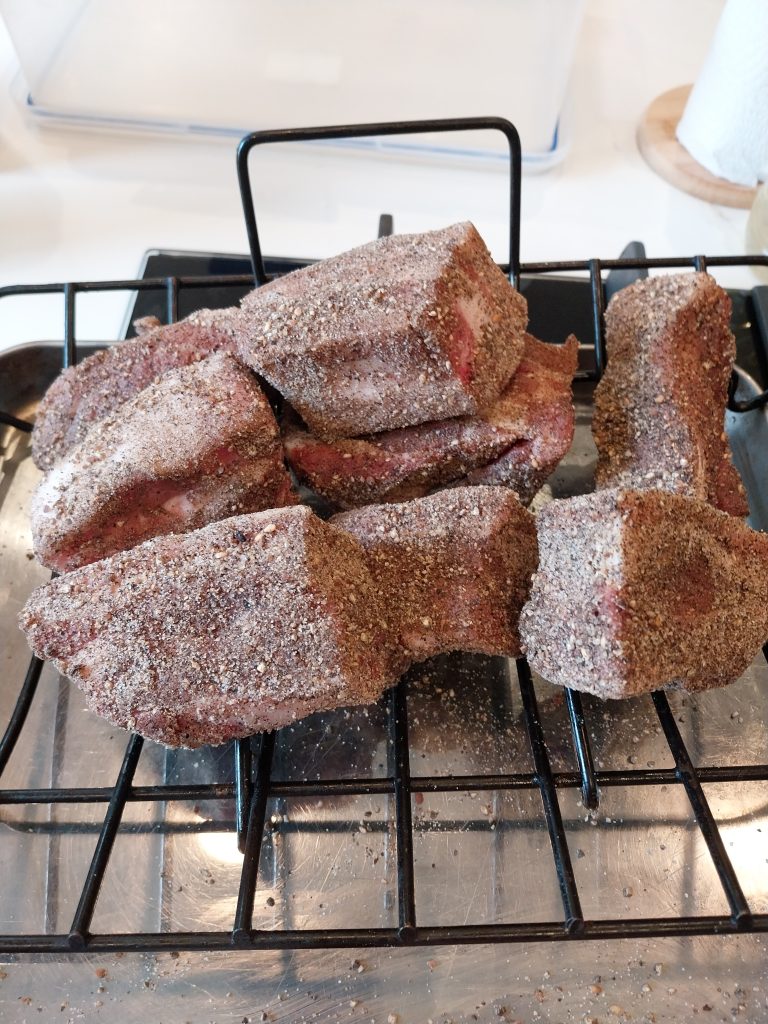
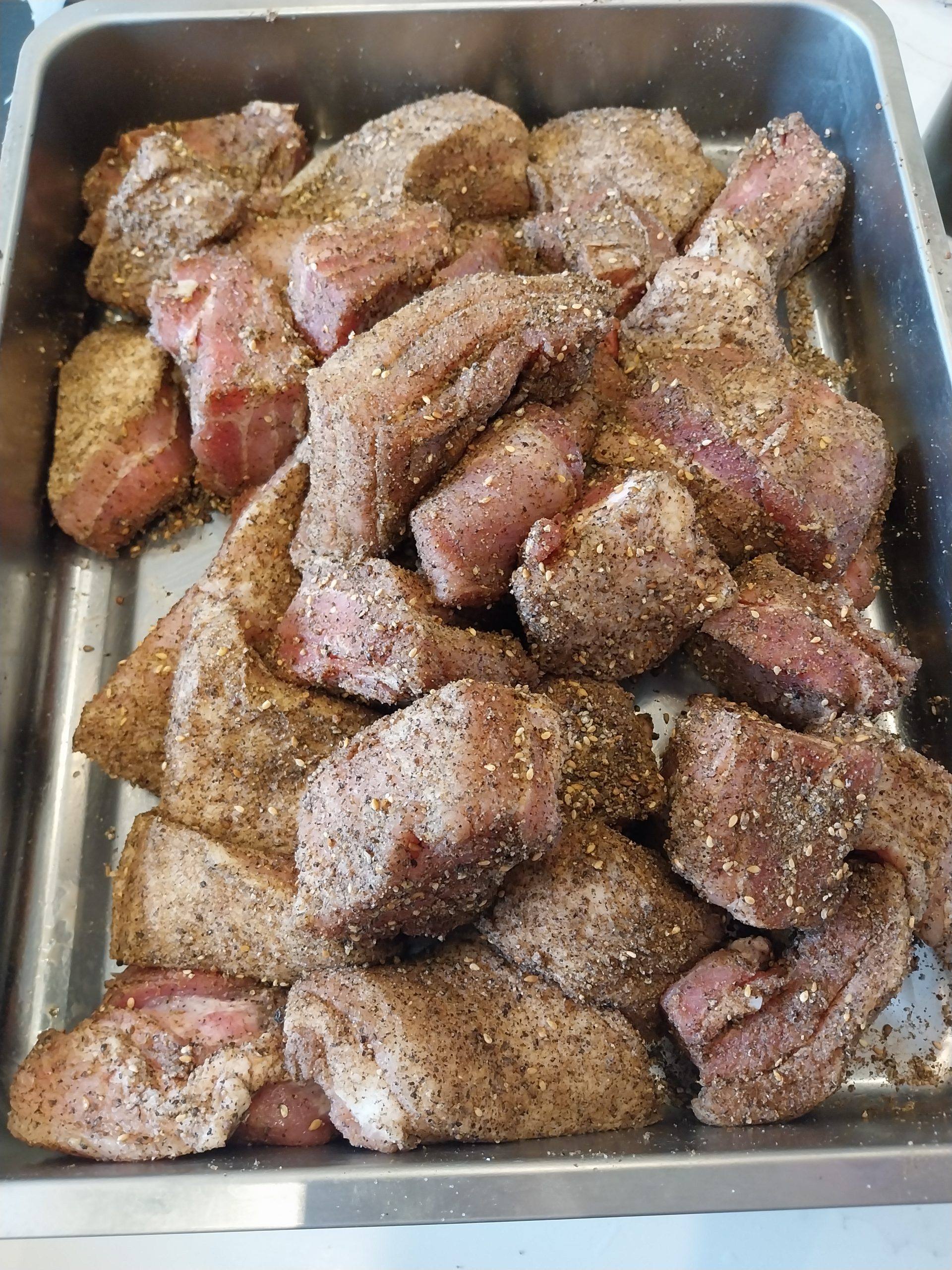
- My standing pepper-forward SPG rub — 2 parts coarse black pepper, 1 part Maldon flaky salt, 0.5 parts garlic granules, by volume. Mixed.
- Ras el Hanout — roughly a tablespoon, eyeballed and mixed through the SPG bowl before rubbing. I kept it restrained because kids were eating too — you can push it harder if it’s an adults-only cook. Any decent Ras el Hanout works; mine was a generic supermarket one.
- 1 × 340 g jar Sharwood’s mango chutney. Major-brand UK supermarket chutney. Patak’s Major Grey would substitute cleanly. A hotter chutney (Mr Naga, Geeta’s Lime & Chilli) would push the heat without losing the sweetness.
- 150 g salted butter — what I used on this cook. I’d drop to 50 g next time (see What I learned).
- A splash of cider vinegar — about a tablespoon. Added at the start of phase 2, into the pan with the chutney + butter + cubes.
The cook
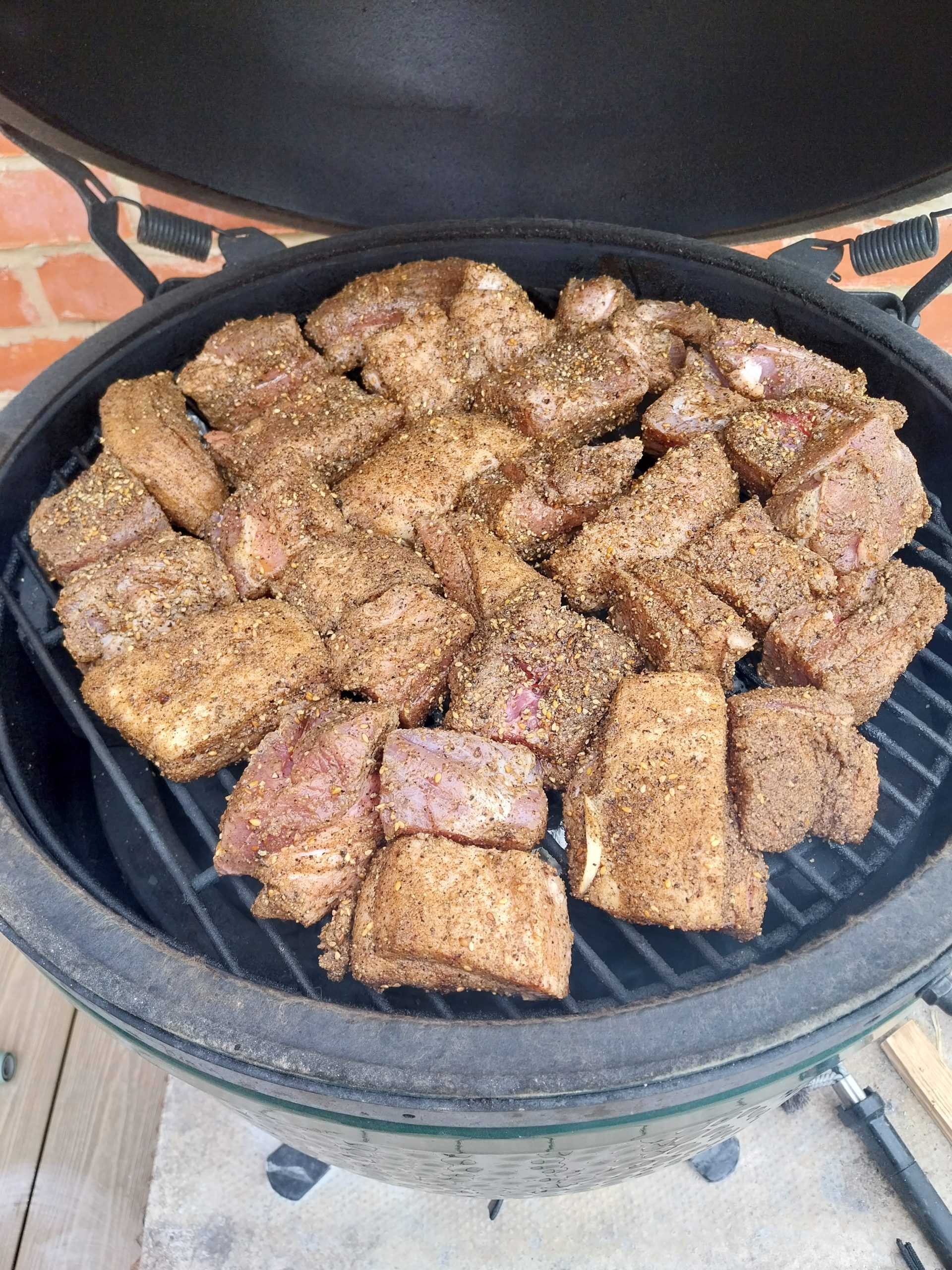
Leopold’s cubed the belly to 3–4 cm for me and set the skin aside in a separate bag for the bar-snack crackling I always make off the back of a belly cook. I picked it all up the day before and left the cubes bare in the fridge to dry off. The SPG-plus-Ras-el-Hanout rub went on the next morning, half an hour or so before the cubes did.

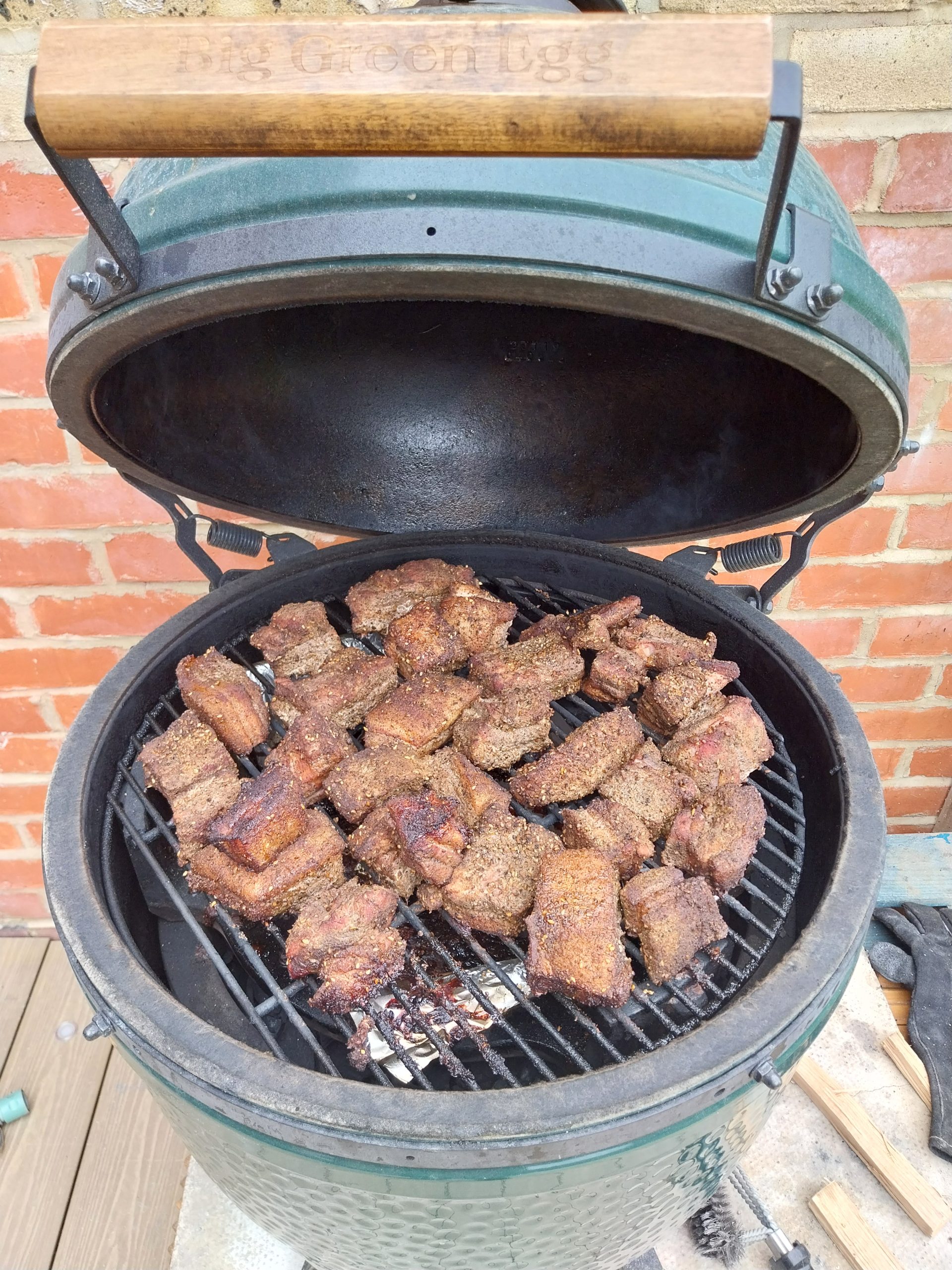
At half-eight the next morning the kamado was up to 110°C dome with the ConvEGGtor in for indirect, vents set to hold steady. Cubes onto the grate, lid down, and that was it for phase 1. No leave-in probe — I trust the kamado to hold the temperature, and a long cook at 110°C doesn’t need the alarm. I got the crackling skin onto the kamado around half-ten and pulled it crisp at midday, alongside checking the cubes for the phase-1 endpoint.


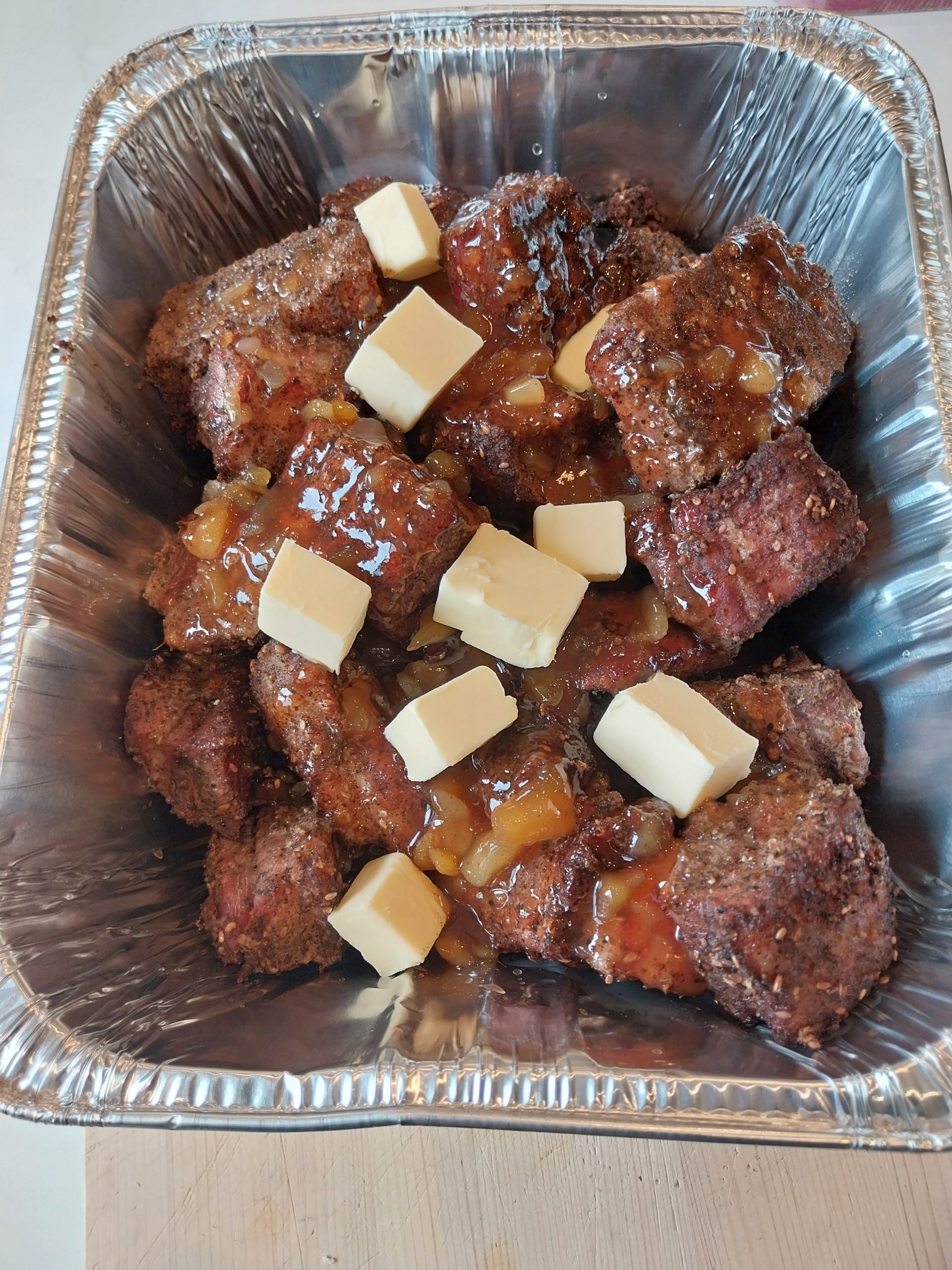
At twelve o’clock the cubes were reading ~80–85°C internal on a hand-probe and felt right — yielding under the prongs, not yet probe-tender, that intermediate stage where a long braise will finish the job. I lifted them into the cast-iron pan, drained the rendered pork fat that had pooled under the grate (set aside for next week’s potatoes — don’t bin it), tipped the jar of Sharwood’s mango chutney over the cubes, added 150 g of butter cut into rough chunks, splashed a tablespoon of cider vinegar in for acid balance, lid on, and back on the kamado at the same 110°C dome temperature.

I had a 2–3 hour window out of the house. The lid-on pan held the moisture, the kamado held the temperature, and the cubes sat there confiting in chutney-butter-rendered-fat while I was gone.
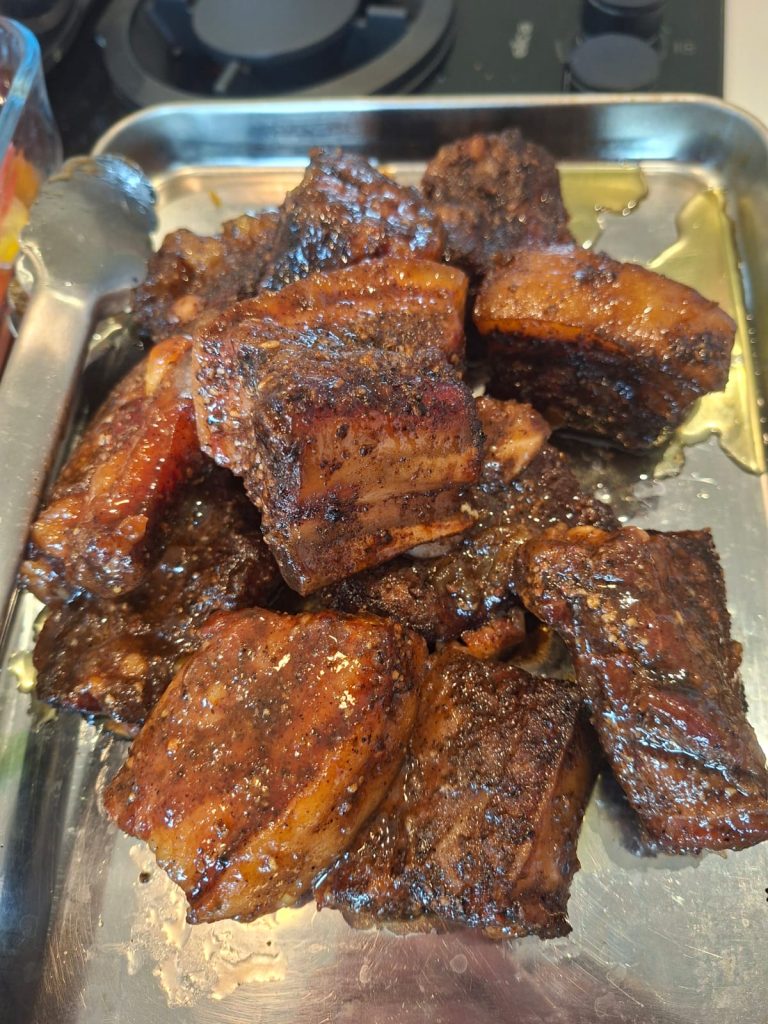
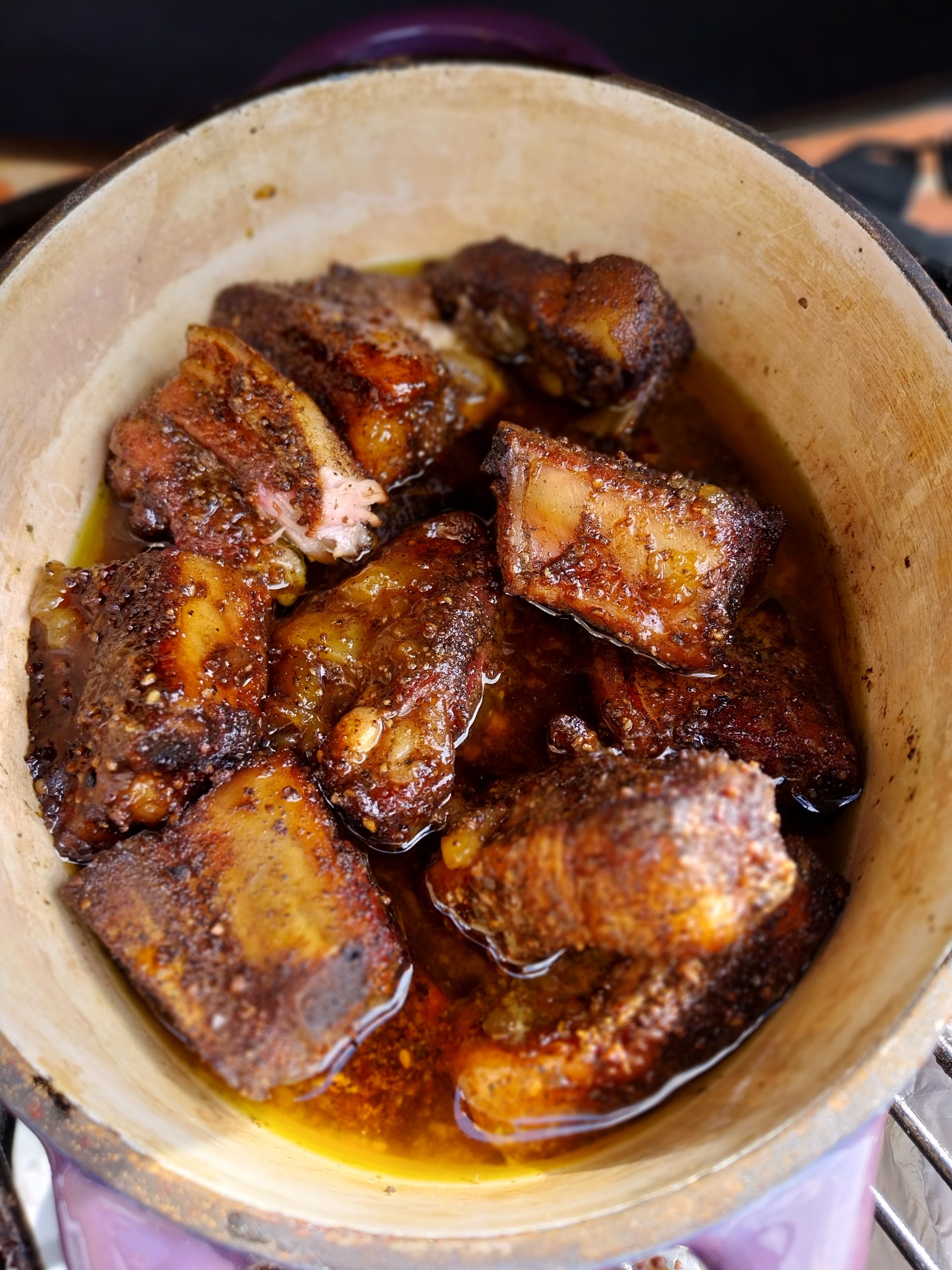
Back home around quarter past three — lid off the pan, and from here it’s about reducing the glaze until it sticks rather than runs. The kamado was still at 110°C with the lid on; with the pan’s lid off, the cubes were exposed to the dome heat. About twenty minutes of that and the glaze had thickened to the dark sticky coating that defines burnt ends — the cubes glossed, the pan sauce viscous, the smell unmistakable. Hand-probed the cubes one last time — around 96°C internal, well into the rendered-collagen zone that’s the burnt-ends-done range.

Lid back on the pan, vents on the kamado nearly closed, kamado at its hot-hold setting, and that’s where the cubes sat for the next three and a half hours while I dealt with kids’ tea at five and got the sides going. Adults sat down to eat at eight. The cubes were as hot off the kamado as they’d been at four — the ceramic dome holds heat with the vents shut down for far longer than any oven sensibly would.
What worked and why
The rendered-fat drain before the glaze. Pork belly throws off a lot of fat over a 3-hour phase-1 cook. If you tip the chutney straight into the rendered-fat pool, you get an oily slick instead of a sticky glaze — the sugar in the chutney can’t bind a sauce that’s swimming in pork fat. Drain the fat off first, then add the chutney. Side benefit: the rendered fat is roast-potato-grade stuff. Decant it into a jar; refrigerate; use it the next time you do roasties.
Lid on for the long braise, lid off for the last twenty minutes. Lid-on for ~3 hours holds moisture and stops the glaze reducing too fast — useful when you’re not there to watch it. Lid-off at the end gets the stickiness back. Lid-off the whole time would burn the chutney; lid-on the whole time would never get the stickiness. The two-step gets you both, and the lid-on phase is what lets you leave the cook for two or three hours.
A tablespoon of cider vinegar in the glaze. The dish is rich and the chutney is sweet — without acid the glaze coats but doesn’t lift, and by the third cube you’ve had enough. A tablespoon of cider vinegar tightens the sweetness and gives the palate somewhere to recover. Even with the vinegar in there the dish reads rich on its own; the sides (below) do the rest of the lifting. Without the vinegar it would be unfinishable.
The kamado as the hot-hold. After phase 2 finished at four, I needed to hold the cubes for nearly four hours while kids’ tea happened and the sides came together. The kamado, with the lid down and the vents nearly closed, will sit at 60–70°C for hours on a single fuel load. No transfer to oven. No foil tent. No food-safe rewarm later. The cubes stayed at serving temperature the whole way through, and the glaze got slightly tackier as the dome heat kept working it.

What to serve it with
The dish is rich enough that the right plate shape isn’t optional. Three things I served:
Heritage tomato salad. Cherry-tomato or full-size heritage tomatoes (or whatever’s good at the supermarket that week), halved or quartered, flaky salt, basil leaves, decent olive oil. Cold, raw, table-ready. The job here is acid + cold against hot + sticky. Tomatoes will do more lifting for this plate than any cooked side would.
Quick-pickled red onions or red cabbage. One red onion sliced thin, into a bowl with a splash of cider vinegar, a teaspoon of sugar, a pinch of salt. Toss. Sit for 20–30 minutes while you finish the cook. The pickle hits in a different register from the tomatoes — sharper, brighter — and adds visual contrast on the plate. Pickled red cabbage works similarly if you’ve got it instead.
Improvised Middle Eastern rice with turmeric, peppers, and onions. Long-grain or basmati rice cooked with a tablespoon of turmeric, sliced peppers (red or yellow), one onion, three or four garlic cloves, and chicken or vegetable stock. Cooked down until the rice is fluffy and the peppers have softened into the grain. The job is to be the fragrant carb base that picks up the chutney’s sweetness without competing with it. It’s the UK home-cook answer to cornbread or mac and cheese — same role on the plate, different flavour. The Ras el Hanout in the rub, the chutney spice in the glaze, and the turmeric in the rice all sit in the same warm-spice family.
These three sides are why this isn’t a US-tradition burnt ends cook. They’re what makes it read as a proper UK Sunday-dinner plate.

What I learned and what I’d do differently
Drop the butter to 50 g next time. I used 150 g, which is roughly two-thirds of a stick. Alongside a 340 g jar of mango chutney and the rendered-out fat from the belly itself, that’s a lot of fat in the glaze. The finished dish was good — knockout, in fact, my family said so — but the glaze coated the mouth more than it needed to. Less butter, glaze still binds, dish reads cleaner. The chutney carries the flavour and the sweetness; butter is the binder, not the flavour driver, and a smaller amount does the binding job perfectly well. That’s the biggest change I’d make on a second cook.
Cube size is a judgement call. I cubed to 3–4 cm — meaty-bite size, closer to a proper burnt-end mouthful than a glaze-coated nibble. A smaller 2–3 cm cube would give you more glaze-to-meat surface and shorter cook times. Both are defensible. The 3–4 cm cube favours the meat; the 2–3 cm cube favours the glaze. I’d cube 3–4 cm again for the same dish; I’d cube 2–3 cm if I were going to serve these as canapés rather than as a main.
No leave-in probe worked fine. I hand-probed at the phase-1 endpoint (~80–85°C internal) and at the phase-2 endpoint (~96°C internal). Both phases have plenty of margin — they’re not the kind of temperature gates that miss in five minutes. A wireless probe would have given me peace of mind during the 2–3 hour out-window but didn’t change the cook. The kamado-and-cast-iron setup does the work while you’re out.
Variations
- Smaller cubes for canapé service — drop to 2–3 cm cubes and pull the cook ~30 minutes earlier on phase 1. The shorter phase 1 keeps the cubes from going soft-and-falling-apart at the canapé size.
- Less butter, more chutney — the 50 g butter / 340 g chutney ratio is what I’d run next time. If you want to lean further into chutney, a second smaller jar (160–200 g of a different brand, Patak’s Major Grey for the sweet end, Mr Naga for the heat end) would give the glaze more dimension.
- Honey + BBQ sauce instead of chutney. The US-tradition route. Honey, a UK-supermarket smoky BBQ sauce, a splash of bourbon. Drop the Ras el Hanout from the rub for this version — keep it SPG only — because Ras el Hanout doesn’t sit alongside honey-BBQ the way it sits alongside mango chutney.
- Apple butter or fig jam. Two other chutney-adjacent glazes that work. Apple butter goes long on autumn; fig jam goes long on sweet-and-jammy. Adjust the cider vinegar splash up slightly to compensate for the lower spice content.
- On a kettle instead of a kamado. Possible. Run a Snake Method or basket setup at 110°C; expect to refuel during phase 1. The hot-hold won’t last 3+ hours on a kettle the way it does on a kamado — eat sooner or transfer to a low oven (60°C) for the hold.
- On a pellet smoker — straightforward. 110°C set point, indirect by default, phase 2 cast-iron pan on the grate works the same way. The hot-hold is closer to a kettle than a kamado in terms of sustainable duration without burning through pellets.
Related
- Big Green Egg Large — my honest review after 200+ cooks — the kit anchor.
- The best UK BBQ charcoal in 2026 — six picks from £18 to £45 — Fuel Express Restaurant Grade is slot 5 (Best Value Workhorse), Big K El Cubano is the upgrade pick.
- Pork crackling on the kamado — bar snack — what to do with the skin you took off the belly.
- Smoked sausages on the kamado — adjacent recipe; the smoke-and-hold pattern overlaps.
- Smoky-mayo potato salad on the kamado — would work as a side alongside this in a multi-protein Sunday spread.
- Apple crumble on the kamado — the dessert that runs on the same kamado after the meat comes off.
- Pulled pork on the kamado — what two cooks taught me — adjacent low-and-slow on the BGE.
Frequently asked questions
What’s the right pit temperature for pork belly burnt ends on a kamado?
110–115°C dome indirect for the full cook. Same temperature for phase 1 (cubes on the grate, ~3.5 hours) and phase 2 (cubes in the lidded cast-iron pan with the chutney glaze, ~3 hours lid-on plus ~20 minutes lid-off). The lower-and-slower end of the kamado range — hot enough to render fat and break down collagen, gentle enough that the glaze doesn’t burn during the long lidded phase.
Do I need to brine the pork belly first?
No. I didn’t brine on this cook — straight from the butcher, the cubes bare in the fridge overnight to dry the surface, rubbed on the morning, on the grate half an hour later. That dry-out is a dry brine without the salt, so if you do want to tighten the texture, salting the cubes for that overnight rest is the change to make. It isn’t necessary for the dish to work: the mango chutney glaze carries enough sugar and acid that the cubes pick up flavour from the outside in.
Why mango chutney instead of honey and BBQ sauce?
Two reasons. First, a working London pitmaster I met at a Surrey BBQ event in June 2026 — who runs Easy E’s BBQ London — framed mango chutney as the obvious UK glaze move on burnt ends. Second, the spice palette in British mango chutney (cumin, coriander, cinnamon, ginger) lines up with the Ras el Hanout in the rub. The dish reads as one coherent spice profile — not as a meat-side and a sauce-side that don’t talk to each other.
How long can the cubes hold in the kamado after the glaze finishes?
I held mine 3.5 hours, lid down, vents nearly closed, kamado at around 60–70°C inside the dome. The cubes stayed at proper serving temperature the whole way through — checked with a hand-probe a couple of times. Pork is safe above 60°C indefinitely from a food-safety angle; the limit is texture rather than safety. Past about 4 hours of hot-hold the cubes start to dry slightly on the outside. Up to 4 hours, no compromise.
Can I make this on a kettle or a pellet smoker?
Yes to both. The cook is “any kit that holds 110°C indirect for 4 hours” — kamado, kettle with a deflector, or pellet smoker all qualify. The kettle will need refuelling once during phase 1; the pellet smoker hits the temperature with no fuss but won’t hot-hold past about an hour without burning through pellets. The kamado’s hot-hold is its real advantage on this cook — if you’re not running a kamado, plan to eat sooner or transfer the cubes to a low oven (60°C) for the hold.
What if I don’t have Ras el Hanout?
The rub will work without it. SPG alone (pepper, salt, garlic granules) is the foundation; the Ras el Hanout adds warmth that ties to the chutney. Closest single-jar substitutes are garam masala (drop the savoury notes slightly, lean Indian) or baharat (more Middle Eastern, similar warmth). Worst case, just SPG — the mango chutney glaze still carries the dish; you lose the spice doubling but not the cook.
Can I scale this up to feed more people?
Yes — pork belly burnt ends scale linearly. 4 kg of belly cubed in two cast-iron pans, same temperatures, same timings. The bottleneck is pan capacity in phase 2, not the kamado’s heat. If you’re cooking for a crowd, run two pans alongside each other on the BGE Large or split across a kamado and a kettle. The hot-hold won’t work as well across two pans — the kamado holds one pan beautifully and two pans adequately.
Disclosure provenance
Tested by Ben Austen on the BGE Large at home in London on 21 June 2026. Ben paid the standard retail price for the 2 kg pork belly at Leopold’s Butchers near Wimbledon — a butcher just outside Wimbledon village, slightly cheaper than the Wimbledon Village butchers, that Ben has used before and recommends as a customer. Leopold’s is a customer-recommendation reference, not a commercial relationship: Ben paid the standard per-kg rate and has no other connection with the butcher. The Ras el Hanout, Sharwood’s mango chutney, and butter were all from regular UK supermarket stock at full retail price. The cook was on Fuel Express Restaurant Grade lump charcoal — the value-workhorse pick at slot 5 in the charcoal Buying Guide, which I’m currently working through and which carries a “no commission earned yet” affiliate disclosure on the Buying Guide itself. The “inspired by Easy E’s London” framing is editorial — the working pitmaster behind Easy E’s BBQ London named mango chutney as his glaze of choice at a Surrey BBQ event in June 2026. No commercial relationship with Easy E’s — they’re named as the spark for the dish, nothing more.
Final verdict
A knockout dish that survives a real Sunday — eleven hours of cook, three hours unattended in the middle, kids fed at five, adults plated at eight. Pork belly burnt ends with a Ras el Hanout rub and mango chutney glaze isn’t an American import — it’s a British-Indian crossover with the spice palette running through both layers. The kamado does the heavy lifting on the hot-hold; the cast-iron pan and the lid-on-then-off two-step does the glaze; the sides are what carries the plate. Cook it again? Yes, the next time I have a quiet Sunday and a 2 kg belly to play with. Cook it the same way next time? Almost — same rub, same chutney, same kamado plan, but 50 g of butter not 150 g. The dish doesn’t need the surplus.

Sourced from the 21 June 2026 cook log — 2 kg pork belly from Leopold’s Butchers near Wimbledon, skin off and cubed at the counter by the butcher, on the BGE Large at 110°C dome indirect for ~3.5 hours, into a cast-iron pan with Sharwood’s mango chutney + ~150 g butter + cider vinegar for ~3 hours lid-on then ~20 min lid-off at the same kamado temperature, hot-hold on the kamado for ~3.5 hours, adults served at ~20:00 BST.