ThermoPro TP20 review
Published 13 August 2026 · Last updated 4 October 2026 · By Ben Austen · Affiliate disclosure
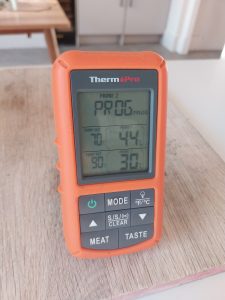
ThermoPro TP20
I bought the ThermoPro TP20 in June for £38.24, and a £14.99 instant-read from the same brand, because I wanted to keep an eye on a long pulled pork through the stall. Since then I’ve used it on somewhere between ten and fifteen cooks: a thirteen-hour pulled pork, a tomahawk, an Iberico pork chop, a chicken with four duck legs, and a lot of pork loin. I’d buy both again tomorrow.
The short version
The TP20 is a wired, dual-probe, wireless-receiver thermometer that costs about forty pounds and does the job a hundred-and-ninety-pound probe does. It got me through a thirteen-hour pulled pork without lifting the lid once, and it has told me the truth every time I’ve cross-checked it by hand. Verdict: 8/10.
Two things stop it being a nine. On a long cook you have to get the wires out of a ceramic kamado somehow, and every way has a cost. You can just close the lid on the lead, but it rubs on the gasket, and that might cause problems in the long run. I’ve had none so far. Out through the ash vent, the probes have to come back past a full ash bucket at the end of the night. Out through the top vent, the lead isn’t long enough to reach the ground, so I prop the transmitter up on a cool box. And two channels sounds like plenty until you’re cooking two things at once, at which point you’ve got nothing left to watch the fire with.
What I’d say to anyone hovering: buy it with the instant-read, not instead of one. Fifty-three quid for the pair, and they do different jobs.
Key takeaways
- The pair — TP20 plus the TP19HB instant-read — cost me £53.23 together, less than a single fashionable wireless probe. A serious cook needs both.
- Ignore the pork presets. The lowest one is 71°C, which is 8°C above the 63°C my own pork loin recipe pulls at, and 8°C above what the USDA itself has recommended since 2011.
- Two probes force a choice on every cook: the pit plus one piece of meat, or two pieces of meat and no eyes on the fire.
- It’s wired, so on a kamado you have to decide how the leads get out of the dome, and none of the ways is perfect.
- The receiver has worked anywhere in the house. The one thing that caught me out is that there’s nothing to tell you the batteries are low. The screen flickered and beeped, and I thought it had broken.
- Don’t bother if you’re cooking sausages. Do bother the moment you go low-and-slow.
The TP20 at a glance
| Probes | Two, wired, stainless with braided leads |
| Claimed range | 500ft / ~150m |
| What I paid | £38.24, Amazon, 8 June 2026 |
| Current price | £40.49 (4 Oct 2026); list price £44.99 |
| Bought with | ThermoPro TP19HB instant-read, £14.99 — £53.23 the pair |
| Verdict | 8/10 |
Who this is for, and who this isn’t
Buy this if you’re going low-and-slow. A hand probe tells you what the meat’s doing while you’re standing over it — the leave-in tells you from the kitchen, thirteen hours into a shoulder. A packer brisket, a pork shoulder, a belly, big beef ribs — those are expensive cuts, temperature is most of what you’ve got to go on, and I’d rather know exactly where they are than find out when I slice it.
Don’t bother if your barbecue is mostly sausages, burgers and chicken thighs on a Friday. Those cooks are short, forgiving, and you can hand-check them in five seconds with a cheap instant-read. Spending forty pounds to monitor a sausage is a waste of forty pounds.
What I’ve cooked on it
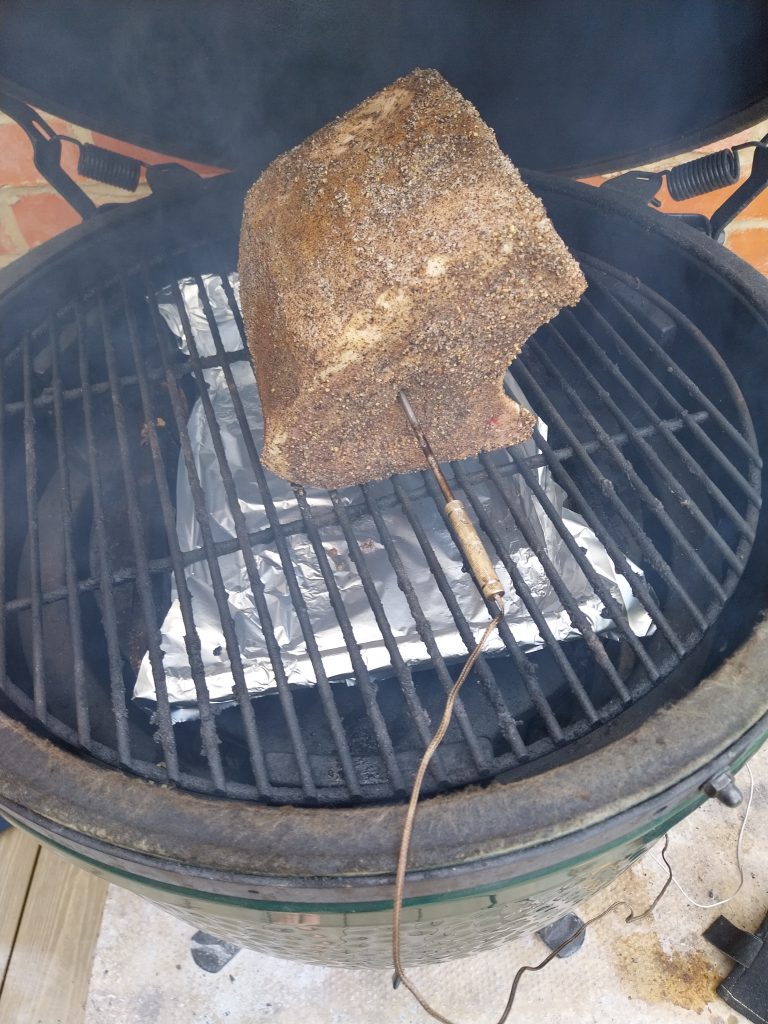
The TP20 arrived on 10 June, and four days later it went into a pulled pork that ran thirteen hours on the BGE Large. It’s still the longest cook I’ve done with it, and it was amazing to watch how long the stall went on. One probe in the shoulder, the other in the pit. That second channel is how I know the Egg sat at 115°C dome and the vents barely moved all day, rather than just believing it had. The shoulder came off at 93°C with the probe sliding in like warm butter, at ten o’clock at night, and I was glad not to have spent the evening lifting the lid to check.
Since then it’s mostly been pork loin — two cooks, both boneless, both at 140°C dome with a probe in the thickest part of the muscle waiting for 63°C. A loin has a narrow window between underdone and dry, so it’s the cut where two or three degrees of thermometer error costs you dinner. Both times I cross-checked with the instant-read at the pull, and both times the TP20 agreed with it.
Then a Sunday in August with a chicken on the vertical roaster, four duck legs sitting in a foil boat of hot oil underneath it, and baked potatoes round the edge of the grate. The chicken ran on a leave-in the whole way and came off at 72–73°C in the breast. The second probe started in a duck leg, gave me a reading I didn’t believe, and ended up in the biggest potato instead — which left nothing watching the pit on the one day the charcoal was the last of a bag and slow to come up.
The duck showed me something I hadn’t hit before. A probe in a small leg sitting in hot oil reads the oil, not the meat — mine alarmed at 90°C about fifteen minutes in, which is impossible for a duck leg on a cook that long. The tip had either gone through the muscle or was sitting in the fat around it. Next time I’ll seat the probe before the legs go into the boat, because you can’t do it blind through foil once the cook is running. The duck went to 94°C in the end and the potatoes to 96°C, both checked by hand.
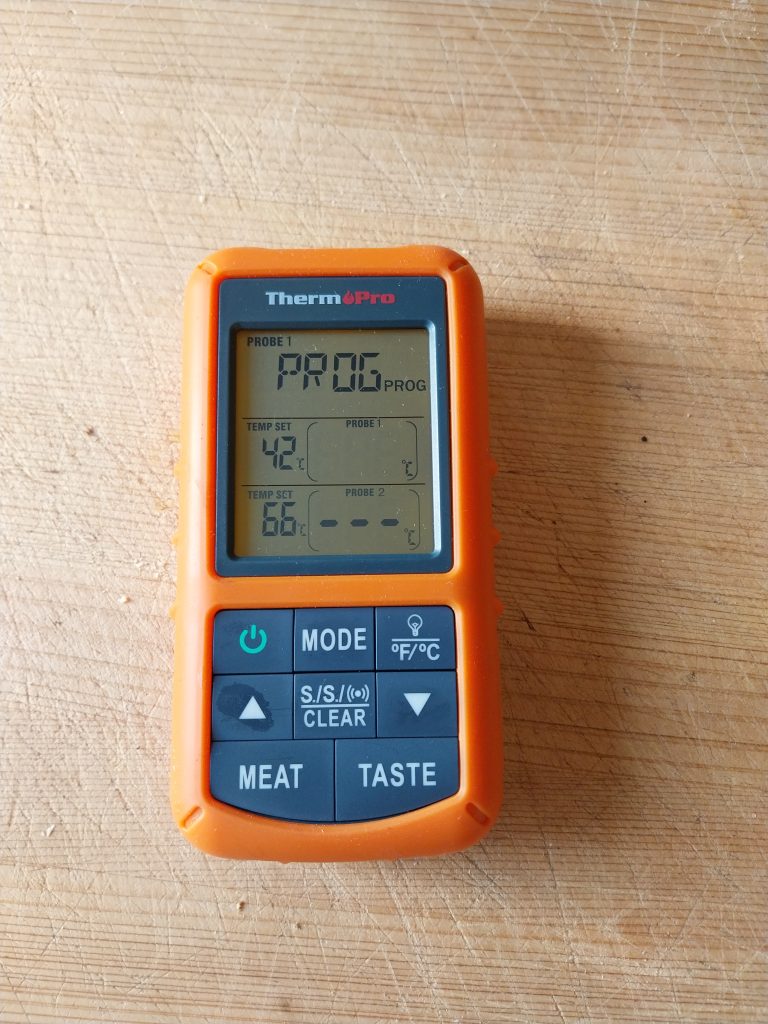
Since then it’s been on a tomahawk, where I used the custom program to set 42°C (108°F) so I’d know when the first stage of the reverse sear was done. I’ve also used it on an Iberico pork chop and on bone-in and boneless pork loins, along with a wide range of other cooks.
I left it off one cook on purpose. The pork belly burnt ends in June ran about eleven hours and I hand-probed at the end of each phase instead. A wireless probe would have given me peace of mind during the two or three hours the cubes were out of my sight, but it wouldn’t have changed the cook.
Pros and cons
What’s good
- Fifty-three pounds bought both the leave-in and the instant-read. A single fashionable wireless probe costs more than that on its own.
- It has agreed with the instant-read every time I’ve cross-checked at the pull.
- The receiver works anywhere in the house, which is the entire point of buying one.
- Two channels let me watch the pit and the meat at the same time on a single-protein cook, and the pit reading is how I know the fire is actually holding rather than assuming it is.
- Nothing has frayed or let water in since June.
What’s not
- Getting the probes back out of a ceramic kamado at the end of a thirteen-hour cook is a real faff if they’ve gone through the ash vent, because you’re fishing them out past a full ash bucket.
- Every way of getting the wires out has a downside. Over the gasket it rubs, through the ash vent it’s awkward to get back out, and through the top vent the lead is too short to reach the ground.
- There’s nothing to tell you the batteries are low. When mine ran down, the receiver’s screen flickered and beeped, and I thought it was broken.
- It feels cheap in the hand.
- Two channels runs out faster than you’d expect. Cook more than two things and something goes unwatched.
- You can’t seat a probe blind in a small cut once the cook is running.
- The pork presets sit eight degrees above what the USDA itself now recommends, so I don’t use them.
Setup and first impressions
Setting it up took no time and involved no decisions. The batteries were in the box as advertised, the receiver and transmitter found each other with no fiddling, and four days later it was running a thirteen-hour pulled pork. In the hand it feels cheap, but for thirty-eight pounds it’s a great buy, especially next to the other options. Nothing about the first cook surprised me, good or bad.
Accuracy, and how I’ve checked it
I’ve done the two checks you can do at home: both probes in a slurry of ice and water, and both probes in a pan at a rolling boil. They read true, and they still do. Do that on any thermometer before you trust it with expensive meat.
Past that, every cook has been a cross-check. The leave-in gets the meat to the pull and the instant-read confirms it before anything comes off the grid, and the two have never disagreed by enough to change what I did.
That matters most on the loin. Mine comes off at 63°C, and the gap between underdone and dry is narrow enough that a probe reading two or three degrees light would ruin it. Every loin I’ve cooked has landed where I expected, and the instant-read agreed at the pull.
The one time the TP20 gave me a number I didn’t believe, it wasn’t wrong. A probe in a duck leg sitting in hot oil alarmed at 90°C fifteen minutes into a cook that should have taken an hour. It was reading accurately — it just wasn’t reading the meat. That’s my mistake rather than the thermometer’s, but a leave-in will confidently report the temperature of whatever its tip is touching, and it won’t tell you when that isn’t the thing you meant to measure.
Getting the wires out of a kamado
The TP20 is wired, so on a ceramic kamado the leads have to get from the meat to the transmitter outside the dome. There are three ways to do it: close the lid on them over the felt gasket, run them up through the ash vent at the bottom, or bring them out of the vent on top of the lid.
On the pulled pork I used the ash vent, to keep the wires off the gasket. It worked, but at ten o’clock at night, thirteen hours in, the probes had to come back out through a vent with a full ash bucket in the way, and the plug end is plastic I don’t want to drag through ash.
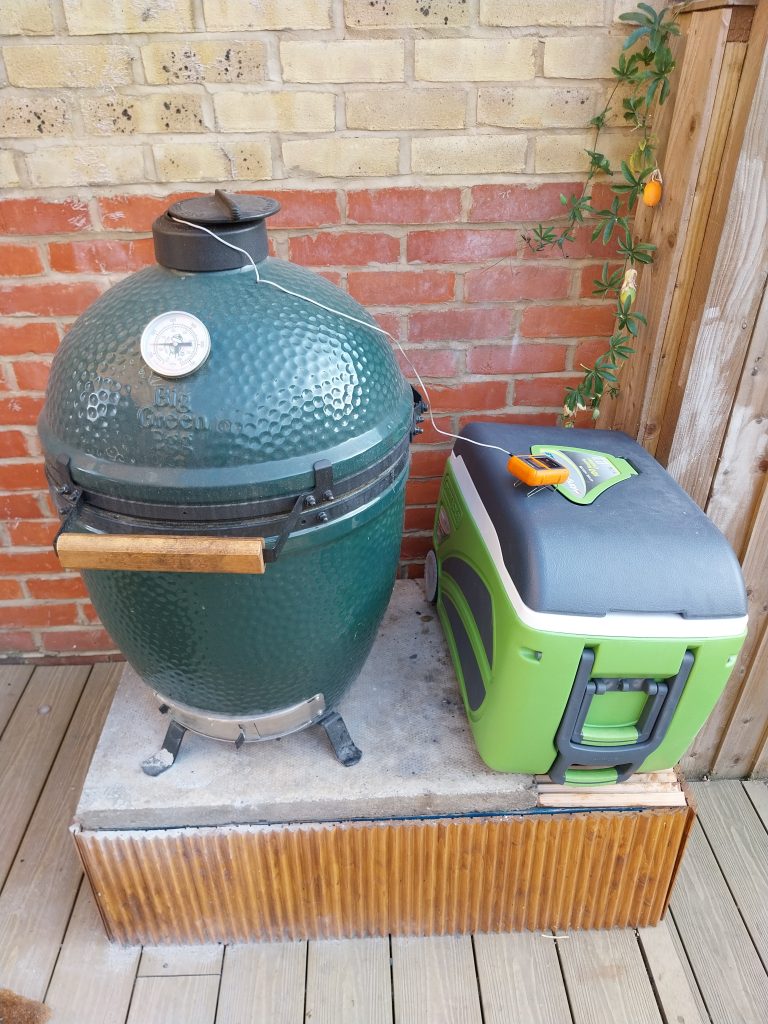
Since then I’ve tried the top vent. It keeps the leads off the gasket and they come out from above with nothing in the way, but the lead isn’t long enough to reach the ground, so I have to prop the transmitter up on a cool box next to the Egg.
The easiest way is just to close the lid on the leads. They rub on the gasket, and I’d assumed that would damage it over time. So far it hasn’t: there’s no wear I can see and no smoke leaking along the seal. I’m still not going to tell you it’s harmless, because it might cause problems in the long run.
The receiver has been faultless. I haven’t tried it from down the road, but anywhere in the house — upstairs, kitchen, back of the house with the doors shut — it holds the signal and keeps reading. That’s the part that earns the money, because the whole reason for buying one is not standing next to the barbecue.
Nothing has frayed at the strain relief and no water has got into the plugs. The one thing that caught me out was the batteries. There’s nothing to tell you they’re running low, so when the receiver’s screen started flickering and beeping I thought it was broken. Taking the batteries out and putting them back in got me through that cook, and the next time it happened I put new ones in and it was fine.
The presets, and why I ignore them
The TP20 has a preset list and I’ve never once used it. The table it’s built from is headed “USDA doneness temperature range”. Its lowest setting for pork is 71°C. USDA moved whole-cut pork to 63°C plus a three-minute rest on 24 May 2011, down from the 71°C it had recommended before that — so the preset is calibrated to a standard the body it names stopped recommending fifteen years ago.
The modern number is already in the unit, which is the odd part. The custom “Program” setting sits at 63°C out of the box, exactly where USDA now puts pork. The current guidance is in the device; it just isn’t in the pork preset.
I pull whole-cut pork at 63°C, and my pork loin recipe says the same. That’s lower than most people will tell you and I’ve never had a problem with it. A loin taken to 71°C is a dry loin, and there is nothing you can do at the pull to get that back.
UK guidance takes a different route to the same place. The FSA’s line on whole cuts of pork is 70°C held for two minutes; USDA’s is 63°C with a three-minute rest. Both work on time at temperature — hold meat lower for longer and you get where a hotter, shorter hold gets you. The preset on this unit follows neither: it’s the old American number with no rest attached to it.
Where I’m completely conventional is poultry. The chicken preset is 74°C, which matches USDA exactly, and I pull chicken at 73–75°C — breast at the lower end, thigh at the higher. Mince the same. The lower temperatures I cook to are for whole muscle, which is where the standards themselves draw the line, and I wouldn’t take a chicken or a batch of burgers down there.
So the presets aren’t wrong so much as stale, and stale in one direction only. Set your own targets instead. On this unit that means using Program rather than the meat list, which takes about ten seconds and is the difference between a loin you want to eat and one you don’t.
Comparison with the alternatives
The TP20 is the only one of these I’ve owned. I read a fair number of reviews before I spent the money and I haven’t cooked on any of the others, so what follows is the reasoning that took me to a forty-pound wired unit rather than a verdict on kit I’ve never had on a fire. Prices are what they were in August 2026.
vs the MEATER Pro Duo
| ThermoPro TP20 | MEATER Pro Duo | |
| Price | £40.49 | £189.00 |
| Meat channels | Two | Two |
| Probes | Wired to a transmitter | Fully wireless |
| Reading it indoors | Handheld receiver, its own radio | Phone app over home WiFi, MEATER Cloud account |
| Wires through the dome | Yes | None |
| Claimed range | 500ft / ~150m to the receiver | Whole-home, via WiFi extension |
The Pro Duo is the unit I looked at and turned down, and it fixes the thing that annoys me most about mine. No leads means nothing over the gasket and nothing to fish out of an ash vent at ten o’clock at night. That’s a real advantage and I’m not going to pretend it isn’t.
Two things stopped me. The first was the money — the best part of five times the price, at a point where I didn’t yet know whether a leave-in would change how I cook. Put plainly, I wanted to find out whether I’d use it before I spent a hundred and ninety pounds finding out. The second is how the reading reaches you. MEATER’s own description of whole-home coverage runs the probe over Bluetooth to your router and out through a cloud account; the TP20’s receiver talks to the transmitter directly and works upstairs with the doors shut and the broadband off. For a thermometer whose entire job is telling me a number while I’m not in the garden, I’d rather that didn’t pass through my WiFi and somebody else’s server.
I’d also read enough owner reviews of fully-wireless probes to be cautious about them, and since I haven’t used one I’m not going to tell you what does or doesn’t go wrong.
Would I switch? No. The wires cost me about two minutes of faff at the end of a long cook, and £148 is a lot to pay for those two minutes.
vs the ThermoWorks RFX
| ThermoPro TP20 | ThermoWorks RFX Starter Kit | |
| Price | £40.49 | £192.00 (Thermapen UK, VAT included) |
| In the box | Two meat probes, transmitter, receiver | One meat probe, one ambient air probe, gateway, charging block |
| Probes | Wired | Fully wireless |
| Radio | Transmitter to handheld receiver | Sub-GHz probe-to-gateway, claimed 1,500ft |
| Reading it indoors | Handheld receiver | Phone app, WiFi or Bluetooth to the gateway |
This is the one that actually gets at my complaint. ThermoWorks put a sub-GHz radio between the probe and the gateway rather than Bluetooth. Sean Martin at Vindulge, who cooks on a Big Green Egg, found Bluetooth probes drop out through thick ceramic and the RFX gets through, which is why it’s the kamado pick in my wireless thermometer guide. If I ever get properly beaten by wire routing, this is where I’d go rather than to a phone-first unit.
What stops me is what you get for the money. £192 buys one meat probe and one ambient probe, so on a two-protein cook you are back to exactly the problem I have with the TP20 — one meat channel and one on the pit — for getting on for five times the price. Adding a second meat probe puts it further up again. And the readout is the app either way, so it shares the phone dependency I’ve just complained about.
Would I switch? Not yet. It’s the direction I’d move in, but not while the same money buys four TP20s and my wire problem is an annoyance rather than a cook it has ruined.
vs a four-channel wired unit, like the Inkbird IBBQ-4T
| ThermoPro TP20 | Inkbird IBBQ-4T | |
| Price | £40.49 | £94.99 (Kamado Kings) |
| Meat channels | Two | Four |
| Probes | Wired | Wired |
| Reading it indoors | Handheld receiver | Phone app over home WiFi |
| Wires through the dome | Two | Up to four |
The two-probe limit is the one thing about the TP20 that has genuinely cost me something. On the August cook there were four things worth watching — a chicken, four duck legs, potatoes and the fire — and two channels to watch them with, which is how the pit ended up unmonitored on the day the charcoal was misbehaving. Four channels for a bit over twice the price is the obvious answer to that, and on a kettle or a pellet grill I think it’s a good one.
On a ceramic kamado it isn’t. Four leads means four times the routing decision I already dislike, four things to get back out through a vent at the end of a long cook, and four leads over a felt gasket if you take the quick option. It also moves the reading to the phone, so I’d be giving up the handheld and adding a home-network dependency to get the channels.
Would I switch? No. The instinct is right and the unit is wrong for how I cook — if I go to four channels it’ll be by getting rid of the wires, not by adding more of them.
vs just buying an instant-read
| ThermoPro TP19HB instant-read | ThermoPro TP20 leave-in | |
| Price | £14.99 | £40.49 |
| Tells you | What the meat is now, in a few seconds | What the meat is doing continuously |
| Needs you standing there | Yes | No |
| Earns its keep on | Every cook, short or long | Cooks with hours you spend elsewhere |
These two don’t compete, which is the point of buying both. The instant-read tells you what the meat is doing while you’re stood over it; the leave-in tells you from the kitchen, thirteen hours into a shoulder. It’s a difference about attendance rather than accuracy — the instant-read isn’t a worse thermometer, it just needs you present to be any use at all.
The August cook is the clearest illustration I’ve got. Both leave-in channels ran all afternoon, and every final call was still made by hand: chicken at 72–73°C, duck at 94°C, potatoes at 96°C. The TP20 told me when to start paying attention and the TP19HB told me when to stop.
Would I switch? No — but if you can genuinely only buy one thing this month, buy the instant-read. Fifteen pounds, it improves every cook you do including the short ones, and nothing else you spend that money on comes close. Then buy the TP20 before your first proper low-and-slow, because that’s the cook where not having one actually hurts.
Where to buy it in the UK
Where to buy
Amazon, which is where I bought mine. If you find it somewhere else in the UK at a comparable price, take it — but Amazon is the route I can actually speak to.
Worth knowing that it isn’t sold by Amazon themselves. It’s a third-party listing with Amazon fulfilment, and the seller on it has changed since I bought mine. Mine came from a Hong Kong seller in June; the same listing today shows a seller trading as ThermoPro UK, with Amazon doing the dispatching, which is a better position for you than it was for me on both returns and warranty. If you’re buying, check who’s selling before you click — on a listing that has already changed hands once, that’s worth ten seconds.
Price and discounting
| What I paid | £38.24 — 8 June 2026 |
| Price now | £40.49 — 4 October 2026 |
| Amazon list price | £44.99 |
| Long-run average | £41.40 |
| Lowest it has been | £25.99 — November 2017 |
| Highest it has been | £69.99 — January 2018 |
The useful thing here isn’t the current price, it’s the shape of the history. This unit has sat within a couple of pounds of forty for years. It carries a £44.99 list price it almost never sells at, so a listing showing “10% off” is the normal price wearing a discount badge, and there’s no sale worth waiting for — a good day gets you a pound or two, not ten.
Which also means the £38.24 I paid wasn’t a clever bit of timing, and the £40.49 you’d pay today isn’t a price rise worth worrying about. Buy it when you need it.
What about secondhand?
Don’t. Used ones average within twenty pence of new ones, which tells you everything you need to know: you’d take on a thermometer with an unknown history, no warranty and probes of unknown accuracy, and save nothing at all. Probes are the part that wears, they’re the part you can’t inspect in a listing photo, and accuracy is the entire product.
The rebrand, and what happened to the name
If you go looking for this unit you’ll hit some confusion, so here it is plainly. ThermoPro has become TempPro — the manufacturer’s own site now reads “Trusted as ThermoPro. Now TempPro.” The TP20 has been succeeded by the TP20B, and the model field on the UK listing I bought from now reads “TempSync CORE TP20B”, so the rebrand and the model succession have already landed on the page you’ll be looking at.
You can still buy it, and the TP20 is the one I own — everything above is that unit, not the B. But it does mean the box, the listing title and the model name may not all agree with each other, and it means the older reviews you’ll find of “the ThermoPro TP20” are reviewing this same unit under a name the manufacturer has retired.
One genuine spec difference if you’re buying from outside the UK: these run on different radio frequencies by region, 868MHz for Europe and 915MHz for North America. Buy the European unit.
Bundles vs unit-only — what I’d add
Nothing from the brand, and one thing from the brand. Buy the TP20 and add the TP19HB instant-read for £14.99 in the same order. That’s the £53 setup I keep coming back to, and it’s the only addition I’d make on day one.
Accessories: what you need and what you don’t
The instant-read, and that’s the list. £14.99 for the TP19HB, or any decent instant-read — the brand matters less than owning one. It’s the other half of the job, it improves every cook including the short ones the TP20 has no business on, and at £14.99 it’s the cheapest thing here by a long way.
Don’t buy spare probes yet. They’re the obvious upsell and the obvious worry, because probes are the part that fails on every leave-in thermometer eventually. Mine haven’t. There’s no fraying at the strain relief, no water in the plugs, and both channels still read true against ice and boiling water. Buy a replacement when one actually dies, not in advance on the assumption that it will.
Don’t buy a second TP20 to get four channels. It’s a tempting bit of maths, because two channels is my main complaint about the thing. It’s still a bad idea: two transmitters sitting by the grill, two receivers to keep track of indoors, two sets of batteries, and four leads to route instead of two. If four channels is what you need, buy a four-channel unit — or better, buy wireless probes.
Don’t count on the extended warranty without checking it still stands. ThermoPro’s one-year warranty was extendable to three years on registration. With the brand mid-rebrand to TempPro I wouldn’t assume that path works the way the old listings describe it, so check before you rely on it.
What I’d do differently
Plan how the wires get out before the cook starts. The ash vent made getting the probes out at the end of the pulled pork a pain. The top vent is easier, but have something ready to stand the transmitter on, because the lead won’t reach the ground.
Seat the probe before the meat goes anywhere I can’t see it. The duck legs taught me that one. Trying to get a probe into a small leg through foil, mid-cook, with hot oil in the boat, is how you end up measuring the oil instead of the meat. Probe first, then assemble.
Think harder about channels before the next big spend. Two was enough until the day it wasn’t, and the day it wasn’t was the day the fire needed watching. I’m not going to pretend two channels is fine — it’s the limitation I’d pay to remove, and when I do it’ll be by getting rid of the wires rather than by adding more of them.
Common questions
Can you still buy the ThermoPro TP20 in the UK?
Yes. It’s on Amazon UK at £40.49 as of 4 October 2026, from a seller trading as ThermoPro UK with Amazon dispatching. It’s a third-party listing rather than an Amazon-direct one, and the seller on it has changed at least once, so check who’s selling before you buy.
What’s the difference between the TP20 and the TP20B?
The TP20B is the successor and the model the brand still sells. The TP20 reviewed here remains on sale in the UK under the old name — confusingly, the model field on the UK listing now reads “TempSync CORE TP20B”, so the names overlap on one page. Buying from outside the UK, the radio differs: 868MHz Europe, 915MHz North America.
Why is ThermoPro now called TempPro?
The company rebranded. Its own site reads “Trusted as ThermoPro. Now TempPro.” The hardware and the model numbers carried over, so a TP20 is a TP20 whichever name is on the listing. It does mean older reviews of “the ThermoPro TP20” are reviewing this same unit under a retired name.
Are the TP20’s preset temperatures safe to follow?
Safe, and out of date for pork. The table cites USDA, but its lowest pork setting is 71°C — what USDA replaced in May 2011 with 63°C plus a three-minute rest. UK FSA guidance is 70°C for two minutes. Follow the preset and you get safe pork, cooked hotter than it needs. I use the unit’s Program mode, which sits at 63°C.
How accurate is the TP20?
Mine has been accurate every time I’ve checked it. I’ve tested both probes in ice water and at a rolling boil and they read true, and I cross-check against an instant-read at every pull without finding a gap big enough to change anything. Do that check before trusting any thermometer.
Do I need an instant-read as well?
Yes, and if you can only buy one, buy the instant-read first. They do different jobs: an instant-read tells you what the meat is doing while you’re standing over it, a leave-in tells you from the kitchen thirteen hours into a shoulder. The difference is attendance, not accuracy. The pair cost me £53.23.
How far does the receiver actually reach?
The claim is 500ft. I haven’t tested it down the road, but it has held anywhere in the house — upstairs, kitchen, back of the house with the doors shut. It runs on its own radio between transmitter and receiver, so it doesn’t need your WiFi or an app to reach you.
Can you use a wired thermometer in a ceramic kamado?
Yes, but you have to decide how the leads leave the dome: over the felt gasket, up through the ash vent, or out of the top vent. I’ve done all three. The gasket shows no wear so far. The ash vent makes getting the probes back out awkward. The top vent is the easiest, but the lead is too short to reach the ground, so the transmitter needs propping up.
Is it worth buying secondhand?
No. Used ones sell for within about twenty pence of new on average, so there’s no saving to be had — and you’d be taking on probes of unknown accuracy with no warranty, on a product whose whole job is being accurate.
Are ThermoPro thermometers any good?
I’ve only used two of them, the TP20 and the TP19HB instant-read. The TP20 reads true in ice water and at a rolling boil, and the instant-read has agreed with it at every pull. For the money they’re a great buy. They do feel cheap in the hand, and the TP20 doesn’t warn you when its batteries are low.
Is ThermoPro better than Meater?
I haven’t used a Meater, so I can’t tell you which is better on a fire. I chose the TP20 over the MEATER Pro Duo because it cost less than a quarter of the price, and its receiver doesn’t need my WiFi or an app. The Meater’s big advantage is that it has no wires.
Sources and how I tested
Between ten and fifteen cooks on a Big Green Egg Large since June 2026, including a thirteen-hour pulled pork, bone-in and boneless pork loins, a Sunday with a whole chicken, four duck legs and baked potatoes, a tomahawk and an Iberico pork chop. Both probes checked in ice water and at a rolling boil, and cross-checked against a ThermoPro TP19HB instant-read at every pull. One further cook, an eleven-hour batch of pork belly burnt ends, was deliberately run without it.
- USDA, “Cooking Meat? Check the New Recommended Temperatures” — the 24 May 2011 revision of whole-cut pork to 145°F/63°C plus a three-minute rest
- Food Standards Agency guidance on whole cuts of pork — 70°C held for two minutes
- The TP20’s own preset table, photographed from the unit’s manual
- TempPro (formerly ThermoPro) manufacturer site — rebrand, TP20B succession, regional radio frequencies
- Amazon UK listing and UK price history for the TP20 — current price and list price checked 4 October 2026, long-run average checked 13 August 2026
- MEATER, ThermoWorks and Inkbird manufacturer and UK retailer listings — competitor prices and specifications, checked 13 August 2026
How I got this, and what I’ve spent
I bought the TP20 and the TP19HB myself, in one order on Amazon on 8 June 2026, from a third-party seller. £38.24 for the TP20, £14.99 for the instant-read, £53.23 the pair. Nobody sent me either one, and nobody has seen this review before you have.
I’ve cooked with it myself: between ten and fifteen cooks since June 2026 on a Big Green Egg Large, including a thirteen-hour pulled pork, a tomahawk and a lot of pork loin, plus one cook I deliberately ran without it.
None of the links here are affiliate links, so nothing here earns a commission.
The verdict
8/10. Buy it, buy the instant-read with it, and don’t spend four times as much until you know you need to.
Ten to fifteen cooks in, the TP20 has done the thing I bought it for. It got me through a thirteen-hour pulled pork without lifting the lid, it has agreed with a hand probe every time I’ve checked, and the receiver has never once failed to reach me anywhere in the house. Nothing has broken, though it does feel cheap, and the batteries caught me out once because it doesn’t warn you they’re low. At about forty pounds — a price it has held for years — it does the job that units at four and five times the money do.
Two things keep it off a nine, and both are real. The wires have to leave the dome somehow, and every way of doing it has a downside. And two channels forces a choice on every cook with more than one thing on the grate — I ran out of channels in August on the one day the fire needed watching, and that’s the limitation I’d pay to fix.
Would I buy it again? Yes, both of them, tomorrow. Will I still be using it in two years? Probably not — I can see myself moving to wireless probes eventually, and when I do it’ll be because of the wires rather than because this one let me down. That’s about as good a report as forty pounds of barbecue kit gets.