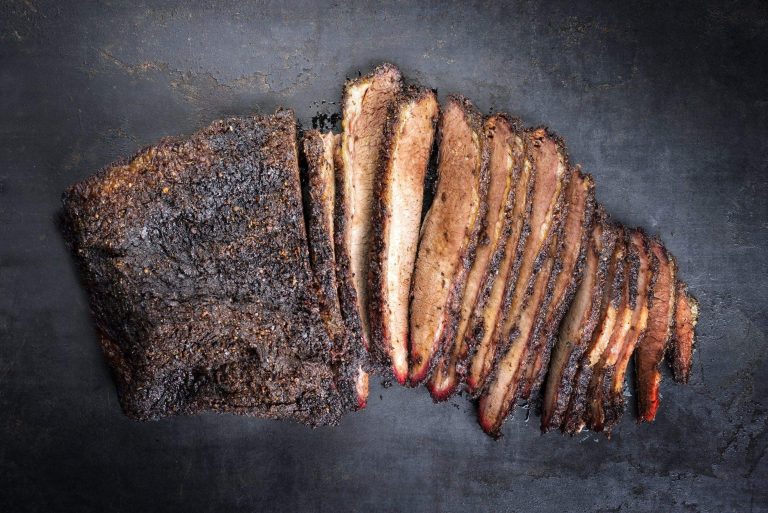
Where to buy a packer brisket in the UK
Published 19 May 2026 · Last updated 19 May 2026 · By Ben Austen · Affiliate disclosure
This is the piece I wished existed when I started looking for a packer brisket in the UK. American BBQ writing assumes the cut is easy to source; UK supermarkets and most UK butchers don’t sell it; the SERP for “where to buy packer brisket UK” is a mess of retailer pages and US-focused recipe sites that quietly assume you can walk into a Walmart and pick one up. I went looking for the proper full thing for a future cook on my Big Green Egg Large and turned up a small handful of UK butchers who will actually sell you one. Here they are, with prices, delivery practicalities, and the script for asking properly.
I want to be upfront about one thing before you read further: I haven’t cooked a packer brisket myself yet. This is a Consensus Report — research synthesis, not a Tested-by-Ben review. Once I’ve sourced a brisket from one of the butchers below, cooked it on the BGE Large, and written that piece up, I’ll update this guide with the supplier I’d actually buy from a second time. For now, what you’re reading is the buying-side work, not the cooking-side verdict.
Key takeaways
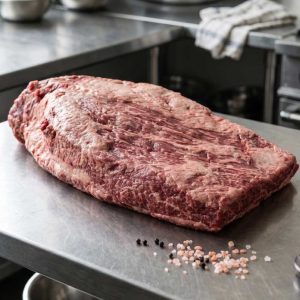
- “Packer” is the American term for the whole, untrimmed brisket as it ships from the meat packer — both the flat (the lean pectoral muscle) AND the point (the fattier deckle), with the fat cap intact, around 5–7 kg of beef. UK supermarkets and most UK high-street butchers sell the flat alone, often rolled and tied as a roasting joint. They are not the same cut.
- UK supermarkets are a dead end for proper BBQ brisket. Tesco, Sainsbury’s, Waitrose, M&S, Morrisons, Aldi, Lidl — none of them reliably stock the full packer. Sometimes the “brisket joint” you find is the point trimmed off; usually it’s the flat alone, sometimes butterflied. Don’t waste a Saturday morning checking.
- The four most reliable mail-order options as of May 2026 are Tom Hixson of Smithfield (London-based, premium), Donald Russell (mail-order, established), Swaledale (British grass-fed), and Grid Iron Meat (native breed). Each delivers nationally; each ships full packers cut to order; each typically prices a 5 kg packer between £40 and £80 depending on grade.
- Order four or five days ahead of the cook. Most UK butchers don’t keep packer briskets on the shelf — they butcher to order, then ship overnight or next-day. The week-out lead time matters when you’re planning around a bank holiday or weekend cook.
- The cut you ask for matters. “Full packer”, “whole brisket — flat and point with fat cap” or “untrimmed brisket joint, around 5 kilos” all communicate what you want. “Brisket joint” alone will get you the flat.
At a glance — the named UK butchers
| Butcher | Typical price (5 kg packer) | Delivery | Grade / sourcing | My read |
|---|---|---|---|---|
| Tom Hixson of Smithfield | £55–75 | National mail order + London Smithfield collection | Aged British and prime imported (US/Australian wagyu options) | The premium option. London-based BBQ scene’s default packer source. |
| Donald Russell | £50–70 | National mail order, frozen-to-door | British, royal-warrant supplier, vacuum-packed | The established mail-order name. Predictable quality, predictable logistics. |
| Swaledale | £45–65 | National mail order, fresh or frozen | British grass-fed, Yorkshire-based, traceability strong | The provenance-and-grass-fed option. Strong editorial content on its own site about how to cook a packer. |
| Grid Iron Meat | £50–75 | National mail order | Native-breed British beef, around 5–6 kg whole brisket | The native-breed angle. Less mainstream than Donald Russell; the SKU is literally “whole brisket”. |
| Bromfields Butchers | £40–55 | National mail order | British, packer cut explicitly listed | The value-oriented packer option among the specialists. |
| The Dorset Meat Company | £45–65 | National mail order | Grass-fed British, “packer brisket” SKU | The smaller-supplier option with clear packer labelling. |
| Local independent butcher | Variable | Walk-in or pickup | Variable | The wildcard. Some will order one in for you; many won’t have heard the term “packer”. |
| Costco UK | £30–45 (when available) | Warehouse only, intermittent stock | Bulk, US-style cuts when in stock | The lucky-find option. Worth a phone call to your local warehouse the week before a cook. |
What “packer” means and why UK butchers don’t usually sell one
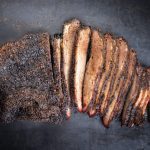
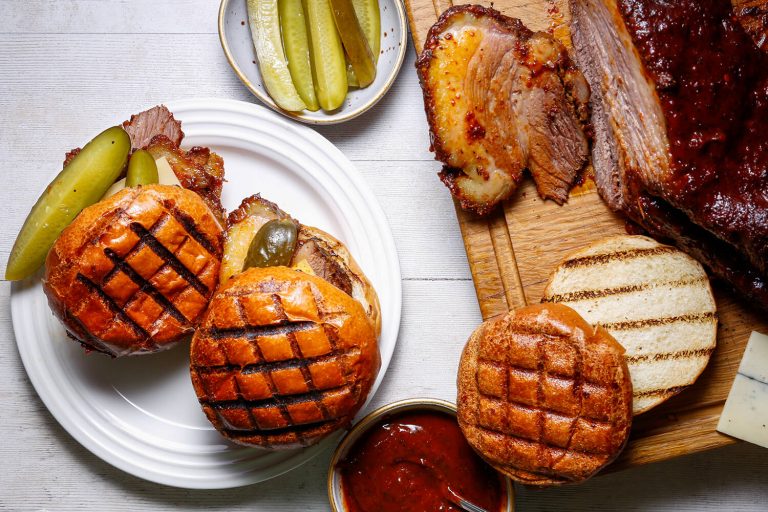
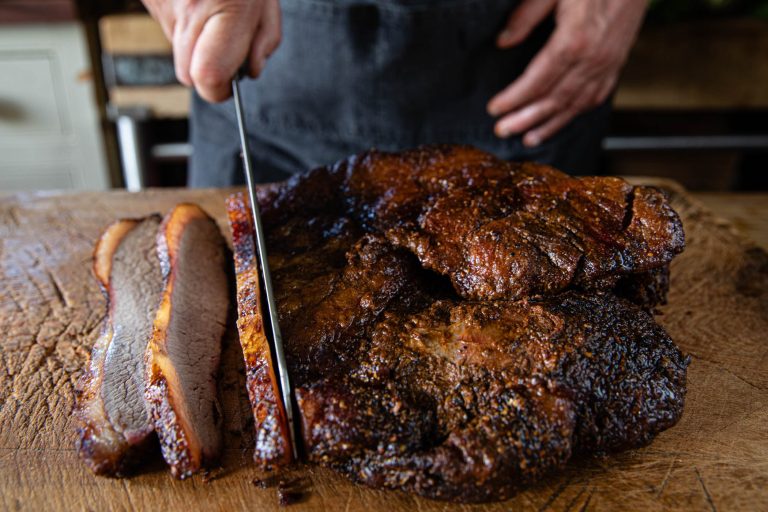
The whole brisket cut comes off the steer’s chest and consists of two muscles connected by a layer of fat. The flat is the larger, leaner of the two — it’s the slice you see in a brisket sandwich. The point sits on top, fattier, smaller in surface area but richer; it’s what gets cubed into burnt ends. The two muscles ship together as the packer brisket — so-called because that’s the cut as it leaves the meat packer at the abattoir, untrimmed, full fat cap intact, weighing 5 to 7 kilos depending on the animal.
UK butchery convention treats this cut differently. Domestic British roasting and braising traditions favour the flat alone — rolled, tied, sometimes salted, sold as “brisket joint” for a Sunday lunch braise rather than a 12-hour smoke. The point gets ground into mince or sold to commercial buyers for sausages and pies, where its fat content earns its keep. So when you walk into Tesco asking for “brisket” you’re getting the flat, often pre-rolled; when you walk into your local butcher asking the same, you’re usually getting the same thing, sometimes butterflied flat for ease of handling.
This isn’t a quality problem — UK brisket flats from a decent butcher are excellent meat. But they aren’t what an American BBQ cookbook means when it says “brisket”. The fat cap that bastes the flat from above during a low-and-slow cook is gone. The point that gives you the smoke-ring-and-burnt-ends sandwich tower isn’t there. You can absolutely cook a UK butcher’s brisket flat on a kamado — it’ll work as a Sunday-lunch smoked beef — but it’s not the cook American BBQ writing is describing.
The good news is that a handful of UK butchers have caught up to the rise of UK BBQ culture and now stock or cut packer briskets to order. Below is the short list of the ones I’d actually trust to send you a proper one.
The named UK butchers — what each one is good for
Tom Hixson of Smithfield
The Smithfield-based butcher with a serious online operation. Tom Hixson is the default packer brisket source for the London BBQ scene — multiple BBQ Instagram accounts and YouTube cookalongs that source UK meat name them as where they buy. They list packer brisket explicitly, in multiple grades: standard British, aged British, prime imported (US Choice and Prime, sometimes Australian wagyu when in season). Prices in the £55–£75 range for a 5 kg British packer; meaningfully more for the wagyu and aged grades. Mail order is fast and well-packaged; Smithfield collection is an option if you’re London-based.
Best for: the cook where you want zero question marks about the meat. If this is the first or second packer brisket cook you’ve ever done and you want to control as many variables as possible, paying the Tom Hixson premium buys you that.
Donald Russell
The established UK mail-order butcher — they hold a royal warrant, ship frozen-to-door, and have been doing premium British beef by post for decades. Their packer brisket appears in the “BBQ cuts” section of the site (when they have it in stock) at £50–70 for a 5 kg piece. Vacuum-packed, frozen on arrival, defrost in the fridge for 36–48 hours before the cook.
Best for: the cook you’re planning a fortnight or more ahead. The frozen-arrival logistics suit advance planning. Predictable in a way that less-established suppliers sometimes aren’t.
Swaledale
Yorkshire-based, grass-fed, strong provenance-and-traceability story. Swaledale list a British grass-fed whole packer brisket on their site and have published their own how-to-smoke-a-brisket guide alongside — useful editorial content on a supplier site, which I rate. Prices around £45–65 for a 5 kg packer. Fresh or frozen delivery options.
Best for: the cook where the meat’s provenance matters as much as the cut. If you’d rather not eat US imported beef and you want to know which farm the brisket came off, Swaledale is the strongest answer on this list.
Grid Iron Meat
A smaller native-breed-focused operation. Their site lists a “native breed beef whole brisket” at around 5–6 kg — the SKU naming is the clearest signal on this list that they understand the BBQ market. Pricing around £50–75. National mail order.
Best for: the cook where you want a meaningful step above commodity-grade beef without the Tom Hixson premium. Native-breed brisket (Hereford, Longhorn, Aberdeen Angus depending on what they have in) has a different intramuscular-fat profile from supermarket beef and renders differently on a long cook.
Bromfields Butchers
A more value-oriented option in the specialist tier. Bromfields list a “whole brisket packer cut” explicitly, which is the labelling you want to see — no ambiguity. Pricing typically £40–55 for a 5 kg piece. National mail order.
Best for: the cook where you’re prioritising the technique experiment over the meat premium. If you’re getting your kamado calibrated and want a packer you can afford to learn on without the £75 sting, Bromfields fits.
The Dorset Meat Company
Grass-fed, smaller supplier, clear “packer brisket” labelling on the SKU. Pricing around £45–65. National mail order.
Best for: the cook where you want a grass-fed brisket but find Swaledale out of stock — these two operations land in similar territory editorially and price-wise.
Your local independent butcher (the wildcard)
Walking into an independent high-street butcher and asking for a packer brisket can go either way. Some butchers — especially in cities with strong BBQ scenes or American expat communities — will know exactly what you mean and either have one or can order one in by Friday. Others have never heard the term. The phrase that works across both groups: “I’d like to order a whole brisket, flat and point together, with the fat cap on, ideally around 5 kilos.” If they can do it, lead time is usually three to four days. Price tends to undercut mail-order specialists meaningfully — £30–50 isn’t unusual for an independent butcher who already orders bulk British beef — because you’re skipping the courier cost.
Best for: the cook where you’ve already built a relationship with a local butcher. The phone call costs you nothing; the worst case is a “no” that points you back to mail order.
Costco UK (the lucky-find option)
Costco UK warehouses occasionally stock American-style cuts including packer briskets, typically priced at the bulk-warehouse end of the market — £30–45 for a 5 kg piece when in stock. Stock is intermittent and warehouse-specific; the only reliable way to find out is to phone your local warehouse on the day. Worth doing if you’re already a member, not worth a Costco membership purely for the brisket access (the membership cost wipes out the price advantage).
What to ask the butcher for — the script
If you’re ordering by phone or in person, the request that lands cleanly across UK butchery vocabulary is:
“I’d like to order a whole brisket — flat and point together, with the fat cap on. Around 5 kilos if possible. I’m cooking it low and slow on a smoker, so I don’t want it trimmed.”
That sentence carries every variable that matters: the cut (whole, both muscles), the trim (fat cap on, untrimmed), the size (5 kg), and the use (low and slow, which signals you don’t want a roasting-joint trim). If the butcher knows the cut they’ll confirm. If they don’t, the conversation tends to clarify — they’ll either offer a flat (“we don’t usually get the point in, would the flat work?”) or admit they can’t get one (“we don’t really do BBQ cuts, you’ll need a specialist”).
For mail-order ordering, the SKU usually does the work — sites that sell packer briskets call them “packer brisket”, “whole brisket”, or “whole brisket — flat and point” in the product title. If the listing only says “brisket joint” or “brisket roasting joint”, that’s the flat, not the packer.
Expected costs in UK 2026 pricing
A 5 kg British packer brisket from a specialist mail-order butcher sits in the £40–£80 range as of May 2026, with most landing between £50 and £65. Premium aged or imported grades (Tom Hixson aged British, US Prime, Australian wagyu) push above £100. Local independent butchers can undercut to £30–50 if they’re willing to order one in; Costco can occasionally beat that further when stock aligns.
Worked example: a 5.5 kg Swaledale British grass-fed packer at £55 lands as £10/kg, which compares against supermarket “brisket joint” at £6–8/kg. The premium is real but not eye-watering — you’re paying about a third more for a cut that’s both larger and meaningfully better-suited to the cook you actually want to do.
Add £5–10 in delivery cost for mail-order; collection-only options like Tom Hixson Smithfield avoid that. Frozen delivery (Donald Russell) means a fridge-defrost window of 36–48 hours, so plan back from the cook day accordingly.
What you can’t do — the supermarket reality
I’ve checked, and so have many UK BBQ-forum threads: the UK big-four supermarkets and the discount chains do not reliably stock packer briskets. Some will stock a butterflied or rolled brisket flat — Tesco, Sainsbury’s, M&S occasionally do — and a few high-end Waitrose stores have been spotted with proper packer-style briskets pre-Christmas, but you cannot plan a cook around supermarket stock. The same goes for online supermarket meat sections (Tesco online, Ocado): the “brisket” SKUs are all flats.
This isn’t a UK-bashing point. It’s a supply-chain reality: UK supermarkets size their meat purchasing around UK domestic cooking traditions, and the proper-packer cut isn’t part of that tradition. The growth of UK BBQ culture is fast enough that this might change — but as of May 2026, supermarket isn’t where you buy your brisket if you want to do the cook properly.
What I’d do next time, when there is a next time
The two pieces I’d genuinely combine on the day are Swaledale or Grid Iron for the meat, and a proper digital probe thermometer for the cook. I haven’t bought either yet — the brisket cook is parked until I’ve got a thermometer I trust — but those are the two purchases I’d line up for a first kamado packer cook on a UK bank-holiday weekend.
When I do cook it, I’ll write up the cook in detail, name the butcher I actually bought from, and update this piece with the supplier I’d buy a second packer from. Until then, treat the verdicts above as research-grounded but not Tested-by-Ben — they’re built from sources I trust, not from a brisket I’ve personally cooked.
Related
- Big Green Egg Large — Tested by Ben review — the kamado I’d cook the eventual brisket on
- Aldi and Lidl ceramic kamados vs the Big Green Egg Large — the buying-guide-side companion piece
- BGE Large pork loin recipe — the brine technique that’ll likely transfer to the brisket cook
- About Ben — who’s behind this
Frequently asked questions
What’s the difference between “brisket” and “packer brisket”?
“Brisket” in UK butchery usually means the flat alone — the larger of the two muscles in the cut, lean, often rolled and tied as a roasting joint. “Packer brisket” is the American term for the whole untrimmed cut as it ships from the meat packer — both the flat AND the point (the fattier deckle on top), with the fat cap intact, around 5–7 kg. American BBQ writing assumes packer; UK supermarket “brisket joints” are flats. The two are not interchangeable for a proper low-and-slow cook.
Where can I buy a packer brisket in the UK?
The most reliable specialist mail-order options as of May 2026 are Tom Hixson of Smithfield, Donald Russell, Swaledale, Grid Iron Meat, Bromfields Butchers, and The Dorset Meat Company. All deliver nationally. Tom Hixson is the premium option; Bromfields the value option; Swaledale and Grid Iron the grass-fed/native-breed options. Local independent butchers can sometimes order one in if they have the supply chain for it.
Why don’t UK supermarkets sell packer briskets?
UK supermarket meat purchasing reflects domestic British cooking traditions — roasting and braising favour the leaner flat, which gets rolled and tied as a brisket joint for Sunday lunch. The full packer cut (flat + point + fat cap) doesn’t have a domestic-cooking use case that justifies supermarket shelf space, so the point typically gets ground into mince or sold to commercial buyers. It’s a supply-chain decision rather than a quality issue — UK supermarket brisket flats are decent meat, just not the cut American BBQ writing is talking about.
How much should I expect to pay for a packer brisket in the UK?
In May 2026, expect to pay £40–80 for a 5 kg British packer brisket from a specialist mail-order butcher. Most land in the £50–65 range. Premium grades (Tom Hixson aged British, US Prime, wagyu) push above £100. Local independent butchers can undercut to £30–50 if they’ll order one in. Costco UK can occasionally beat that further when warehouse stock aligns.
How far ahead should I order?
Four to five days is the safe lead time for mail-order specialists — most butcher to order rather than holding stock. Frozen-delivery suppliers like Donald Russell add a 36–48 hour fridge-defrost window after delivery. If you’re planning a bank-holiday weekend cook, order on the Tuesday for the meat to arrive Friday and the cook to start Sunday morning.
Can I cook a UK butcher’s brisket flat on a kamado low-and-slow?
You can, and it’ll work — it just isn’t the same dish as an American BBQ brisket. The flat alone cooks faster (you don’t have the fat cap or the point to render), tends toward drier slicing if you overshoot the internal temperature window, and gives you slice without the burnt-ends moment. Treat a brisket flat as a smoked-beef Sunday lunch rather than a 12-hour packer cook and it’ll serve you well; just don’t expect the American BBQ tower-of-flavour outcome.
What about Wagyu or aged grades — worth the premium?
For a first or second packer brisket on a kamado, probably not. The cook itself is the variable you’re learning to control — fire management, wrap timing, internal temperature targets. A £150 wagyu packer cooked imperfectly is a more expensive lesson than a £55 British grass-fed packer cooked imperfectly, and the marginal flavour difference is hard to perceive until the technique is dialled in. Cook a couple of standard British packers first; treat wagyu as a reward for a cook you trust yourself to land.
Provenance and disclosure
This is a Consensus Report — research synthesis from named UK butcher sources rather than a Tested-by-Ben review. As of writing (May 2026), Smoke and Lump has no commercial relationship with any of the butchers named above. No commission, payment, or other consideration was received in connection with this piece. If a commercial relationship arises in future (any of the named butchers run UK affiliate programmes via Awin or PartnerStack), this disclosure will be updated to reflect that, and the relevant links will switch to ThirstyAffiliates /go/ redirects with rel="sponsored" flags per the Affiliate Disclosure page. Until then the links above are plain external links.
I’ll update this piece with a Tested-by-Ben verdict — naming the butcher I actually bought from and would buy from a second time — after I’ve cooked a packer brisket on the BGE Large. The cook is currently parked until I have a digital probe thermometer I trust.
The full chain of supply and our standing affiliate-network disclosures are on the Disclosures page.
Pricing data current as of May 2026. Spot-check the linked butcher pages for live pricing and current stock before ordering.