BGE Large pork loin — brined, dry-finished, kamado-roasted
Published 11 May 2026 · Last updated 11 May 2026 · Tested by Ben Austen · Affiliate disclosure
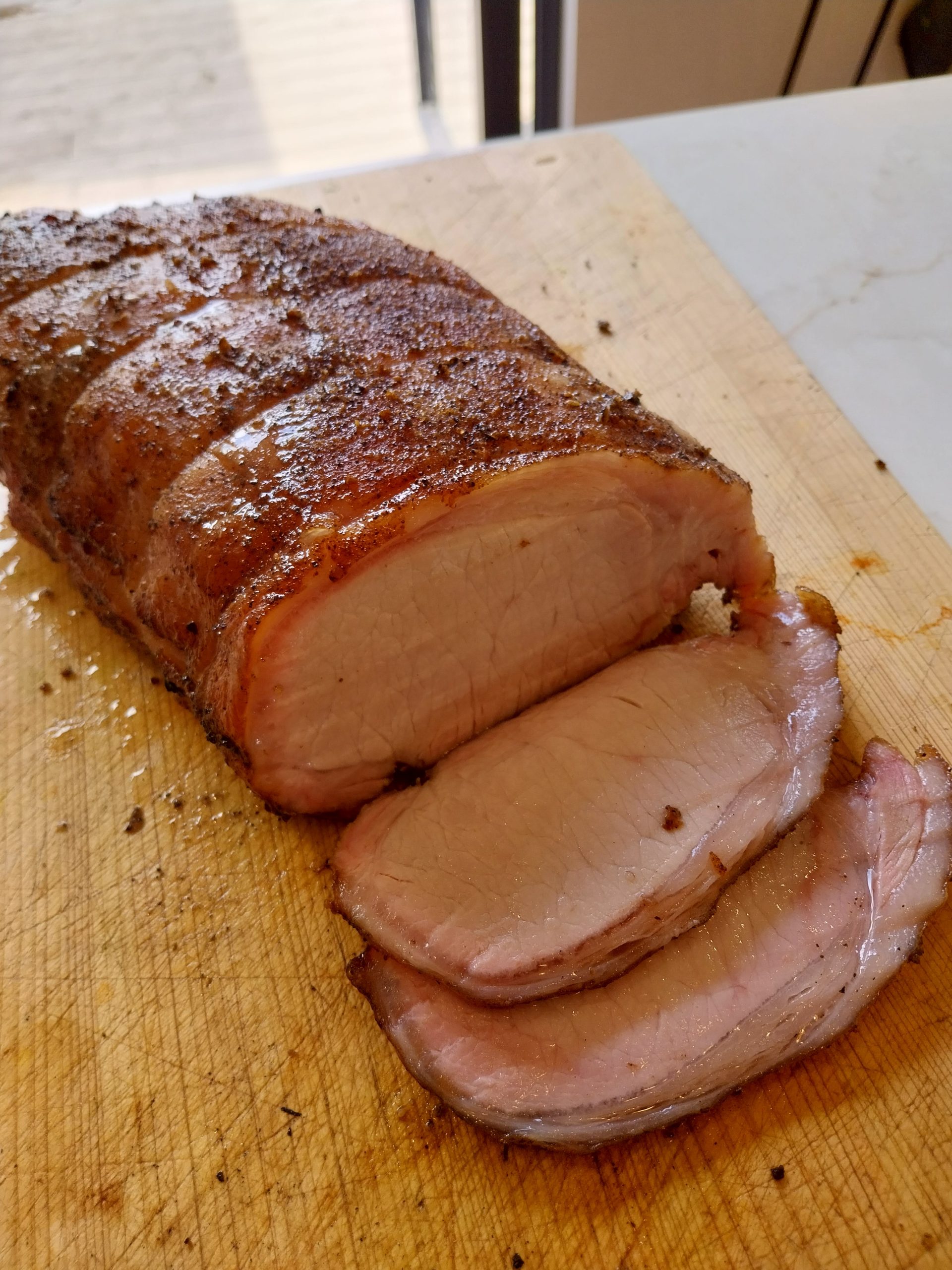
A 1.5 kg pork loin, brined in equal parts salt and sugar for twenty-four hours, dry-finished uncovered overnight in the fridge, then roasted at 140°C indirect on the Big Green Egg Large until the probe reads 63°C — pulled, foil-wrapped, rested in a cold oven for over an hour. I’ve run this method on two cooks now, a fortnight apart, with the same result both times: juicy interior all the way through, clean medium-pink slice, and a smoke ring that turns up in Monday’s cold sandwich as the retrospective receipt that the cook actually worked.
Key takeaways
- A 1.5 kg loin is the right size to brine in a domestic-fridge container, feed six to eight people on the day, and leave Monday-cold-sandwich leftovers. Bigger and the timing gets awkward; smaller and you’re cooking a chop.
- The brine is 3% salt + 3% sugar by water weight — and the easiest way to know how much water you need is to drop the meat in the vessel, fill with water until it’s just covered, take the meat back out, then weigh the water. No guessing.
- Cook spec: 140°C dome temperature, indirect, on top of the ConvEGGtor, unwrapped on the grid. Pull at 63°C internal, foil-wrap, into a cold oven with a tea towel on top to rest for at least an hour.
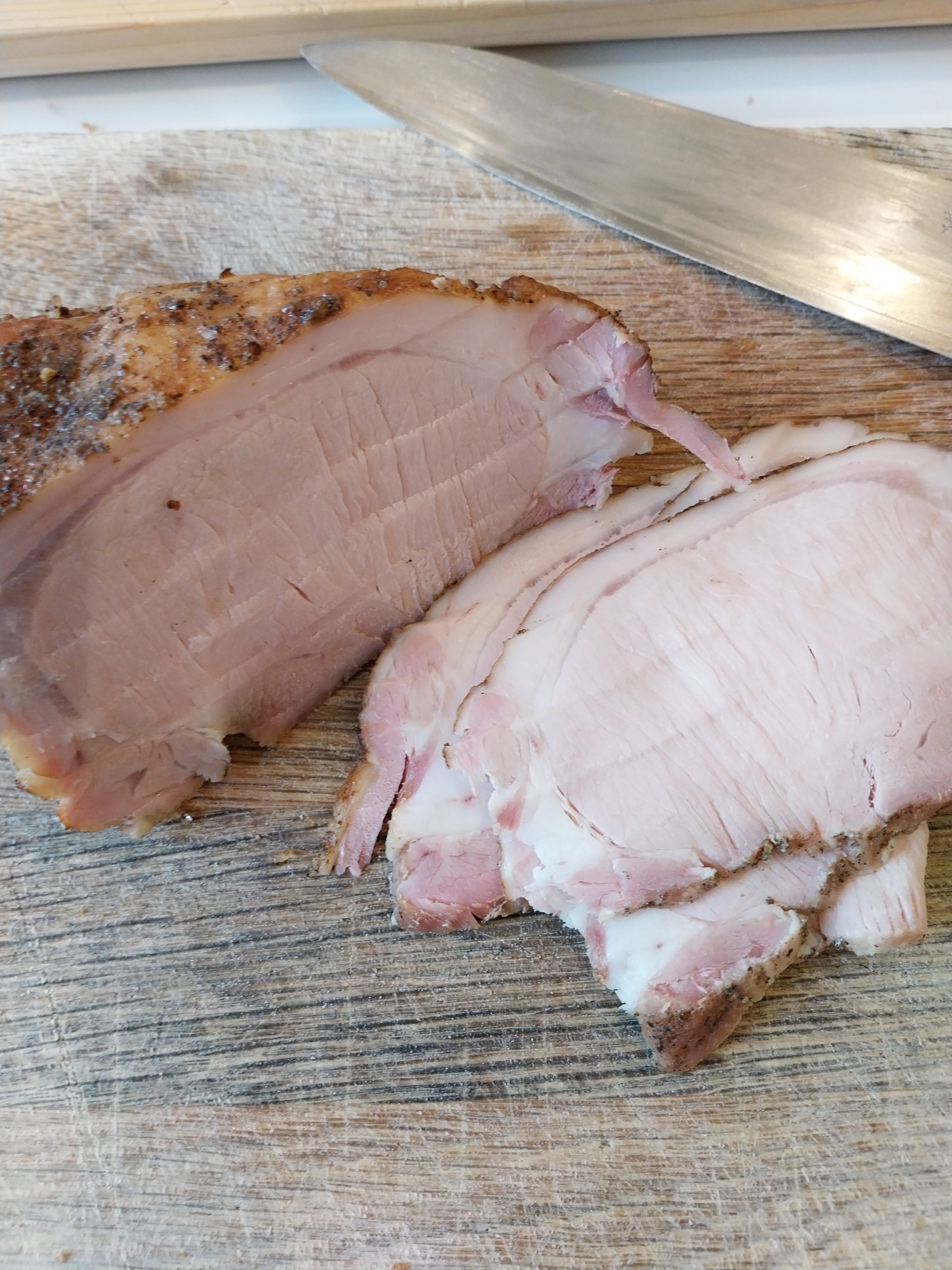
- The smoke ring on Monday’s cold sandwich is the credibility evidence that the cook actually got smoke into the meat — subtler than brisket but unmistakable when you carve a cold slice.
- The fat cap stays attached to the loin during the cook — that’s what bastes the meat. The skin comes off separately and becomes bite-size pork crackling on the kamado, cooked in the same session.
At a glance
| Spec | Detail |
|---|---|
| Prep time | 15 minutes (active) — plus 24 hours brine, plus overnight dry-finish |
| Cook time | 90 minutes on the kamado |
| Total time | ~28 hours from brine-start to plate |
| Servings | 6–8 hot, plus Monday cold-sandwich leftovers |
| Method | Kamado, indirect heat |
| Temperature | 140°C dome, pulled at 63°C internal |
| Difficulty | Medium |
| Equipment | Kamado, ConvEGGtor (heat deflector), probe thermometer, foil, food-safe brining container |
| Cuisine | British |
What you’ll need
Equipment
- A kamado-style barbecue capable of holding 140°C steady for ninety minutes. I cook this on my Big Green Egg Large; any 46cm-class ceramic kamado with a heat deflector will work the same way.
- A ConvEGGtor or equivalent ceramic heat deflector. Indirect heat is non-negotiable on this cook — direct heat at 140°C scorches the outside of the loin before the middle gets there.
- A probe thermometer you trust. The pull point is 63°C internal; if your thermometer reads two or three degrees off, the loin comes out either undercooked or dry.
- A food-safe brining container with a lid — a large Tupperware-style tub is fine. The container needs to be deep enough that the loin sits fully submerged, and small enough that you’re not making twice the brine you need.
- Aluminium foil for wrapping during the rest.
- Wood chunks for smoke. I use oak — I’ve got two bags of it from a tree that came down at my parents’. Apple, cherry, or hickory all work; oak gives the cleaner background note that pairs with pork.
- A roasting tin or board for resting and carving.
Ingredients
- 1.5 kg pork loin, skin-on if you can get it (the skin comes off pre-cook and becomes bite-size crackling on the same kamado). The standard UK supermarket pork loin is roughly this weight.
- Table salt, at 3% of the water weight in the brine. Use table salt, not Maldon. If you can only get Maldon, go to roughly 5% — Maldon’s coarser flakes mean less actual salt per measured volume than table salt.
- Caster sugar, at 3% of the water weight in the brine. Equal parts to the salt.
- Black peppercorns, a tablespoon, whole, for the brine.
- Bay leaves, three or four, for the brine.
- For the SPG rub: black pepper, table salt, and garlic granules at a ratio of 1 : 1 : 0.5 by volume. Roughly two tablespoons pepper, two tablespoons salt, one tablespoon garlic granules covers a 1.5 kg loin with a bit left over.
The cook method
1. Work out how much brine you need by weighing the water
I drop the loin into the brining container, fill the container with cold water until the loin is just covered, then lift the loin back out and weigh the water that’s left. That weight is what the 3% calculations work off. A 1.5 kg loin in a snug container typically needs about 1.5–2 litres of water — but the exact number depends on the shape of your container, so I weigh rather than guess. Scales to any size of meat, no measuring cylinders needed.
2. Make the brine and submerge the loin
I weigh out 3% of the water weight in table salt, the same again in caster sugar, dissolve both into the water, then add the peppercorns and bay leaves. Drop the loin back in, fully submerged, lid on, into the fridge for twenty-four hours. The salt brings the pork’s seasoning up evenly through the whole muscle; the sugar balances the salt and helps the surface caramelise in the cook.
If you’ve got the skin still attached, the skin brines with the loin — which is the prep that makes the crackling work later. The brine isn’t doing anything different for the skin specifically; it’s just convenient that the same brine does both jobs.
3. Dry-finish uncovered overnight in the fridge
I lift the loin out of the brine after twenty-four hours, pat the surface dry with kitchen paper, sit it on a rack over a tray, and leave it in the fridge uncovered overnight. The dry-finish does two things: it gives the loin’s surface time to firm up so it takes a rub cleanly, and it pulls the surface moisture down so the kamado’s convection environment can get to bark formation rather than fighting wet meat. If you don’t have the overnight window, pat-dry with kitchen paper works as a fallback — it won’t be quite as effective but it’s workable.
4. Remove the skin (if you’re making crackling) and apply the SPG rub
Just before the loin goes onto the kamado, I lift the skin off with a sharp kitchen knife. The fat cap underneath stays attached to the loin — that’s what bastes the meat during the cook. The skin in one piece goes to the crackling tray (see the pork crackling recipe for what happens to it next).
I mix the SPG rub — two tablespoons of black pepper, two tablespoons of table salt, one tablespoon of garlic granules — and apply it generously all over the loin and the fat cap. Honest caveat on the garlic granules: I’m not entirely sold on them. UK garlic granules might be a notch off what US BBQ writers mean when they say “garlic” in an SPG, or it might be that US BBQ writers mean garlic powder rather than granules. I’d happily try garlic powder as a swap; the pepper-and-salt parts of the SPG do the real work. Treat the garlic component as the test-the-alternatives bit of the rub rather than as gospel.
5. Set up the kamado at 140°C indirect
I light the kamado single-spot minion-style and run it slow on the way up. UK ambient temperatures mean the vents stay tight: at 140°C dome on the BGE Large, both vents are barely cracked open. American BBQ articles calibrate vent openings to warmer ambient temperatures and routinely overshoot in UK conditions — the discipline here is closing down earlier than feels natural.
ConvEGGtor goes in, then the grid on top. Drop a couple of small wood chunks onto the lit lump before the deflector closes the firebox. Let the dome settle at 140°C and hold there for ten or fifteen minutes before the loin goes on — you want the thermal mass of the ceramic at temperature, not still climbing.
6. Cook unwrapped on the grid until the probe reads 63°C
I sit the loin straight on the grid, fat-cap up, and slide the probe into the thickest part of the muscle. No foil, no wrap, no tray — the kamado’s indirect convection environment does the work uncovered. The fat cap melts and bastes the meat downward through the cook.
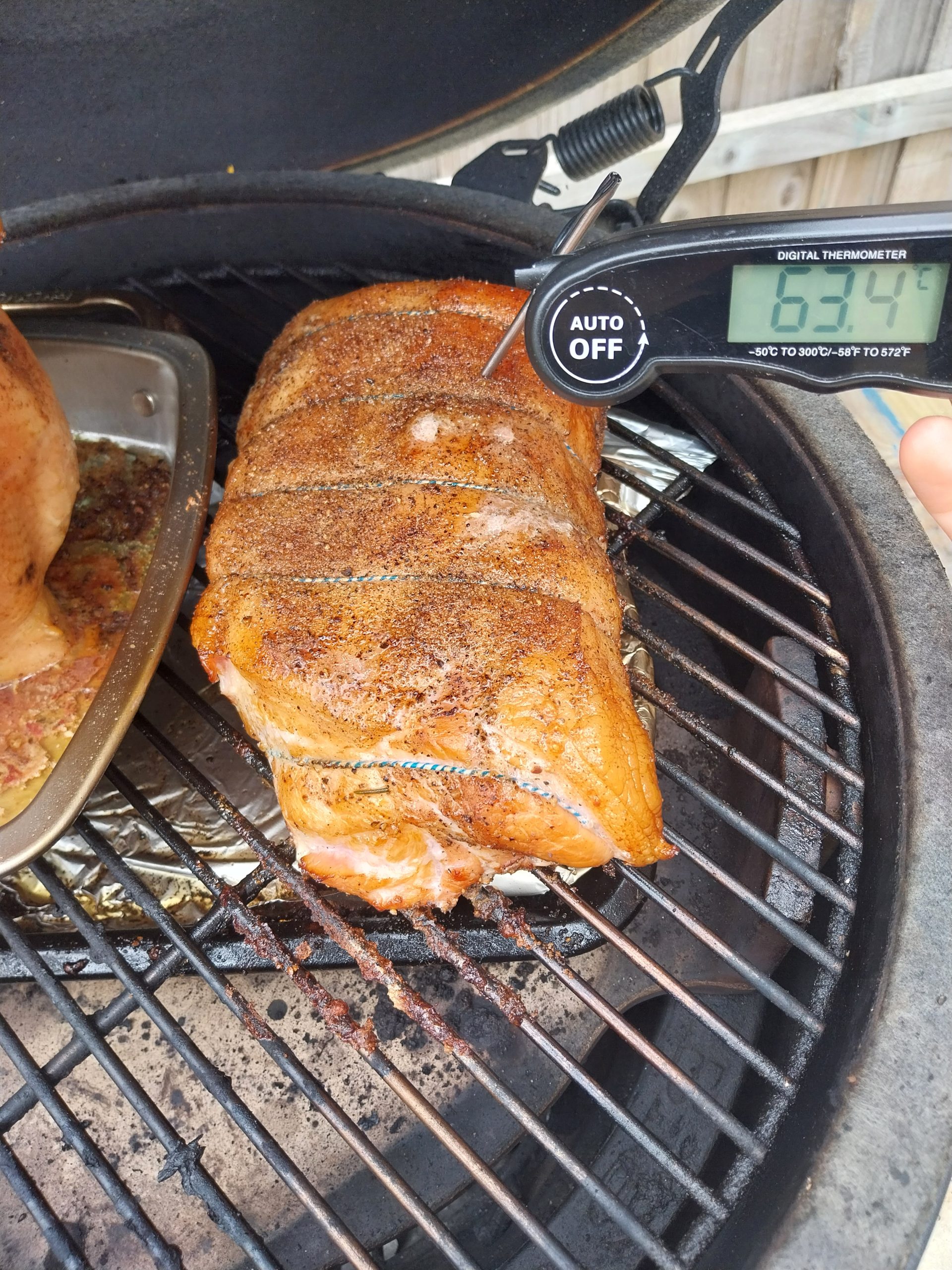
At 140°C dome the loin typically takes ninety minutes to climb to 63°C internal, but variance is real — the next-cook reading depends on the loin’s starting temperature, the dome’s actual hold, and the probe’s calibration. Trust the probe over the clock. I check at sixty minutes to see where the temperature curve is sitting, then again every fifteen minutes after that.
7. Pull at 63°C, foil-wrap, rest in a cold oven for an hour or more
The moment the probe reads 63°C, the loin comes off. I wrap it in a double layer of foil, sit the foil packet in a cold oven (oven off, door closed), and pile a tea towel on top of the packet for extra insulation. The cold oven is the resting environment — keeps the loin warm without continuing to cook it.
A full hour is the minimum rest; over an hour is better if the rest of the meal isn’t ready. On the 3 May cook the loin rested for over seventy-five minutes while guests sat down and ate — still warm to slice, juicy all the way through.
8. Slice across the grain and serve
I unwrap the loin onto a wooden board, slice across the grain at about a centimetre thick, and serve. The slice should be evenly pink-medium from edge to edge — no grey rim, no rare core. That’s the brine plus the slow indirect cook plus the rest doing what they’re supposed to do.
What to serve it with
The cook this recipe came from was a Sunday lunch for six adults and four kids: pork loin sliced, smoky-mayo potato salad (the foil-packet-confit technique that runs underneath the deflector at the same time — recipe coming), charred peppers and courgettes done direct on the grid after the loin came off, and bread. The crackling went round in a bowl as soon as it came off the kamado. Beer or a light red — nothing heavy.
For weeknight repeats I’ll do the loin with mashed potato, a green vegetable, and apple sauce — the brine makes the pork hold its own against anything starchy on the plate. Monday is always cold-pork-loin sandwiches: white bread, mustard, mayonnaise, salad, the crackling pressed in if any survived.
What I learned, and what I’d do differently next time
The brining-by-water-weight method is the single technique I’d put highest in the recipe. I used to estimate the brine by eye and got inconsistent results — too salty one week, undersalted the next. Weighing the water removes the guesswork entirely, scales to any size of meat, and means the brine recipe stays the same whether you’re doing a 1.5 kg loin or a half-shoulder. It feels fussy the first time you do it and routine by the third cook.
The garlic granules in the SPG are the bit of the recipe I’m least confident about. I’ve made the SPG to the same 1:1:0.5 ratio on every cook and the salt-and-pepper parts always do the job — the garlic component is the variable I’d happily test alternatives against. Worth treating the rub as a starting point rather than a finished product; if you’ve got a rub you trust already, use that and keep the brine.
The cold-oven rest is non-negotiable. I tried foil-on-the-counter on an earlier cook (not the ones this recipe sources from) and the loin lost temperature too quickly — fine for a quick Tuesday dinner, but for a Sunday lunch where the rest stretches to an hour or more, the cold oven is what holds the warmth without continuing to cook the meat.
Variations
If your loin doesn’t have skin attached, skip step 4’s skin-removal and go straight to the SPG rub. The cook works identically. You just won’t have crackling to go alongside.
On a kettle barbecue or another kamado, the principle is the same: indirect heat at 140°C dome, ConvEGGtor or equivalent deflector, probe to 63°C internal. The cook should run a similar duration on any 46cm-class kamado. A kettle barbecue with an indirect setup (coals to one side, loin on the other) should also work — I haven’t run this specific cook on a kettle, but the underlying technique doesn’t depend on the kamado specifically.
In a domestic oven, the brine and dry-finish stand alone — both do meaningful work regardless of the cook environment. Run the oven at 140°C fan-assist and probe to 63°C internal. You’ll lose the kamado smoke, which is a real flavour layer, but the brined-and-dried loin still beats a straight-from-the-fridge oven roast by a clear margin.
For a bigger loin (2 kg or more), the brine scales linearly — same 3% salt and 3% sugar by water weight, same twenty-four hours. The cook will run longer to reach 63°C internal. Trust the probe, not the clock.
Related
- Pork crackling on the kamado — the bar-snack bite-size method — what to do with the skin you took off the loin in step 4
- Big Green Egg Large — Tested by Ben review — the kamado I cook this on
- About Ben — who’s behind this
Frequently asked questions
Why brine the pork loin for twenty-four hours?
Twenty-four hours is the time it takes for a 3% salt brine to penetrate evenly through a 1.5 kg loin. Less than that and the brine stays close to the surface — you get a salty edge and an underseasoned middle. More than that doesn’t hurt but doesn’t help either; the brine reaches equilibrium with the meat after about a day. Twenty-four is the sweet spot for this size of loin.
What internal temperature should I pull the pork loin at?
63°C, measured at the thickest part of the muscle. UK food-safety guidance has moved to 63°C as the minimum safe internal temperature for whole-cut pork — the loin will carry over by a degree or two during the rest and finish at a perfectly safe 64–65°C with the juicy medium-pink slice you want. Going higher (70°C+) overcooks the loin into the dry zone.
Do I need to use a probe thermometer?
Yes. Pork loin’s window between underdone and overdone is narrow — the difference between 60°C and 70°C internal is the difference between juicy and dry, and you cannot judge that by feel or by time. A probe thermometer is the only reliable way to hit 63°C consistently. Any decent instant-read or leave-in probe works.
Can I skip the dry-finish if I’m short on time?
You can pat the loin dry with kitchen paper as a fallback. It won’t give quite the same surface as the overnight dry-finish — the SPG rub won’t stick as cleanly, and the bark won’t form as well — but the cook still works. The brine is doing most of the heavy lifting; the dry-finish is a meaningful refinement on top.
What’s the right wood for pork loin on a kamado?
I use oak — partly because I’ve got bags of it from a tree at my parents’, partly because it’s the cleanest background note for pork. Apple, cherry, hickory all work and bring slightly different flavour profiles (apple gentler, hickory more assertive). Avoid anything heavily resinous (pine, fir) — they don’t belong near meat.
Why does the smoke ring matter?
The smoke ring — the pink rim visible in a cold slice — is the visible evidence that nitric oxide from the smoke penetrated the meat surface during the cook. It’s a retrospective check that the cook actually got smoke into the meat rather than just cooking the loin in a warm box. On Monday’s cold sandwich the smoke ring is unmistakable; on the warm Sunday slice it’s harder to see because the meat colour is still pink throughout.
Provenance and disclosure
This recipe is sourced from two cooks on my own Big Green Egg Large — Sunday 3 May 2026 (the BGE Large launch cook) and Saturday 9 May 2026 (the same method repeated as a second data point). Both cooks used the same brine, the same dry-finish, the same SPG rub, the same 140°C indirect setup on the BGE Large, the same 63°C pull, and the same cold-oven rest. The BGE Large was a Christmas 2025 gift from my sister, originally supplied to her by Big Green Egg as part of a paid content partnership that has since ended. I own the unit outright. Smoke and Lump has no commercial relationship with Big Green Egg, and no commission, payment, or other consideration was received in connection with this recipe. The full chain of supply and our standing affiliate-network disclosures are on the Disclosures page.
Sourced from the 3 May 2026 cook log and the 9 May 2026 cook log — the BGE Large launch cook and the second-data-point cook a fortnight later.