Smoky-mayo potato salad on the kamado — semi-sealed foil packet, two-yolk mayo, tarragon
Published 18 May 2026 · Last updated 18 May 2026 · Tested by Ben Austen · Affiliate disclosure
New potatoes confit in their own foil packet under the deflector on a kamado, deliberately semi-sealed so the smoke gets in while the oil stays in. The oil that drains off becomes the base of a two-yolk mayo with the confit garlic mashed through it, folded back through the still-warm potatoes with spring onions and tarragon. The dish that made everyone go quiet for a beat when it landed on the table at a Sunday lunch in May.

Key takeaways
- The whole dish runs as a side off the back of any other kamado cook — sits under the deflector at 140°C for roughly thirty minutes, hands-off, while the main protein cooks above.
- Semi-sealed foil packet is the technique that matters. Sealed enough to keep the oil and potatoes contained; open enough that the kamado’s smoke can get to the oil. Sealed-shut gives you confit oil; wide-open lets the oil escape. Semi-sealed gives you both.
- Two egg yolks, not four — Ben’s standard mayo batch is a “jam jar full” from two yolks. The smoky-mayo version is the same recipe with the smoky oil swapped in for plain.
- Cider vinegar, not white wine — a notch sweeter, softer acid, better with the smoke than white-wine vinegar’s sharper finish.
- Tarragon, because the dish is going with chicken. The herb is chosen for the protein pairing, not for the potato.
At a glance
| Spec | Detail |
|---|---|
| Prep time | 15 minutes (active) |
| Cook time | 30 minutes |
| Total time | 50 minutes including mayo-making and assembly |
| Servings | 6–8 as a side |
| Method | Kamado, indirect heat |
| Temperature | 140°C dome |
| Difficulty | Medium |
| Equipment | Kamado, ConvEGGtor (heat deflector), aluminium foil, stand mixer or balloon whisk + bowl |
| Cuisine | British |
What you’ll need
Equipment
- A kamado-style barbecue running indirect at 140°C dome. I cook this on my Big Green Egg Large — any 46cm-class ceramic kamado works. The dish runs as a parallel side underneath whatever else is cooking, so the kamado’s already lit anyway.
- ConvEGGtor or equivalent ceramic heat deflector. The foil packet sits under the deflector, on the firebox-side of the ceramic, not above it on the grid. The under-deflector position is the accidental discovery that gives the oil more smoke exposure than the standard above-deflector position.
- Heavy-duty aluminium foil — the packet needs to hold ~400ml of oil through the cook without leaking. Standard kitchen foil works if doubled up.
- A stand mixer with a whisk attachment (I use a KitchenAid) or a balloon whisk + bowl. The mayo can be made by hand but a stand mixer’s a lot easier when you’re trying to drizzle oil one-handed.
- A jug or measuring jug to decant the smoky oil from the foil packet — Pyrex works, anything heat-tolerant.
- A fat-separating jug if you have one (optional — useful for the chicken-drippings side-technique if you’re running this alongside roast chicken).
Ingredients
For the foil-packet confit:
- ~2 kg new potatoes, washed but not peeled. Charlotte or Anya or whatever decent UK new potato you can lay hands on — small enough to go in whole, or halved if they’re larger than a golf ball.
- ~400 ml sunflower oil. Quite a lot of oil — the potatoes need to be three-quarters submerged in it during the cook. Sunflower not olive: olive oil’s bitterness comes out wrong in a smoky-mayo context, and sunflower takes smoke cleanly without fighting it.
- 2–3 whole heads of garlic, sliced in half across the equator (not cloves separated). Both halves go in the packet skins-on; the cloves confit in their skins and slip out soft and sweet.
- A few sprigs of rosemary and a few sprigs of thyme, both straight from the garden if you have a herb patch. Otherwise a small handful of each from the supermarket. They cook down into the oil and stay there.
For the mayo:
- 2 egg yolks (one batch). The whites go into a pavlova or get frozen for meringue another day.
- A capful of cider vinegar — about a teaspoon. Not white wine vinegar.
- A pinch of caster sugar, salt, freshly ground black pepper to season once the emulsion has come together.
- A teaspoon of boiling water at the end to loosen the finished mayo to a folding consistency.
For the assembly:
- 3–4 spring onions, finely sliced.
- A small handful of fresh tarragon, leaves picked off the stalks and roughly chopped. Tarragon specifically — the herb is chosen for whatever protein the dish is going with. With chicken, it’s tarragon. With pork it could be flat-leaf parsley. With beef, chives. The pairing is the point.
The cook protocol
1. Build the foil packet and prep the potatoes
I tear off a long sheet of heavy-duty aluminium foil and fold it in half lengthways so it’s double-thickness — the packet’s got to hold ~400 ml of oil through a 30-minute cook without leaking, and a single layer doesn’t always hold. I tip the new potatoes onto the foil, scatter the garlic halves cut-side-down on top, lay the rosemary and thyme over the lot, and pour the sunflower oil in to roughly three-quarters cover the potatoes.
2. Semi-seal the packet — this is the technique that matters
I gather the foil up around the contents and crimp it closed along the top with my fingers, but I don’t seal it shut. The crimping holds the foil’s shape and keeps the oil contained when the packet sits flat; the un-sealed seam at the top is open enough that the kamado’s smoke can find its way in and get to the oil during the cook. Sealed-shut gives you a confit oil with no smoke flavour. Wide-open lets the oil escape and the potatoes scorch. Semi-sealed gives you confit-with-smoke, which is the whole point.
3. Sit the packet under the deflector at 140°C
Once the kamado’s at 140°C indirect with the ConvEGGtor in, I lift the deflector off, sit the foil packet directly on the firebox-side ceramic (where the deflector usually goes), and put the deflector back on top. The packet is now sandwiched between the firebox and the deflector — closer to the radiant heat and the smoke than it would be above the deflector on the grid.

4. Cook for 30 minutes, hands-off
Thirty minutes is the right number. The first time I ran this I cooked it for 35–40 minutes and the potatoes were a touch too soft for the fold — slightly collapsing rather than holding their shape. Thirty is the sweet spot for new potatoes at this size; bigger potatoes might push to 35. Trust a fork — if the fork goes through the potato cleanly with a bit of resistance still, you’re there. No turning required, no stirring, no checking.
5. Pull the packet and decant the smoky oil
I lift the foil packet off the kamado with two pairs of tongs (it’s hot, full of oil, easy to spill) and sit it on a tea towel to settle. I tip the contents into a colander over a heat-proof jug, catching the oil in the jug and leaving the potatoes plus garlic plus herbs in the colander. The herbs go to the compost — they’ve given everything they had. The garlic stays — both halves get squeezed once they’re cool enough to handle, and the soft confit cloves slip out of their skins into a small bowl ready for the mayo.
Let the oil cool for ten minutes before it goes anywhere near the egg yolks. Hot oil scrambles yolks; warm oil makes mayo.
6. Make the mayo
While the oil’s cooling I get the mayo set up. Two yolks into the bowl of the stand mixer, a capful of cider vinegar in with them. The whisk goes on immediately — within a few seconds of the vinegar landing on the yolks. If you leave the vinegar sitting on the yolks before whisking, the acid starts to cook the yolks. Not enough to ruin the mayo, but enough to make the emulsion harder to build. Whisk first, ask questions later.
With the whisk on a medium-high speed I start drizzling the smoky oil in slowly — at the start it’s drip-by-drip until the emulsion catches and the yolks start to look thicker, then a steady thin stream from there. The mayo builds itself; I don’t need to do anything except keep the oil drizzle steady and watch the consistency. Around three or four minutes in the bowl’s full of pale-yellow smoky mayo, glossy and thick, and the oil’s nearly all in.
The confit garlic gets mashed with the side of a knife into a paste and stirred through. A pinch of caster sugar, a pinch of salt, freshly ground black pepper, taste and adjust. A teaspoon of boiling water at the end loosens the consistency from “stiff mayo” to “folding mayo” — the texture you want for the potato fold.
7. Fold through the warm potatoes
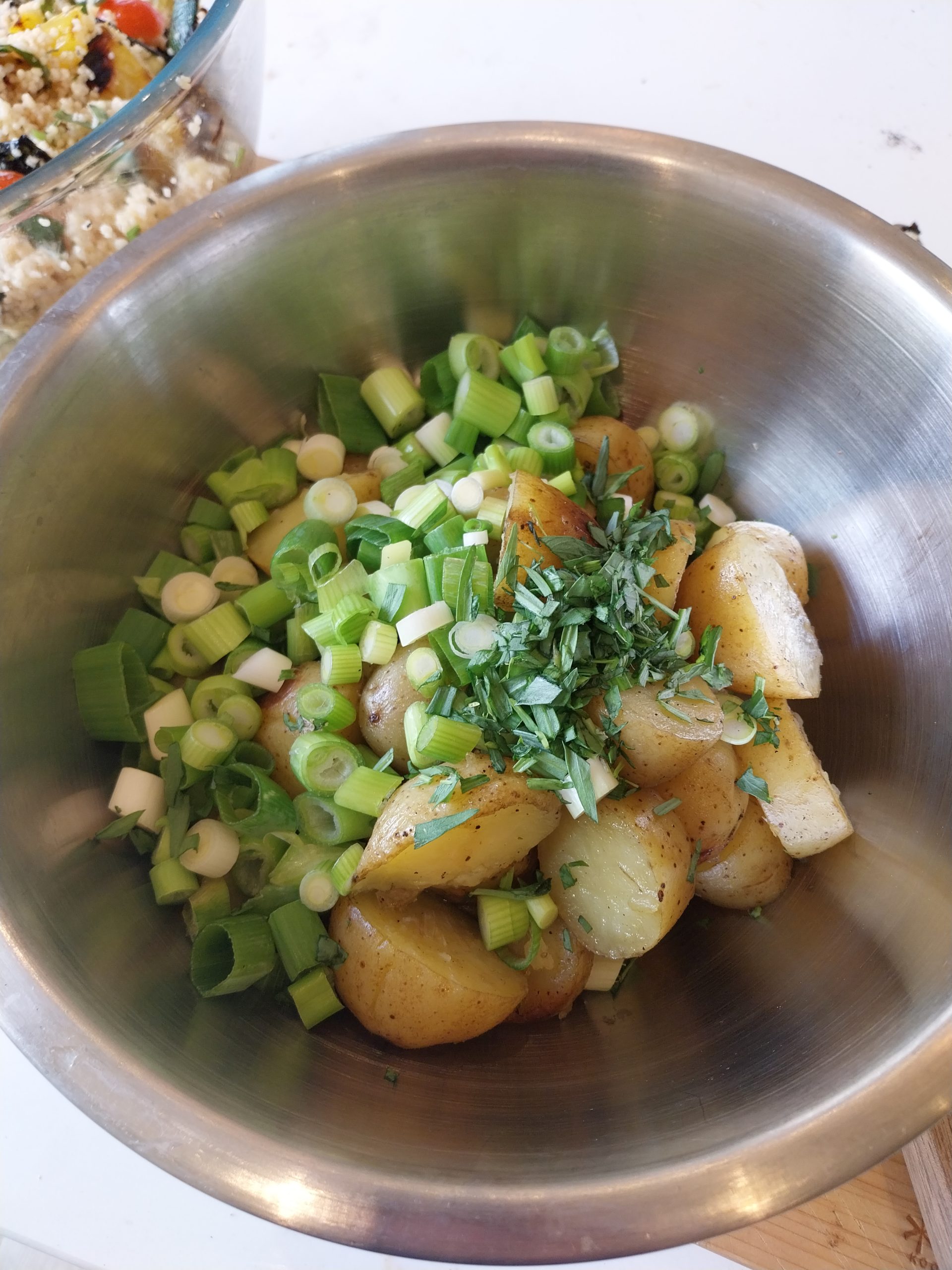
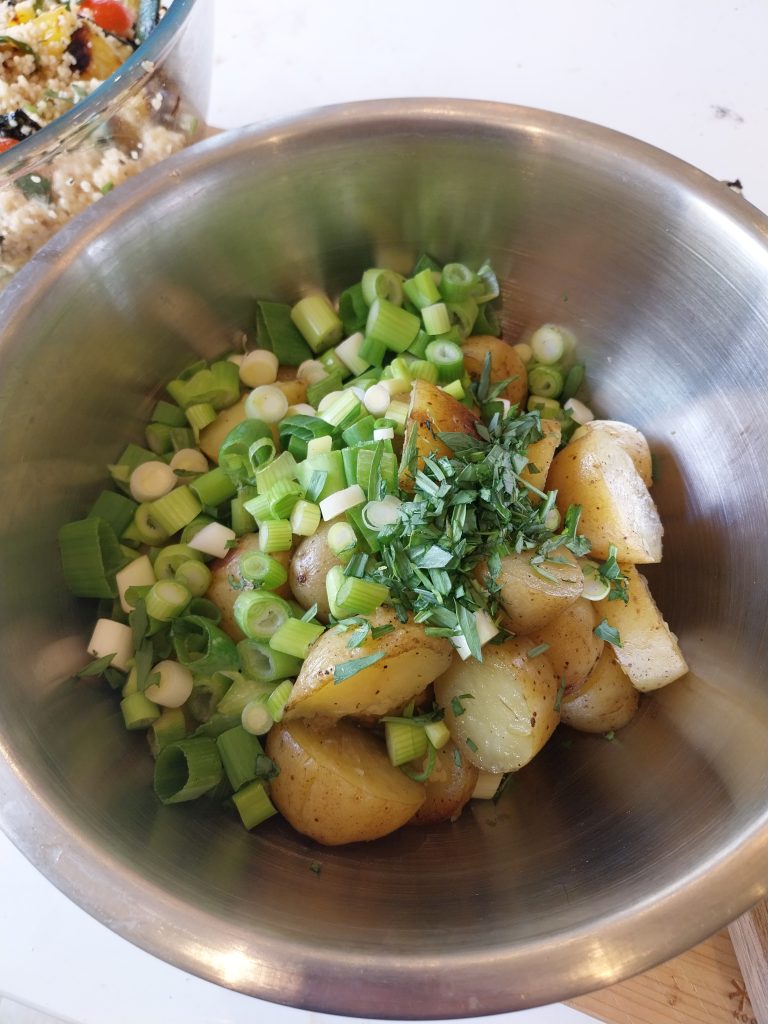
The potatoes from the colander are still warm — that’s deliberate. I tip them into a large mixing bowl, halve any that are bigger than a mouthful, and spoon the smoky mayo over the top. I fold it through gently with a rubber spatula rather than stirring — fold rather than mix, so the potatoes coat without breaking up. Spring onions and tarragon get folded in last.
8. Plate hot or warm — don’t refrigerate
The dish is at its best served warm, within ten or fifteen minutes of the fold. The warm potatoes hold the mayo as a glaze; cold-refrigerated, the mayo seizes up and the dish loses its character. If you’ve got to make it ahead, fold the spring onions and tarragon in just before serving and warm the bowl gently in a low oven for ten minutes before plating.
What to serve it with
The cook this recipe came from was a Sunday lunch for six adults and four kids: pork loin sliced (the BGE Large pork loin), reverse-finished chicken on a vertical roaster, charred peppers and courgettes direct on the grid, pork crackling on a foil-lined tray (the bar-snack method), and this potato salad as the side that got the most comments. The tarragon-with-chicken pairing did the heavy lifting on the plate.
Beyond the original cook, it works as a side with any roast chicken or fish — the smokiness gives it a kamado-cook context but the dish stands on its own with an oven-roast chicken too. Not the natural partner for beef (too rich on rich); not the natural partner for lamb either (the tarragon would clash). The pairing logic — pick the fold-in herb for the protein — keeps the dish flexible without falling into “potato salad goes with everything” lazy mode.
What I learned, and what I’d do differently next time
The 35-to-40-minute cook on the original day was too long. The potatoes were a touch too soft for the fold — they collapsed into the mayo rather than holding their shape. Thirty minutes is the right number, and that’s what the recipe specifies. The lesson is straightforward: the kamado’s indirect 140°C drives the confit faster than my domestic-oven instinct suggested, and “another five minutes won’t hurt” was wrong.
The semi-sealed foil packet was an accidental discovery worth keeping. I’d originally planned to put the potatoes in a tray on the grid above the deflector, but ran out of grid space because of a chicken on a vertical roaster and a whole pork loin already up there. Sitting the foil packet under the deflector was a space-saving move that turned out to give the oil more smoke exposure than the original plan would have. The lesson is: the under-deflector position is the upgrade, not the compromise. If you’ve got the grid space and put the packet above, you’ll miss out on the smoke layer that makes the dish what it is.
The two-yolk mayo is the standard mayo batch in my kitchen. It makes about a jam-jar’s worth of mayo from two yolks; that’s the right quantity for ~2 kg of potatoes. The published BGE Large review said “four egg yolks” in the prose — that was wrong (corrected now). The recipe needs two yolks, no more. Four yolks would give you twice the mayo and double the richness, both of which would unbalance the dish.
Vinegar choice matters more than I thought. Cider vinegar gives a softer acid that lets the smoke through; white-wine vinegar’s sharper finish fights it. Don’t substitute lemon juice — the citrus dominates the smoke in a way that’s pretty but loses the whole point of the foil-packet technique.
Homemade mayo is genuinely a different dish from shop-bought. Not better — different. Shop-bought mayo is shelf-stable, neutral, predictable; it does a job. Homemade two-yolk mayo with smoky oil and confit garlic is none of those things — it tastes assertively of whatever oil and acid you built it from, lasts maybe 48 hours in the fridge, and rewards the protein context more than it rewards the potato. Worth the fifteen minutes once you know how it goes.
Variations
Without a kamado, the foil-packet step transfers to a domestic oven at 140°C fan-assist for 30 minutes — you’ll lose the smoke layer entirely, which is the whole point of the recipe. Worth doing for the technique (confit oil + confit garlic in a foil packet is a useful trick in any kitchen) but the resulting dish is “confit-mayo potato salad” rather than “smoky-mayo potato salad”. Honestly: cook it on a kamado or save the recipe for next time.
On a kettle barbecue with an indirect setup (coals to one side, packet on the other), the principle should transfer cleanly. I haven’t tested this — but the underlying technique (semi-sealed foil packet with oil + garlic + herbs cooking near radiant heat with smoke access) doesn’t depend on the kamado’s ceramic. A kettle’s indirect side should give you the same result.
For the herb fold-in, match the herb to the protein the dish is going with. Tarragon for chicken (the classic French pairing). Flat-leaf parsley for pork (the standard British pairing). Chives for beef (a quiet but real combination). Dill for fish. The fold-in is the dish’s chameleon layer; the smoky-mayo base is the constant.
For the oil, sunflower is the standard. Rapeseed works but tints the mayo darker yellow and adds a slight grassy note that some palates flag and some don’t. Light olive oil works in a pinch but the bitterness comes through; extra-virgin olive is wrong (too assertive against the smoke). Avoid coconut oil and anything aromatic.
Vegan version: replace the egg yolks with two tablespoons of aquafaba (chickpea-tin water) per yolk, and the mayo recipe scales directly. I haven’t run this version on the kamado but the standard aquafaba-mayo technique should hold; the smoky oil and confit garlic give the dish enough character to carry without the yolk richness.
Related
- BGE Large pork loin recipe — the protein this dish was originally served alongside
- Pork crackling on the kamado — the bar-snack bite-size method — what to do with the loin skin while this is cooking underneath the deflector
- Big Green Egg Large — Tested by Ben review — the kamado I cook this on
- About Ben — who’s behind this
Frequently asked questions
Why semi-seal the foil packet and not seal it shut?
A sealed packet gives you a clean confit — oil and garlic and herbs slow-cooking in their own steam, no smoke contact. The dish you’re after is one notch beyond that: confit with smoke. Crimping the top of the packet closed but leaving a small open seam lets the kamado’s smoke find its way in to the oil during the cook, which is what makes the resulting mayo “smoky” rather than just “garlicky-and-herby”. Sealed shut, the mayo’s good but generic. Semi-sealed, it’s the dish.
Can I use olive oil instead of sunflower?
Light olive oil works at a push, but extra-virgin olive is wrong — its bitterness comes through and fights the smoke. Sunflower is the standard because it takes smoke cleanly without contributing its own flavour. Rapeseed works too but tints the mayo a deeper yellow and adds a faint grassy note.
Why two egg yolks and not four?
Two yolks gives you a jam-jar’s worth of mayo (~250–350 ml), which is the right quantity for ~2 kg of potatoes. Four yolks would double the mayo volume and double the richness — too much of both for this dish. The published BGE Large review prose initially said four; that was an error, corrected since.
Do I need a stand mixer to make the mayo?
No, a balloon whisk and a bowl work fine — Ben’s mum and grandmother both did it that way for years. The stand mixer is a convenience for drizzling the oil one-handed; with a whisk you need someone else to drizzle (or a steady left hand and a drizzle-bottle). Either way works. The technique is the same: start whisking as soon as the vinegar lands on the yolks, then drizzle the oil slowly until the emulsion catches and thickens.
Can I make this ahead?
Up to a point. The mayo and the confit oil both keep in the fridge for 48 hours. The assembled potato salad doesn’t — refrigeration seizes the mayo and the dish loses its character. If you’ve got to prep ahead, make the mayo and chill it separately, cook the potatoes fresh, fold them with room-temperature mayo (warm the bowl gently first), and add the spring onions and tarragon at the table.
Can I cook the potatoes in the same foil packet for less than 30 minutes if I want them firmer?
Yes — at 25 minutes the potatoes are firmer with a fraction of bite, at 30 they’re the right side of soft for a fold, at 35 they’re tipping into too-soft. Fork-test from the 25-minute mark if you want to dial it precisely. Bigger potatoes (over a golf ball) want the full 30.
What’s the difference between this and a confit potato salad?
A confit potato salad uses oil-cooked potatoes folded with a neutral mayo or vinaigrette. The smoky-mayo version replaces the neutral mayo with one built from the same oil the potatoes confit’d in — so the smoke and garlic and herb from the cooking environment all carry through into the dressing. The mayo is the cook, in dressing form. That’s the whole game.
Provenance and disclosure
This recipe is sourced from a cook on 3 May 2026 on my own Big Green Egg Large — the BGE Large launch cook, a Sunday lunch for six adults and four kids. The BGE Large was a Christmas 2025 gift from my sister, originally supplied to her by Big Green Egg as part of a paid content partnership that has since ended. I own the unit outright. Smoke and Lump has no commercial relationship with Big Green Egg, and no commission, payment, or other consideration was received in connection with this recipe. The full chain of supply and our standing affiliate-network disclosures are on the Disclosures page.
Sourced from the 3 May 2026 cook log — the BGE Large launch cook with pork loin, reverse-finished chicken, charred vegetables, pork crackling, and this potato salad on the side.