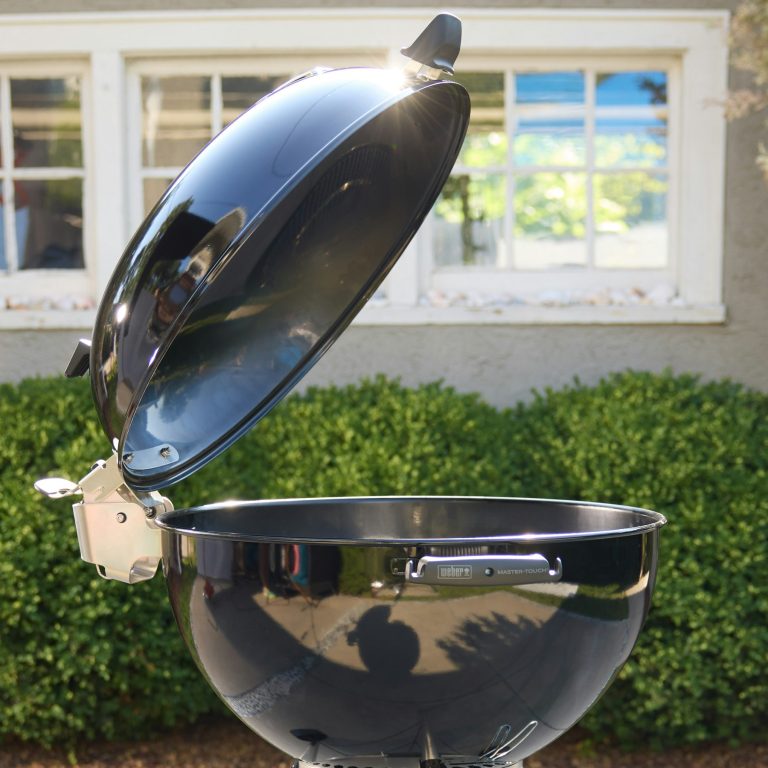
Weber Master-Touch GBS 57cm — UK Tested-leaning review by Ben Austen

A few years ago I owned a Weber Master-Touch GBS and cooked on it regularly: chicken thighs and wings, sausages, burgers, koftas, the quick-direct end of what a kettle does well. I don’t currently own one, and I never ran a long low-and-slow cook on a Weber kettle, so this is a Tested-leaning review with its limits in plain sight. My direct experience covers the high-heat half of the unit’s range. Low-and-slow performance, the new Kettle Smart Ring, the Performer Smart comparison, and long-cook fuel economy are all sourced and linked. No photos from my Master-Touch period survive, so the unit imagery here is attributed Weber UK press material throughout. Full provenance and current commercial relationships are in the Disclosure provenance section at the foot of the piece. The site’s affiliate framework is on the /disclosures/ page.

The short version

The Master-Touch GBS 57cm is the kettle the considered first-time charcoal cook should buy in 2026. At £200 to £260 depending on retailer, bundle, and colour, it’s the right tool for the buyer leaving gas behind who doesn’t want to spend kamado money, with the build quality and warranty pipeline Weber has spent a century earning. If your typical cook is a 12-hour low-and-slow brisket, a kamado is the better answer; for everything else, the Master-Touch is.

The surprise finding from the year: Weber’s new £289 Kettle Smart Ring changes the upgrade-path conversation entirely. The kettle plus a retrofitted Smart Ring at total £490 to £550 buys you the same controller-managed temperature handling as the £579 to £719 Performer Smart, for less money. “Master-Touch now, Smart Ring in Year 2” is the most cost-efficient route to smart-charcoal cooking in the UK in 2026.

Key takeaways

  • At £200 to £260, the Master-Touch GBS 57cm is the right kettle for first-time UK charcoal cooks. The bundle and accessory choices matter more than the unit choice at this tier.
  • I cooked on a Master-Touch GBS regularly for several years: chicken thighs and wings, sausages, burgers, koftas. The unit handles quick-direct cooks at a level that justifies the £200 to £260 price (Tested-by-Ben evidence).
  • Sears at 260°C+ on a full chimney for direct cooks (Tested). Holds 110 to 130°C for 4 to 6 hour low-and-slow on a half-basket (sourced from Expert Reviews and Honest John).
  • The £289 Kettle Smart Ring is the most interesting Weber-kettle development in a decade. It makes the Master-Touch smart-charcoal-ready at retrofit cost instead of new-unit cost. Sourced, not Tested.
  • Where the Master-Touch can’t reach: 12+ hour overnight cooks without refuelling, true low-temperature smoking, the gasket seal of a kamado. For those, my BGE Large review covers the alternative.
  • Weber UK covers the bowl and lid for 10 years. The long-run cost story holds up before you factor in fuel efficiency.
  • Verdict: 8.5/10.

At a glance — Weber Master-Touch GBS 57cm

Cooking area57cm diameter, approximately 2,550 cm²
Lid/bowl materialPorcelain-enamelled steel
Max temperatureAround 315°C lid-thermometer reading; sear-grate area higher
Lid mechanismHinged with Tuck-Away holder
Ash managementOne-Touch cleaning system + ash catcher
GasketNone (kettle category doesn’t seal like a kamado)
FuelBriquettes (intended) or lump charcoal
Smart-charcoal upgrade pathKettle Smart Ring £289 (retrofit)
UK price£200 to £260 depending on retailer, bundle, colour
Warranty10 years bowl & lid; 5 years One-Touch + plastics; 2 years remaining
Where to buyWeber UK direct · BBQ World

Who this is for, and who this isn’t

If you’re moving past gas and into charcoal for the first time, the Master-Touch is built for you. The mental model the unit assumes is the parent or partner who wants the kettle to be the centre of two or three weeknight cooks a month plus the occasional weekend session, with a patio or back garden that can take a 57cm circle of charcoal kettle. The mid-priced kettle market exists precisely because that buyer is the median UK BBQ shopper, and the Master-Touch is what Weber built for them.

If you cook five times a year, the entry-level Original Kettle is the more honest recommendation: you won’t use the Master-Touch’s extras enough to earn them. If you cook weekly and you want the controller to handle temperature management for you, the Performer Smart (or Master-Touch + Smart Ring, see Section 8) is the better fit. If your typical cook is a 12-hour low-and-slow brisket, a ceramic kamado is the right tool. Read my BGE Large review for the case. And if you’re in a flat with no outdoor space, charcoal cooking isn’t a safe fit at all: the carbon monoxide risk is real and well-documented.

If I were buying my first charcoal BBQ in 2026, I’d buy the Master-Touch and budget for the £289 Smart Ring as a Year 2 upgrade once I’d worked out how I cook on a kettle. That £490 to £550 path gets you the best-value first-charcoal setup in the UK in 2026, without paying the integration premium of the Performer Smart at the start.

What I’ve cooked on the Master-Touch

A few years ago I had a Master-Touch GBS in the garden and used it as the regular weeknight unit. The cook log, if I’d been keeping one, would have been the quick-direct stuff: chicken thighs and wings, sausages, burgers, koftas. Fast, hot, done in twenty-five minutes from lighting to plating. That’s the range I can speak to from direct experience.

What the Master-Touch did well. Direct grilling between 220 and 280°C with the lid on or off. Burger sear with the crust that only direct radiant heat gets you. Chicken thighs and wings cooked skin-down to render the fat, then flipped and given a brief indirect rest near the edge of the grate before plating. Koftas on skewers across the grate, turned three or four times, finished in under ten minutes. Sausages handled better than they ever did on a gas barbecue, because the kettle’s lid traps just enough convection heat to cook the meat through without splitting the casing. These were the cooks I reached for the unit for, and the cooks where the Master-Touch felt like exactly the right tool.

Vent management at the high end. Bottom vent and top vent both wide open is the kettle’s natural configuration for high-heat direct cooks. The whole airflow path is open, the chimney pulls strongly, and the coals burn hot and clean. Closing the top vent halfway shifts the cook from sear-fast to roast-medium without dropping the unit’s temperature below useful, which is what you want for a finishing rest on chicken thighs after the sear has gone on. That’s the discipline of the kettle: the bottom vent sets the air supply to the fire, and the top vent steers what happens to the heat once it has done its work.

Where the Master-Touch sat in the Weber line. Briefly: the Original Kettle below it offered a simpler vent system, no hinged lid, and no Tuck-Away holder for the lid when you were working on the grate. The Performer Standard alongside it was the same kettle with a propane ignition added for people who didn’t want to bother with a chimney starter. Nothing comparable above it until the Performer Smart and the Kettle Smart Ring arrived in 2026, which Section 8 above covers in detail. At the Master-Touch’s price point, it was the best-equipped kettle Weber sold.

What I never did on it. I never cooked a brisket on the Master-Touch. I never cooked a pork shoulder. I never ran a 6-hour cook on it, and I certainly never ran a 12-hour overnight. Looking back, I think the kettle’s strengths quietly steered me toward the cooks it was best at and away from the cooks it would have laboured through. That isn’t a flaw in the unit. It’s an honest acknowledgement that the kettle category, including the Master-Touch, is a compromise versus a kamado for low-and-slow work, regardless of which specific kettle you buy. My honest take on long cooks on a Master-Touch is sourced: I link to the named UK reviews that cover them in Section 6, and to my BGE Large review for the kamado alternative if low-and-slow is the cook you’re optimising for.

I’ll close the Tested-by-Ben part of this review here. The rest of the piece (the smart-charcoal upgrade story, the long-cook fuel maths, the side-by-side comparisons) is sourced, with the boundaries I’ve named where they sit.

Setup and what new Master-Touch owners are getting

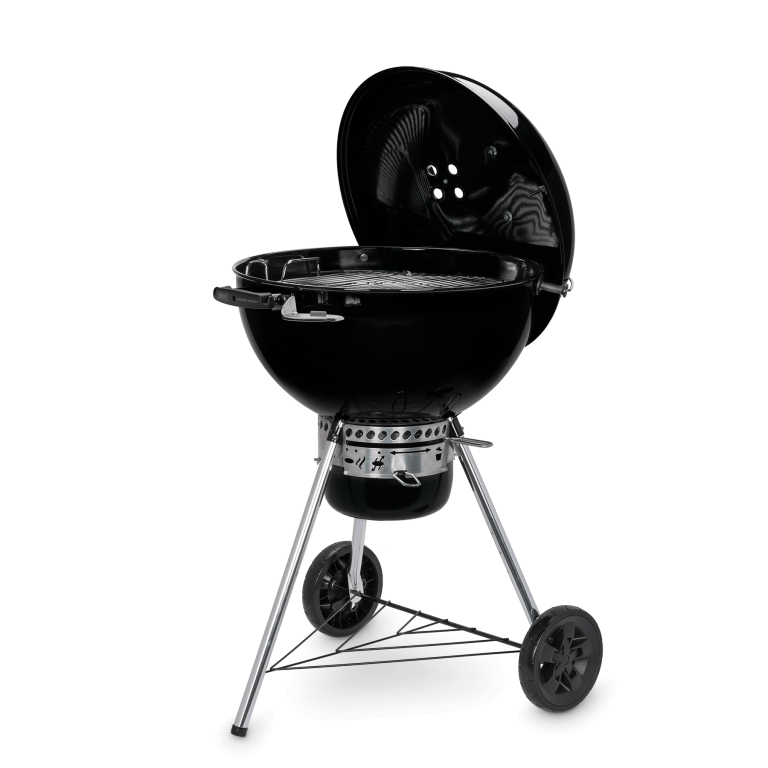
What you get in the box for the £200 to £260 RRP is the 57cm porcelain-enamel kettle bowl and lid, the One-Touch cleaning vent system, the ash catcher, the Tuck-Away lid holder, two side handles, two plated-steel cooking grates (one full circle, one hinged for fuel access), and the assembly hardware. The premium variants add a Gourmet BBQ System (GBS) hinged grate with a removable centre insert for the optional pizza stone, sear grate, wok, or rotisserie skewer (Weber’s modular accessory system). Assembly is a thirty-minute job for one person, no specialist tools beyond a Phillips screwdriver. Aesthetics: black is the default. Weber UK also offers Slate and Smoke Grey at some retailers if you’d rather the unit didn’t disappear into the garden.

First cook: don’t skip the burn-in. A full chimney of briquettes at high heat for thirty minutes, lid on, vents wide, before you cook food on the unit for the first time. The porcelain enamel is fine straight from the box but the assembly oils and packaging residue burn off cleaner with an empty unit than under your first batch of chicken thighs. One tainted cook is the lesson, and you only have to learn it once.

Temperature control and fuel performance

The Master-Touch’s temperature behaviour is best understood across four distinct regimes the kettle category puts you in: lighting, holding high, dropping low, and recovering from weather. The first three I can speak to from direct experience on my own Master-Touch; the long-cook fuel-economy claims at the low end are sourced from the named UK reviewers cited inline.

Lighting. A chimney starter with briquettes or lump charcoal takes the unit from cold to cook-ready in twelve to fifteen minutes. The same kettle without a chimney, lighting with firelighter cubes alone, takes about double that. The Master-Touch’s One-Touch bottom vent plus the ash catcher together make the post-cook clean-up genuinely fast, which is the part of charcoal cooking most cooks initially underestimate.

Vent control at the high end. Bottom vent and top vent both wide open is the configuration for direct grilling above 250°C. The whole airflow path is open, the chimney pulls strongly, and the coals burn hot and clean. Closing the top vent halfway shifts the cook from sear-fast to roast-medium without dropping the unit’s temperature below useful. That’s the discipline of the kettle: the bottom vent sets the air supply to the fire, the top vent steers what happens to the heat once it has done its work.

Vent control at the low end (sourced). Holding 110 to 130°C for low-and-slow on a Master-Touch is achievable with the Snake or Minion charcoal arrangement on a half-basket, with a realistic 4 to 6 hour single-fuel-load window before refuelling. The published UK reviews from Expert Reviews and Honest John cover this in detail and broadly agree on the figures; I link to them in the comparison section because they tested cooks I didn’t.

Running costs. Weber-branded briquettes are the unit’s intended fuel at around £20 to £25 per 8kg in 2026. Lump charcoal works fine but burns roughly 30 to 40% faster on the kettle’s open-air geometry, which makes the per-cook cost broadly similar even though the per-kg cost of supermarket briquettes is materially lower than lump. For the quick-direct duty cycle the Master-Touch suits best, you’re looking at around £2 to £3 of fuel per cook.

Build quality and what it’s like to live with

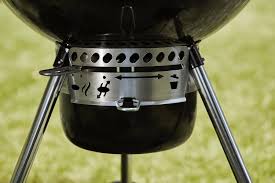
The porcelain-enamel finish ages slowly. The black darkens slightly over a season but doesn’t fade, chalk, or chip in normal use. The One-Touch cleaning system (three angled blades inside the bowl that sweep ash into the catcher when you rotate the bottom vent) is fiddly enough to feel engineered, effective enough that you actually use it. The hinged lid plus Tuck-Away holder is the refinement that justifies the price gap to the Original Kettle: hands-free lid management mid-cook is worth more than the £80 difference once you’ve cooked on a kettle without it.

The Master-Touch doesn’t have a gasket, and it isn’t trying to be a sealed unit. That matters for low-and-slow performance (kamado wins) and for fast temperature recovery after lifting the lid (kettle wins). The wear items I’d budget for over a decade of ownership are the ash sweeper blades (typically replaced after roughly five years of regular use) and the lid hinge pins (eight to ten years). Both are replaceable.

Weber UK covers the bowl and lid for 10 years, the One-Touch cleaning system and plastic parts for 5 years, and remaining parts for 2 years. The headline structural warranty matches the unit’s realistic lifespan: a Master-Touch from 2015 is still cooking in plenty of UK gardens, and one bought new today should last as long.

Smart-charcoal in 2026: Performer Smart + Kettle Smart Ring

A fortnight ago, the smart-charcoal conversation didn’t really apply to Weber kettle owners. Now it does, and the question is suddenly worth asking on its own terms.

I haven’t cooked on a Performer Smart, and I haven’t installed a Kettle Smart Ring on a kettle of my own. What follows is the buyer-decision logic I’d run if I were spending my own money in 2026, drawn from Weber UK’s published specs and the early independent first-look coverage from BBQ Mag, Tom’s Guide, and T3. Where a specific claim is sourced rather than tested, I name the source.

The Weber Performer Smart Charcoal Grill launched in UK spring 2026 at £579 for the base unit and £719 for the premium edition. The difference between the two is the side table and the propane ignition assist. What you actually get for the money is a Wi-Fi controller wired into an automated bottom vent: the unit reads its internal temperature, the app holds your target, the vent opens and closes itself to keep it there. That’s a meaningful change for charcoal cooking, because the temperature-management work that traditionally separates good kettle cooks from frustrated ones is what the controller now handles for you.

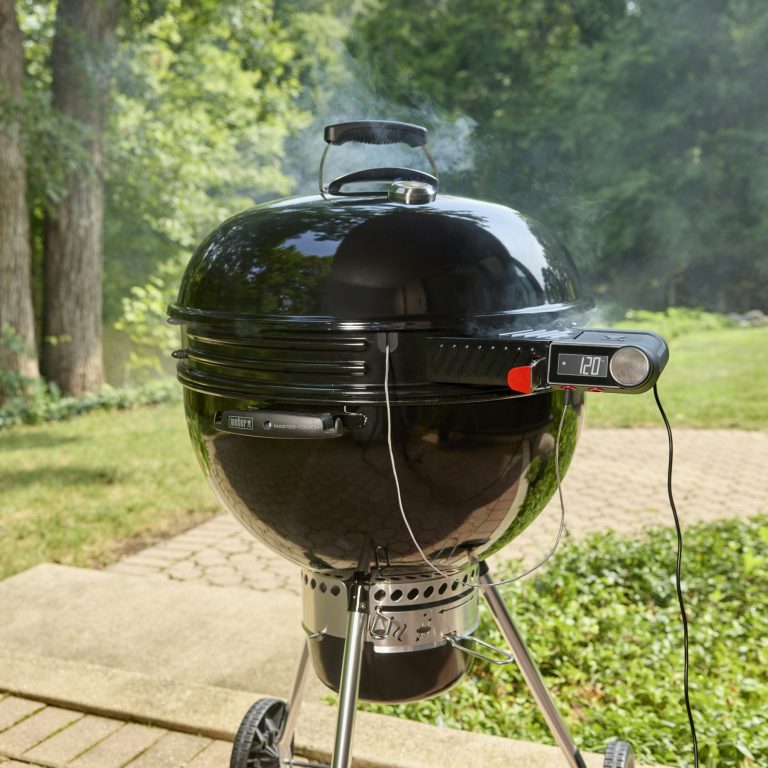
The Kettle Smart Ring is the more interesting product. Weber priced it as a £289 retrofit kit for any 57cm Weber kettle from roughly the last decade, including the Master-Touch GBS itself. Same controller, same automated vent, mounted onto a unit you may already own. The cost difference is real: £289 to upgrade your existing kettle, against £579 to £719 for a new Performer Smart that is essentially a Master-Touch with the controller built in.

That arithmetic creates three buyer-decision questions worth answering honestly.

If you don’t own a kettle yet and you’re choosing what to buy in 2026, the maths favours Master-Touch plus Smart Ring at total £490 to £550 over the Performer Smart at £579 to £719. You get the same controller, the same vent automation, on the same underlying kettle, for less money. The compromise is two separate purchases instead of one, and you are trusting a retrofit to do what an integrated unit does. From what I have read in the early UK first-looks, that compromise looks small.

If you already own a Master-Touch and you’re wondering whether £289 for the Smart Ring is worth it, the honest answer depends on how comfortable you are with vent management. If you have worked out the kettle and you read its temperature curve from muscle memory, £289 buys convenience rather than capability. If the analogue learning curve has frustrated you (burgers overcooked because you could not drop the temperature fast enough, an overnight brisket abandoned because the drift was too much to manage), the Smart Ring is the product that closes that gap. The break-even on whether to buy depends almost entirely on which of those two cooks you are.

If you are kamado-curious because you want temperature control without the learning curve, the Smart Ring changes the calculus less than the Performer Smart does. A kamado still wins on the long-cook job — the seal, the fuel efficiency, the unattended-overnight credibility — and the smart-charcoal kettle has not closed that gap. But on the everyday duty cycle of chicken, burgers, ribs, and the cooks 80% of UK kettle owners actually run, a Master-Touch with Smart Ring is a competitive answer for materially less money than a Kamado Joe Konnected Joe (£1,999 in the same UK market).

What I would want to do next, and what the next Tested-by-Ben piece on this might be, is borrow or buy a Smart Ring, retrofit it to a Master-Touch, and run a 12-hour overnight brisket on it. The interesting question is not whether the controller holds a temperature in the steady state — every published spec says it does — but whether the app-controlled vent recovers from the moments when an analogue kettle drifts: the wind shift at 2am, the fuel pile collapsing under its own weight at hour eight, the lid lifted to check the meat. Until someone runs that test in writing, the verdict on the Smart Ring is conditional on the spec sheet, not the cook log.

For most UK readers buying in 2026, the practical answer is Master-Touch GBS plus Kettle Smart Ring as the most cost-efficient route to smart-charcoal cooking. The verdict in Section 13 assumes that is the configuration most readers will land on, even if your first purchase is the kettle alone with the Smart Ring as a Year 2 upgrade.

Comparison with the obvious alternatives

The Master-Touch GBS doesn’t exist in a vacuum. Five units sit in its category-adjacent space in the UK in 2026, each making a different bet on what a charcoal buyer should value. I’ll take each one in turn, then summarise in a comparison table.

vs Weber Original Kettle 22-inch. The Original Kettle is the kettle the Master-Touch grew up from. It does the same fundamental job (direct charcoal grilling on a 57cm round grate) for around £80 to £100 less. What you give up at the lower price is the hinged lid, the Tuck-Away lid holder, the slightly more refined vent system, and the One-Touch ash sweeper that the Master-Touch ships with. If you cook on the kettle two or three times a year, the Original Kettle is the right call. If you cook two or three times a month, which is what the Master-Touch’s design assumes, the £80 to £100 buys you small daily-use improvements that add up over a decade of ownership.

vs Weber Performer Standard. The Performer Standard is the same Master-Touch kettle with a propane ignition system bolted underneath. You hold a button, the gas torch lights the charcoal, you put the kettle into normal cook mode after the coals catch. It typically costs £100 more than the Master-Touch. Worth it if you genuinely don’t want to bother with a chimney starter, which is a real preference for some cooks. Not worth it if you’re comfortable with a chimney: the chimney is faster than the propane ignition once the coals start moving, and the chimney never needs a gas cylinder.

vs Weber Performer Smart. Covered at length in Section 8. The short version: the Performer Smart is a Master-Touch with the Kettle Smart Ring built into the unit at the factory, for £579 to £719. Master-Touch plus a retrofitted Smart Ring lands at £490 to £550: the same hardware, less money, two purchases instead of one. The Performer Smart is the cleaner option if you want everything in the box and you don’t mind paying the integration premium.

vs Big Green Egg Large or any ceramic kamado. A different tool. A kamado’s ceramic body holds heat for 12-hour overnight cooks the kettle category can’t sustain, and the gasket seal turns the unit into a low-temperature smoking environment that a kettle approximates rather than replicates. The trade-off goes the other way too: the kamado is heavier, slower to come up to temperature, and harder to recover after the lid lifts. If your typical cook is a 25-minute weeknight grill, a kamado is the wrong tool. If your typical cook is a 12-hour low-and-slow, a Master-Touch is the wrong tool. For the cooks that fall in between, both work, and the choice comes down to which extreme you do more often. I cover the BGE Large in detail in my Big Green Egg Large review if low-and-slow is the cook you’re optimising for.

vs Aldi/Lidl supermarket kamados. The £244 to £249 supermarket kamados that landed in UK retail this spring are a different question again. They aren’t competing with the Master-Touch on cook type. They’re competing on whether £244 buys you something better than a £244 kettle would. I worked the five-year ownership maths on this question in detail in my Aldi vs Lidl vs BGE Large analysis. For the Master-Touch specifically, the relevant takeaway is this: if you want low-and-slow capability on a tight budget, the supermarket kamados beat the Master-Touch on that one job. If you want a flexible everyday unit that handles the cooks most UK households actually run, the Master-Touch beats the supermarket kamados on durability and accessory ecosystem.

Compared withStrengths of the Master-TouchWhere the alternative winsMy take
Weber Original KettleHinged lid, Tuck-Away, refined vents, One-Touch ash sweeper£80–£100 cheaper for the casual cookMaster-Touch if you cook monthly; Original Kettle if you cook a few times a year
Weber Performer StandardSame kettle, no propane cylinder dependency, cheaperPropane ignition for chimney-averse cooksStick with the chimney; the Standard isn’t worth the £100 premium for most
Weber Performer Smart£490–£550 with Smart Ring retrofit beats £579–£719 integratedSingle purchase, factory-integrated, side tableMaster-Touch + Smart Ring on cost; Performer Smart on convenience
BGE Large / ceramic kamadoQuick-direct grilling, lighter, faster to temperature, cheaper12-hour cooks, low-temperature smoking, fuel efficiencyDifferent tools for different cooks; own one of each if you cook both extremes
Aldi/Lidl supermarket kamadosDurability, accessory ecosystem, brand support£244–£249 entry price, low-and-slow capability built inMaster-Touch for flexible everyday use; supermarket kamados for budget low-and-slow

UK retailer routing

Two routes to buy a Master-Touch in the UK in 2026 cover most readers. The first is Weber UK direct via their product page. The manufacturer route gives you the cleanest warranty registration, although Weber UK doesn’t run an affiliate programme so Smoke and Lump earns no commission on the click. The second is BBQ World, the UK BBQ specialist that consistently stocks the full Master-Touch line including the Slate and Smoke Grey colours; Smoke and Lump’s affiliate relationship with BBQ World pays commission on confirmed purchases.

Beyond Weber UK and BBQ World, the Master-Touch is widely stocked at commodity retailers including Argos, John Lewis, and Robert Dyas. Prices fluctuate by season and bundle: a Black Friday or May bank-holiday weekend deal often shaves £30 to £50 off the year-round RRP. The difference between the best UK price and the worst for the same unit can be 15% within a typical month, so a Google Shopping price alert is worth the two-minute setup.

Secondhand units are worth considering. The Master-Touch is built durably enough that a six or eight-year-old unit in normal-use condition is still a sound buy at around 40 to 50% of new price. What to inspect: porcelain enamel for cracks (rare but disqualifying); the One-Touch cleaning blades for sweep travel (the most common wear point); the lid hinge pins for play (replaceable); and the ash catcher for warping (cosmetic, not structural).

Accessories: what you actually need vs what Weber sells

At order time, three items earn their place beyond the unit itself. A chimney starter (£20 to £30) does work no other tool replaces. An instant-read thermometer (£40 to £75) is what the lid-mounted thermometer fails to do accurately; you’ll use it on every cook. A pair of long-cuff heat gloves (£20) for handling the chimney and the grate.

Within the first year, an ash tool, a charcoal basket for two-zone indirect cooks, and the GBS sear grate (if it didn’t come with the unit you bought) are worth adding. Weber’s branded versions cost roughly 30% more than the generic equivalent; the generic does the same job.

What I’d wait on: the Smart Ring (Section 8 covers the timing case) and the Weber pizza stone (unbranded round stones at £40 to £60 work as well at half the price). What I’d skip entirely: any “BBQ tool set” with seven-plus pieces sold in a single box. You need a long spatula, long tongs, and a probe. The other items are filler. On the probe specifically, a Meater Plus (£99) or Inkbird IBT-4XS (£40 to £60) covers most needs; I’ll cover the comparison in a future piece.

What I’d do differently if I were buying today

If I were buying a Master-Touch today, I’d buy the same 57cm GBS variant. The smaller 47cm Master-Touch is a real compromise for any cook beyond a couple: too tight on grate area to handle a roasting chicken plus sides, and the spare lump charcoal you’d save doesn’t make up for the cooks the smaller kettle can’t accommodate. Same generation, too: the current E-5750 is essentially the unit I owned, with the same durability profile and the same warranty pipeline.

The Smart Ring decision is the genuinely interesting one. Buying the Master-Touch on day one and the £289 Smart Ring six to twelve months later is what I’d do, for two reasons. The first is the obvious financial spread of a one-off cost into two purchases. The second is harder to argue without sounding patronising: the analogue Master-Touch is a teacher. Working out how the bottom vent and the top vent interact, and learning to read the temperature gradient across the grate, is a skill the Smart Ring partly removes from the cook. There’s value in earning the kettle’s temperature management before you hand it off to a controller. If the controller never feels worth the £289 to you, that’s an honest answer too.

The mistake I’d warn first-time kettle owners against is running it like a kamado. The Master-Touch wants frequent fuel cycles, more attention than a sealed ceramic, and a mental model that accepts a 4 to 6 hour cook as the realistic ceiling on a single charcoal load. If you find yourself doing the all-night brisket cook anyway, it isn’t a unit problem. It’s a tool-mismatch problem, and the answer is a kamado, not a louder kettle.

If I could push Weber to improve one thing on the current generation, it would be the lid-mounted thermometer’s accuracy: the published sources I trust all flag it as the unit’s weakest spec, and a £15 instant-read probe is what most owners end up buying to work around it. A factory thermometer that read true would shave £15 off the real out-the-box cost.

Final verdict and rating

The Master-Touch GBS 57cm is the kettle the considered first-time charcoal cook should buy in 2026, and the £289 Kettle Smart Ring is what makes that statement stronger than it was six months ago. At £200 to £260 for the unit and an optional £289 Smart Ring on top, the Master-Touch has the build quality of Weber’s century of kettle iteration, the warranty Weber UK puts behind it, and the most useful upgrade path the kettle category has seen in a decade. The case against owning one is straightforward: if your typical cook is a 12-hour overnight low-and-slow, a kamado is the better tool. For every other cook the kettle handles, the Master-Touch is the right unit at the right price.

Overall: 8.5/10.

  • Build quality: 9/10. Porcelain enamel finish, sound vent geometry, 10-year warranty on bowl and lid.
  • Temperature control: 7/10 on the analogue Master-Touch; 9/10 with the £289 Smart Ring retrofit closing the low-end gap.
  • Cooking versatility: 7/10. Excellent for quick-direct and indirect cooks up to about six hours; a kamado wins beyond that.
  • Value for money: 9/10. £200 to £260 buys a unit that should last a decade with the warranty backing it.
  • Smart-charcoal upgrade story: 9/10. The £289 Smart Ring is the cheapest legitimate route to controller-managed charcoal cooking in the UK in 2026.
  • UK retailer support: 9/10. Weber UK has the retailer network, the parts pipeline, and the warranty service the category needs.

Who should buy it. First-time charcoal cooks leaving gas behind. Considered upgraders who want quality at sensible money. Households cooking two to four times a month who want one unit that does most of what a back-garden cook needs. If that’s you, the Master-Touch is the right answer at this price point, and the Smart Ring is the upgrade worth thinking about as a Year 2 purchase if temperature management is something you’d rather hand off than learn.

Disclosure provenance

This is a Tested-leaning review, not a full Tested-by-Ben review. The honest boundary:

  • Direct experience: I owned a Weber Master-Touch GBS a few years ago and cooked on it regularly: chicken thighs and wings, sausages, burgers, koftas. Quick-direct cooks on a 57cm kettle. That’s the cook range I can speak to from lived experience.
  • Sourced (not tested by me): Low-and-slow performance on the Master-Touch (Section 6), the Kettle Smart Ring at £289 (Section 8), the Performer Smart at £579 to £719 (Section 8), long-cook fuel-economy claims (Section 6), the Weber UK warranty terms (Section 7). Each section names the source and links where appropriate.
  • No current-unit photography: No photos from my Master-Touch ownership period survive. All imagery in this piece is Weber UK press material, credited inline.
  • No commercial relationship with Weber UK. I receive no consideration from Weber, no review unit, no Smart Ring loaner, and no editorial input from Weber UK or any retailer. Weber UK has not seen this review before publication.
  • Affiliate links: Where this review links to a UK retailer via a /go/ URL, that link is an affiliate route per the site-wide framework on the /disclosures/ page. The recommendations in this review are made on editorial grounds; the affiliate routing is set after the recommendation is locked, not before.

Frequently asked questions

Is the Weber Master-Touch worth it in 2026?

Yes, for the first-time charcoal cook who’s leaving gas behind and cooks two to four times a month. The £200 to £260 RRP buys you genuine 10-year build quality and Weber’s full UK warranty and retailer network. If you cook less often, the entry-level Original Kettle is the more honest recommendation; if you cook differently (long low-and-slow), a kamado is the better tool.

Master-Touch vs Performer Smart, which should I buy?

For total cost, Master-Touch plus Kettle Smart Ring (£490 to £550 together) beats Performer Smart (£579 to £719) for the same hardware. For convenience, the Performer Smart is one purchase instead of two and has a factory-built side table. If you want the controller-managed temperature now, both work; if you want to spread the cost, buy the Master-Touch first and add the Smart Ring later.

Is the £289 Kettle Smart Ring worth it for an existing Master-Touch owner?

If the analogue learning curve has frustrated you (overcooked burgers because you couldn’t drop the temperature fast enough, an overnight cook abandoned because of temperature drift), then yes. If you’ve already worked out how to read the kettle and you cook by muscle memory, the Smart Ring is convenience rather than capability, and £289 is a lot of money for convenience.

Can the Master-Touch do low-and-slow like a kamado?

To a point. A 4 to 6 hour cook holding 110 to 130°C on a half-basket Snake or Minion arrangement is realistic on a single fuel load. Beyond that, the kettle’s gasket-less design and smaller fuel capacity mean refuelling and temperature variability that a kamado avoids by design. For a 12-hour overnight brisket, a kamado is the better tool; for a 5-hour rack of ribs, the Master-Touch handles fine.

Briquettes or lump on a Master-Touch?

Briquettes for predictable temperature and the longer single-load burn; lump for cleaner flavour and faster lighting. Weber’s intended fuel is briquettes, and most owners default to them for the consistency advantage. Lump works fine but burns roughly 30 to 40% faster on the kettle’s open-air geometry.

What size Master-Touch should I buy?

The 57cm GBS, in almost every case. The 47cm Master-Touch is a real compromise for any cook beyond a couple. It’s too tight on grate area to handle a roasting chicken plus sides, and the per-unit saving doesn’t make up for the cooks the smaller unit can’t accommodate.