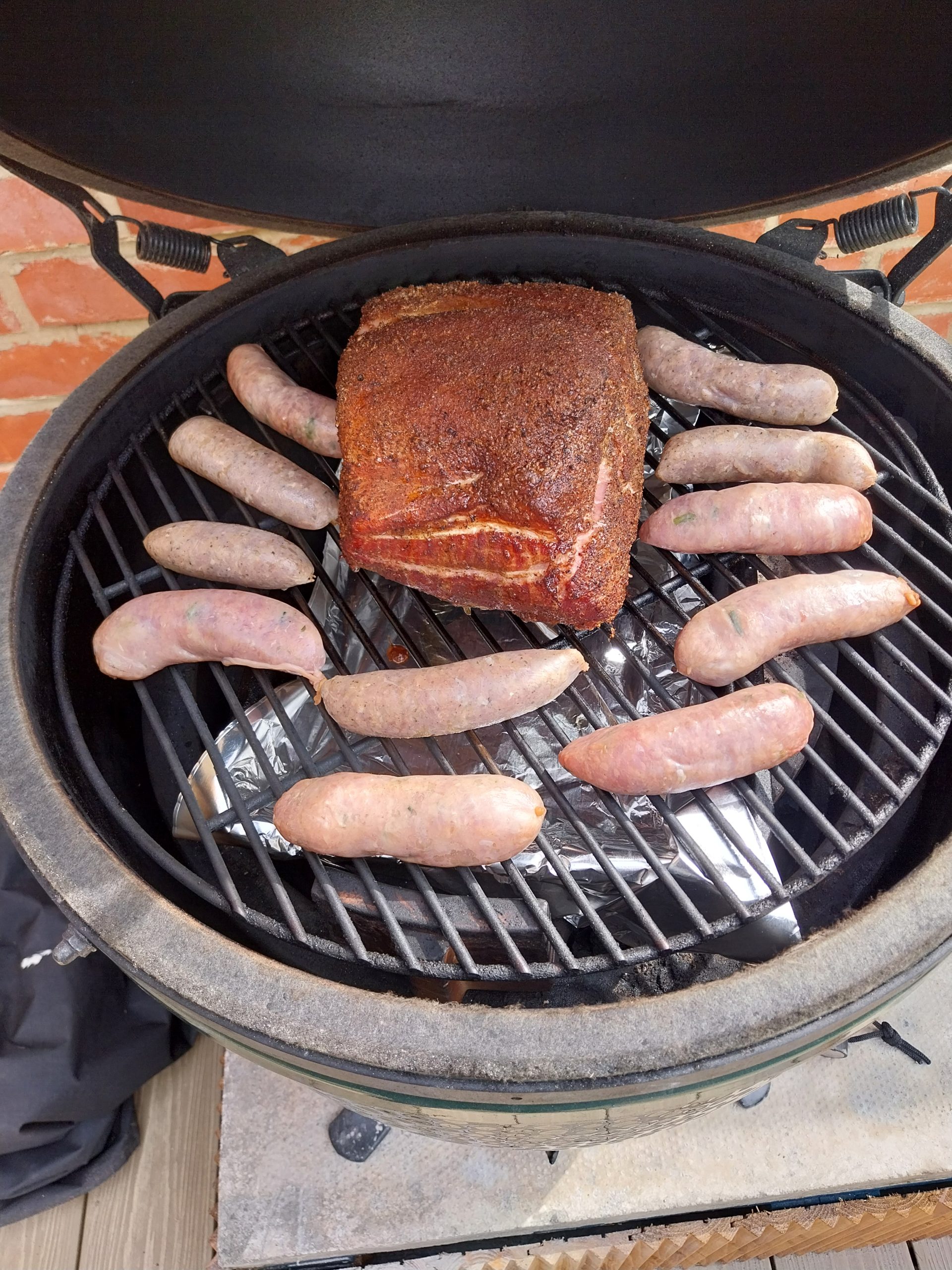
Smoked sausages on the back of the pork loin cook
Published 12 June 2026 · Tested by Ben Austen · Affiliate disclosure
The smoked sausages went on the back of another cook. I’d had the kamado holding 140°C indirect for two and a half hours on the bone-in pork loin cook — Sunday’s multi-protein spread — and two oak chunks were still smouldering under the grid with hours of life left in them. So I put twenty-four sausages on the main grid alongside the pork: six wild boar, six traditional English, twelve Heck 100% Pork. Lid down, parallel to the bars, no fresh wood added.
Twenty-four sausages for a table of five — two adults and three kids — is deliberate overstock. The pattern in this house is one big barbecue at the weekend, then cold-cut leftovers and sliced sausage in pasta, on toast, in sandwiches through the working week. The Sunday cook does the heavy lifting; the weeknights ride on its back. Smoked sausages hold their texture in the fridge for three or four days without going dry, and the smoke gives the leftovers a different flavour profile from anything supermarket pre-cooked.
The cook itself is simple — thirty minutes at 140°C dome, turned once, lid down throughout, finished by touch and visual (the temperature probe broke earlier in the pork cook, so the sausages never went on a probe at all). What I’d change on cook two is the one thing I didn’t do: blast them over direct heat for the last two-to-three minutes to get the maillard char that smoke-only doesn’t give you. The smoke earned the flavour and kept the skin intact; a direct finish would have earned the colour and the snap. Next time, that’s the version.
Key takeaways
- Smoke-only on the back of an indirect cook gets you a second protein for free. If the kamado’s already at 140°C for something bigger, sausages on the grid alongside cost no extra fuel and no extra fire-management. The same pattern runs on a kettle two-zone, a pellet smoker, or a gas grill with the burners on one side.
- Don’t prick sausages. Pricked sausages drip their juice into the fire. The skin’s job is to hold the cook moisture in until the bite. Pricking is a myth that’s earned its retirement.
- 30 minutes at 140°C indirect, turned once, lid down throughout — gentle smoke penetration, skin intact, juice held. Slightly too long in hindsight; 25 minutes would be closer on cook two, with the smaller sausages pulled first.
- The honest miss: no direct char. Smoke-only sausages come off pale. The reverse-sear-finish on cook two — smoked indirect, then 2-3 minutes direct over the lit lump at the end — is the version I’d run for the colour and the snap the smoke-only method doesn’t earn.
- Texture is method-sensitive, not just product-sensitive. The Heck 100% Pork had firmer texture than the Sedum Butchers wild boar and English on this cook — but the smoke-only method softens any sausage skin, and the butcher’s product would likely come into its own with the direct finish. Recommendation stays Sedum; the cook needs to match the product.
At a glance
| Prep time | 10 minutes (out of fridge to temper) |
| Cook time | 30 minutes |
| Total time | 40 minutes |
| Servings | 24 sausages (2 adults + 3 kids with leftovers for the week) |
| Cooking method | Indirect smoking |
| Temperature | 140°C dome |
| Difficulty | Easy |
| Equipment | Any BBQ holding 140°C indirect, lid closed (kamado, kettle two-zone, pellet smoker, gas with side burner off) |
| Smoke wood | Two oak chunks (or residual from a prior cook on the same fire) |
What you’ll need
Equipment
- A barbecue capable of running indirect at 140°C with the lid closed. I cook this on my Big Green Egg Large; any kamado, two-zone charcoal kettle, or pellet smoker that holds 140°C dome with the lid down will work the same way. Direct heat from below is not what this cook wants — indirect, lid closed, smoke doing the work.
- A ceramic deflector or heat shield. The BGE’s ConvEGGtor on the kamado; on a kettle, the lit charcoal banked to one side and the sausages on the cool side.
- Tongs. No temperature probe required for this cook (the probe broke during the pork loin earlier in the day; turned out the sausages don’t need one anyway — touch and visual are enough at 140°C indirect).
- Two oak chunks for smoke. Apple, cherry, or beech all work as alternatives. Avoid anything resinous.
Ingredients
- 6 wild boar sausages (Sedum Butchers, Chessington Garden Centre)
- 6 traditional English pork sausages (Sedum Butchers, Chessington Garden Centre)
- 12 Heck 100% Pork sausages (Sainsbury’s)
- Good-quality lump charcoal (I use Fuel Express Restaurant Grade)
- Two oak chunks for smoke
The cook
1. Temper
10 minutes out of the fridge before the sausages go on. Fridge-cold sausages will steam rather than cook; room temperature lets the skin set up properly under the heat.
2. Set up the kamado for indirect at 140°C dome
ConvEGGtor in, lump charcoal banked underneath, two oak chunks sat on top of the lit lump. If this is the back-of-an-indirect-cook pattern — sausages going on alongside a pork loin or any 140°C cook already running — you don’t need fresh wood. The residual smoke from the earlier cook is plenty.
3. Lay the sausages parallel to the bars on the main grid
Lid down. Parallel rather than across, so the bar marks run the length of the sausage and you can flip the row in a single motion later.
4. 30 minutes at 140°C, turned once at halfway
Smoke-only at this temperature, the cook’s gentle and forgiving. One flip evens the skin colour. Lid down between the turn and the finish — the smoke does its work in the closed dome.
5. The smaller sausages come off first
Sedum’s wild boar and English are slightly narrower in diameter than the Heck. They’ll feel done by hand a few minutes before the Heck do — firm to the touch (not soft, not bouncing-firm), skin set without bursting. Pull them when they get there; the Heck can stay on a few minutes longer.
6. Skip the direct char on cook one — plan it for cook two
I didn’t do this step on the 7 June cook. What I’d run on cook two: pull the ConvEGGtor at the 25-minute mark, open the vents to wake the fire up, and blast direct heat from below for the last two-to-three minutes. The smoke gives the flavour; the direct char gives the maillard browning the smoke-only cook doesn’t earn. Apply with judgement on cook two — I haven’t run the reverse-sear-finish yet, so it’s the next-cook hypothesis rather than tested method.
7. Plate and serve
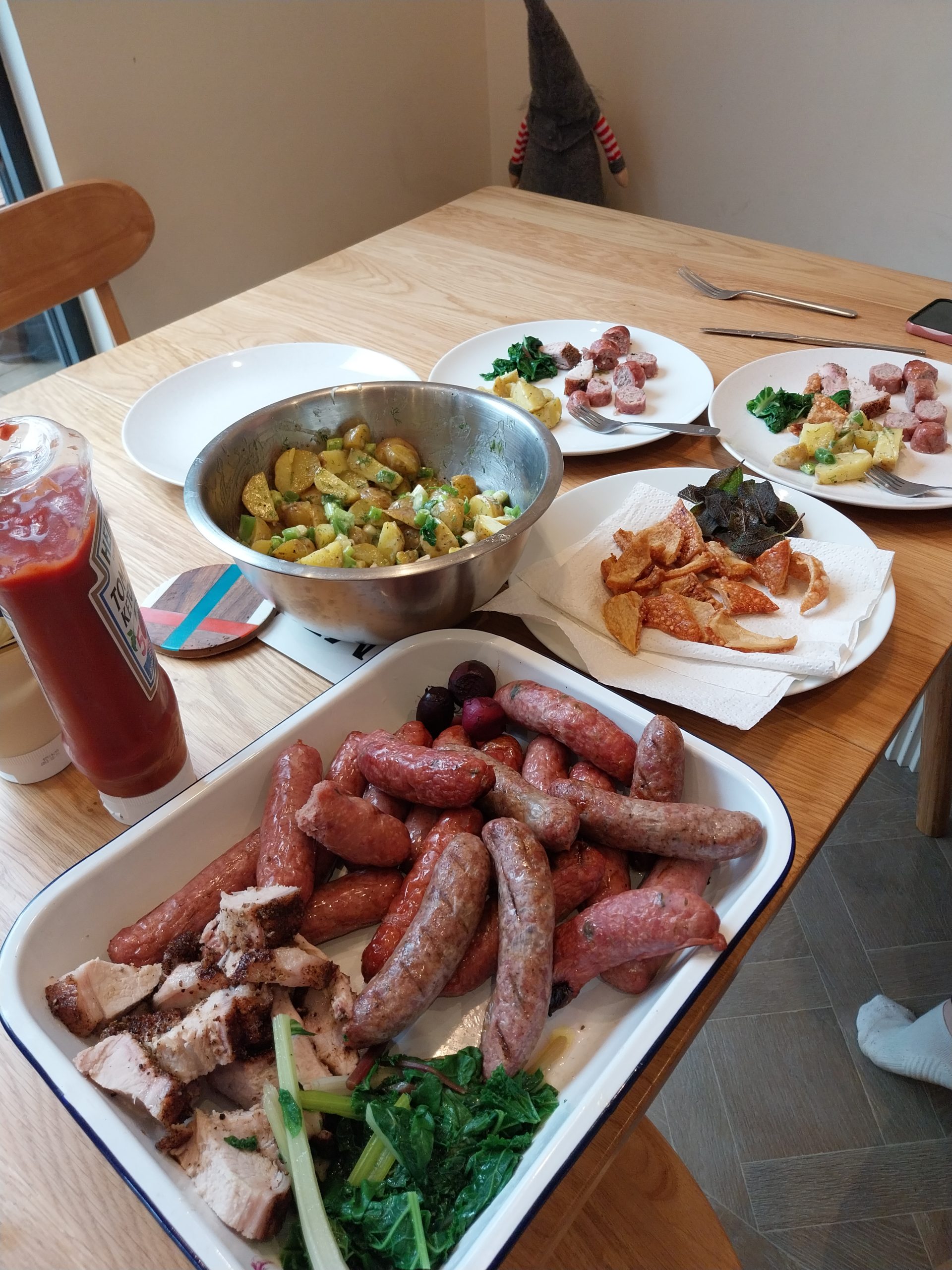
No rest required. Sausages out of the smoker go straight to the board or the plate. English mustard on the table — Colman’s, hot, the only condiment they actually needed.
What to serve it with
On the 7 June cook the sausages were plated as part of a multi-protein Sunday spread alongside the bone-in pork loin, rainbow chard, kale, and sage. English mustard on the table covered it — anything sweeter (chutney, brown sauce) would have flattened the smoke; anything mayo-based would have softened the skin texture the indirect cook had earned. Mustard cuts both fats and balances the smoke without competing.
For drinks: we drank Chocolate Block — Boekenhoutskloof’s South African Cape blend, a generous fruit-forward red with a peppery finish that doesn’t get steamrollered by smoke. Beer works as you’d expect (a Belgian witbier or a hopped lager both clean cut the fat), but red wine isn’t the wrong call with smoked sausages despite the pairing convention. The Chocolate Block in particular ran well alongside the sausages and the pork loin from the same fire.
What I learned
Three things came out of the 7 June cook worth naming as findings rather than facts.
1. Pricking is a myth — and now it’s tested. The Heck and Sedum sausages went on unpricked, untouched. None burst, none split, none leaked. Every one came off the grid intact with the juice held inside. Pricking sausages before they go on heat is the most repeated bad advice in barbecue, and it’s wrong: the skin’s job is to keep the cook moisture in, not to vent steam. Vented sausages dry out faster, fat drips into the fire and flares, and the texture suffers.
2. The smoke-only cook is pale. Indirect at 140°C earns flavour from the wood and keeps the skin texture honest, but it doesn’t earn colour. Where a direct-grilled sausage gets the maillard browning that signals “cooked” to the eye, the smoke-only sausage comes off looking gently bronzed at best. The cook reads as restrained on the plate. The fix is the reverse-sear-finish on cook two — smoke the flavour in indirect, then blast the colour on direct for the last two-to-three minutes. I didn’t do that on cook one and the absence showed.
3. Heck beat Sedum on mouthfeel — but the method didn’t do Sedum justice. The Heck 100% Pork from Sainsbury’s had firmer texture and a noticeably better bite than the Sedum Butchers wild boar and traditional English. That’s a finding I didn’t expect — the working assumption was butcher-counter wins on quality, and the cook proved otherwise. But the method was the variable: smoke-only without a direct finish softens any sausage skin, and softer sausages from Sedum suffered the comparison more visibly than firmer ones from Heck. The lesson is that texture is method-sensitive, not just product-sensitive. On cook two with the reverse-sear-finish, I’d expect the comparison to swing back toward Sedum — and even if it doesn’t, the Sedum sausages are worth cooking properly. Recommendation stays Sedum Butchers; the cook needs to match the product.
Variations
On a kettle two-zone setup. Lump banked to one side, sausages on the cool side, vents nudged to hold 140°C dome. Same 30 minutes, same one flip, same lid-closed discipline. Add the wood chunks on the hot side rather than under a deflector.
On a pellet smoker. Set to 140°C, load with oak or fruit pellets, same time. Pellet smokers earn the cook with less fuss than charcoal; the trade-off is less control of smoke intensity.
On a gas grill. Burners on one side at low, sausages on the unlit side, smoke box with oak chips on the lit burner. Holds 140°C cleanly. The gas option doesn’t get the depth of smoke that hardwood lump gives, but the cook works.
Different sausages. Any high-meat-content sausage at 80–90 mm length runs on the same method. Avoid pre-cooked breakfast-style sausages — they’re designed for direct heat and the smoke-only cook will leave them flat. Merguez, Italian, Polish-style smoked sausages all run on the same time and temp; adjust the condiments to match.
No pork. Heck does a chicken sausage variant; the method’s the same at the same temperature.
Related
- Bone-in pork loin on a kamado — the primary cook these sausages rode on the back of
- Big Green Egg Large review — the kamado I run this on, 9/10 verdict after 20 cooks across 5 months
FAQ
Do I need a kamado to smoke sausages?
No — any barbecue holding 140°C indirect with the lid closed runs this cook. A charcoal kettle with lump banked to one side, a pellet smoker at the same temperature, or a gas grill with one burner off and a smoke box all work. The fire setup matters more than the brand of grill.
Should I prick sausages before smoking?
No. Pricking sausages is the most repeated bad advice in barbecue. The skin holds the cook moisture in — vent it and the juice drips into the fire, the meat dries, and the texture suffers. None of the 24 sausages on this 30-minute smoke burst, split, or leaked. Save yourself the step and put them on whole.
How long do smoked sausages take at 140°C?
30 minutes is the working number for standard-diameter sausages — 25 is the next-time correction I’d apply, slightly safer side. Smaller-diameter sausages come off a few minutes earlier than larger ones, so check by feel rather than by clock once you’re past 20 minutes. A temperature probe is not strictly required at this temperature; touch and visual are reliable.
Can I just smoke them without finishing direct?
Yes — that’s what cook one was. The result is gentle, smoky, skin-intact, but visually pale. If you want the colour and the snap of a grilled sausage, plan the reverse-sear-finish: 25 minutes indirect, then 2-3 minutes direct over the lit lump at the end. Smoke gives the flavour; the direct finish gives the colour.
What wood should I use?
Two oak chunks ran the 7 June cook — clean smoke that doesn’t dominate the pork. Apple, cherry, and beech all work for a fruitier note. Avoid resinous woods (pine, cedar) for any meat smoke. If the kamado’s already running indirect for a longer cook, you don’t need fresh wood for the sausages.
What goes with smoked sausages on the plate?
English mustard on the table covered it on cook one — Colman’s, hot, no other condiment needed. The Chocolate Block (Boekenhoutskloof’s Cape blend) is a generous red that holds its own alongside smoke; a Belgian witbier or hopped lager works equally well. Avoid anything sweet — chutney and brown sauce both flatten the smoke without earning the trade.
Provenance and disclosure
This recipe is sourced from a single cook on my own Big Green Egg Large — Sunday 7 June 2026, on the back of the bone-in pork loin cook running indirect at 140°C with two oak chunks for smoke. The sausages went on alongside the pork loin and came off after 30 minutes — smoke-only, no direct finish on the day. The reverse-sear-finish improvement is what I’d cook into the method on cook two and isn’t yet tested on this site.
The butcher’s sausages came from Sedum Butchers at Chessington Garden Centre — a high-street butcher counter inside the garden centre, no online ordering. I bought six wild boar and six traditional English pork over the counter at the standard rate. Sedum Butchers is a customer-recommendation reference, not a commercial relationship: Smoke and Lump has no affiliate, advertising, or referral arrangement with Sedum Butchers or with Chessington Garden Centre, and I paid the standard counter rate for what I bought.
The Heck 100% Pork sausages were bought from Sainsbury’s at the standard retail rate. Heck is named here as the supermarket product I actually cooked, not as a recommendation or comparison endorsement. No commercial relationship with Heck or Sainsbury’s.
When the second cook happens this piece gets updated with the new findings — particularly the reverse-sear-finish method and whether the direct char changes the texture comparison.
Sourced from the 7 June 2026 cook log — the multi-protein Sunday spread (bone-in pork loin + 24 smoked sausages from Sedum Butchers and Heck) on the BGE Large at 140°C indirect, served to a table of two adults and three kids.