Whole rainbow trout on a kamado — caught with my son on Friday, cooked on Sunday
Published 11 June 2026 · Last updated 11 June 2026 · Tested by Ben Austen · Affiliate disclosure
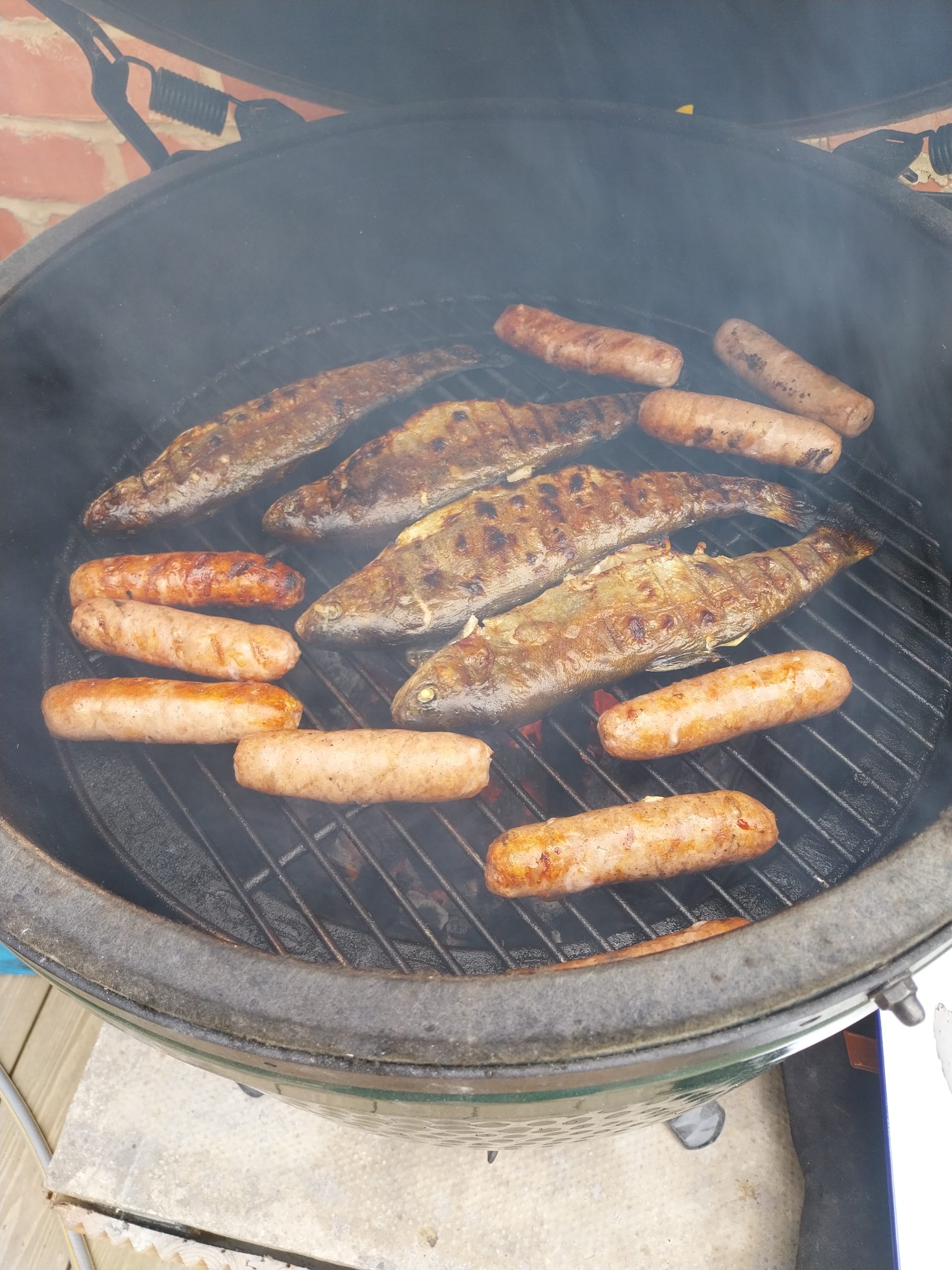
I took my son to Tillingbourne Farm in Surrey on Friday afternoon. Sweetcorn on a barbless hook, four trout in the bucket inside an hour, gutted and cleaned at the kitchen sink that evening with him watching, then frozen overnight and defrosted in the fridge on the Saturday ready for Sunday’s cook. The kamado was already running direct at 200°C after the bone-in pork loin had come off — same fire that did the indirect cook earlier in the day, plate setter pulled off, lump still hot. Four trout went on alongside the lamb rump, six minutes each side, off the grate twelve minutes later, plated up with the rest of the Sunday spread. Friday’s catch on Sunday’s plate. That’s the recipe.
Key takeaways
- Catch it, kill it, cook it, eat it. Stocked trout fisheries in the UK don’t require a rod licence or specialist gear — barbless hooks, sweetcorn for bait, a few hours on a Friday with whoever wants to come along. The cook is the easy part; the catch is the recipe.
- A 400g whole trout cooks in about 10 minutes direct on the BGE Large at 200°C dome with the ConvEGGtor pulled off. I ran mine 12 minutes (six a side) on the 31 May cook and the finish landed a touch dry. Next time: four to five minutes each side, total around nine to ten.
- Oil the skin, season the cavity, no brine, no marinade. Dill from the garden, half a lemon sliced into the cavity, salt and pepper, a rub of oil on the outside of the skin to stop it sticking. The fish carries the cook on freshness alone.
- The kamado does the same work as a hot grill pan, plus a hint of background smoke from whatever wood the kit was running for the earlier cook. I didn’t add any fresh smoke wood for the trout — the two oak chunks that ran the pork loin had burned down and left only a background note in the kit. Honest about what it is: direct-grilled trout, not smoked trout.
- Four whole trout will feed eight people as part of a wider spread. The lamb rump, the sliced pork, the smoky-mayo potato salad, the garden chard — the trout sits as a course on a multi-protein table rather than the centrepiece.
When to reach for whole trout on the kamado
| You should cook… | If you… |
|---|---|
| Whole trout on the kamado (this recipe) | Have whole trout to use (caught, bought from a fishmonger, or supermarket whole fish), want a 10-minute cook on a fire that’s already running, are feeding several people across a wider table |
| Trout fillets on the kamado or kettle | Only have fillets — lay them skin-down on the grate at the same 200°C direct; the fillets cook through from the bottom and don’t need turning |
| Hot-smoked trout (kamado indirect with smoke wood) | Want the cured-pink flesh, oily-smoke flavour profile; have 60-90 minutes for a proper indirect cook; are building a starter or a salad component rather than a hot main |
| Trout in foil with butter and herbs | Want a more forgiving method that’s harder to overcook; happy without the crisp skin that the open grate gives |
At a glance
| Spec | Detail |
|---|---|
| Prep time | 5 minutes (stuff the cavity, oil the skin — assuming the fish has been gutted and cleaned the day of the catch) |
| Cook time | 9-10 minutes on the kamado (4-5 minutes each side) |
| Total time | ~15 minutes from prep to plate |
| Servings | 4 whole trout — feeds 4 as a main, or up to 8 as a course on a wider table |
| Method | Kamado, direct heat (ConvEGGtor removed) |
| Temperature | 200°C dome direct |
| Pull cue | Skin golden, eyes opaque white, flesh near the spine flakes when pressed at the thickest point |
| Rest | 2-3 minutes on a board while you carve off the grate |
| Difficulty | Easy |
| Equipment | Kamado, long tongs, kitchen scissors, board, cutlery knife |
| Cuisine | British |
What you’ll need
Equipment
- A barbecue capable of running direct at 200°C with the lid closed. I cook this on my Big Green Egg Large; any kamado, charcoal kettle, or pellet smoker that holds 200°C dome with the lid down will work the same way. Direct heat from below, dome heat from above — that’s all the cook needs. The kamado-as-shared-fire angle (direct after an indirect cook on the same lump) is specific to this method, but you can light a kettle or pellet smoker from cold and run the same ten minutes.
- Long tongs — for laying the fish onto the grate and lifting them off. A wide spatula or fish slice isn’t needed; the fish hold their shape well enough that tongs do the job, and the 5-6 minutes per side gives the skin time to crisp and release cleanly from the bars. No hand under the fish, no risk worth gloving against.
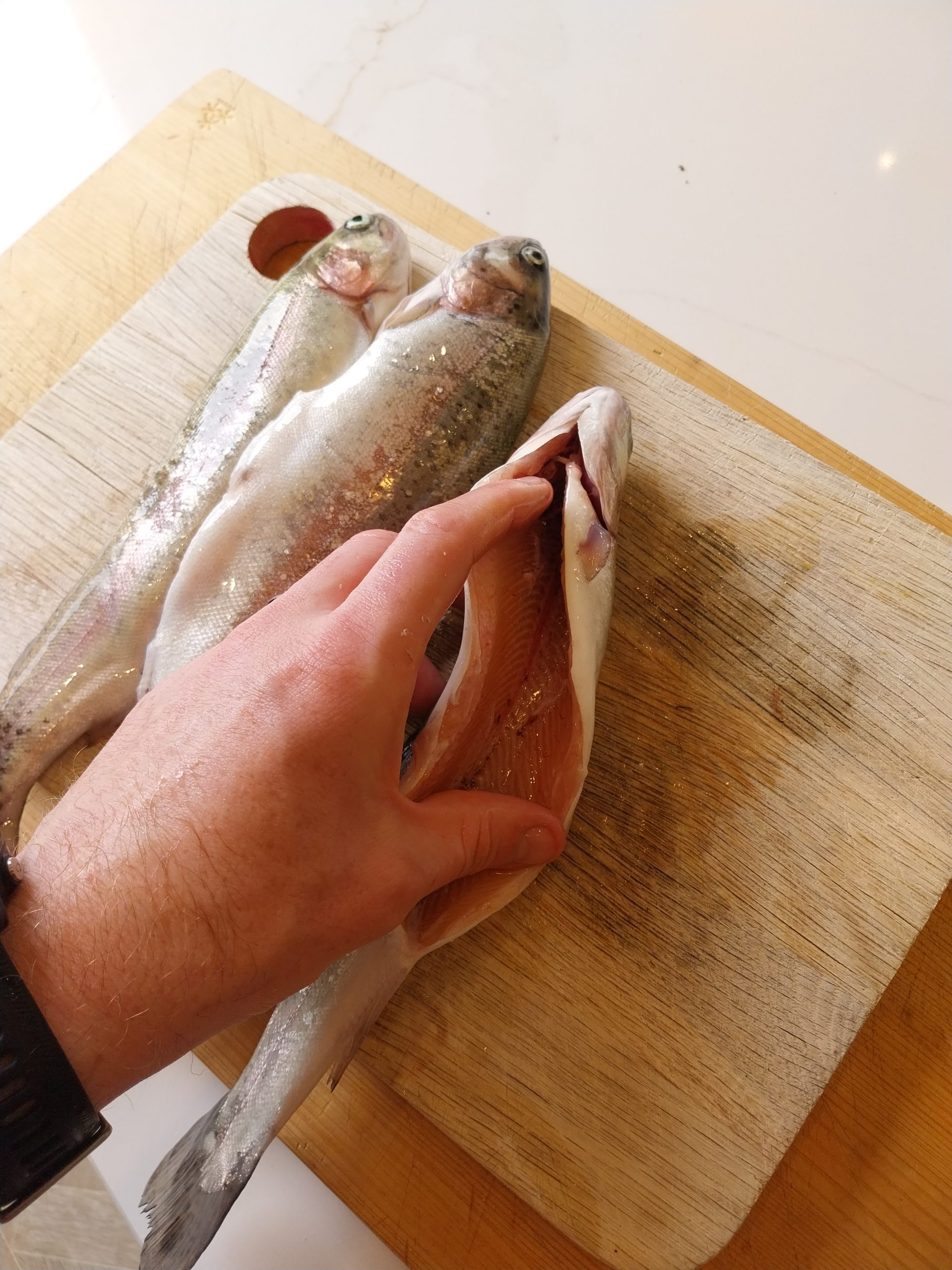
- Kitchen scissors — if you’re gutting and cleaning the fish yourself the day of the catch, scissors snip up the belly cleanly from the vent and let you pull the guts out in one go. Easier than a knife for that specific job. Optional for the cook day; the method below assumes the fish has already been gutted and cleaned.
- A board for the brief rest after the cook and for the carving away from the table.
- A normal cutlery knife for easing the fillets off the spine after the cook. A specialist fish knife isn’t needed — a standard table knife is enough.
Ingredients
For four whole trout serving four as a main or up to eight as a course on a wider table:
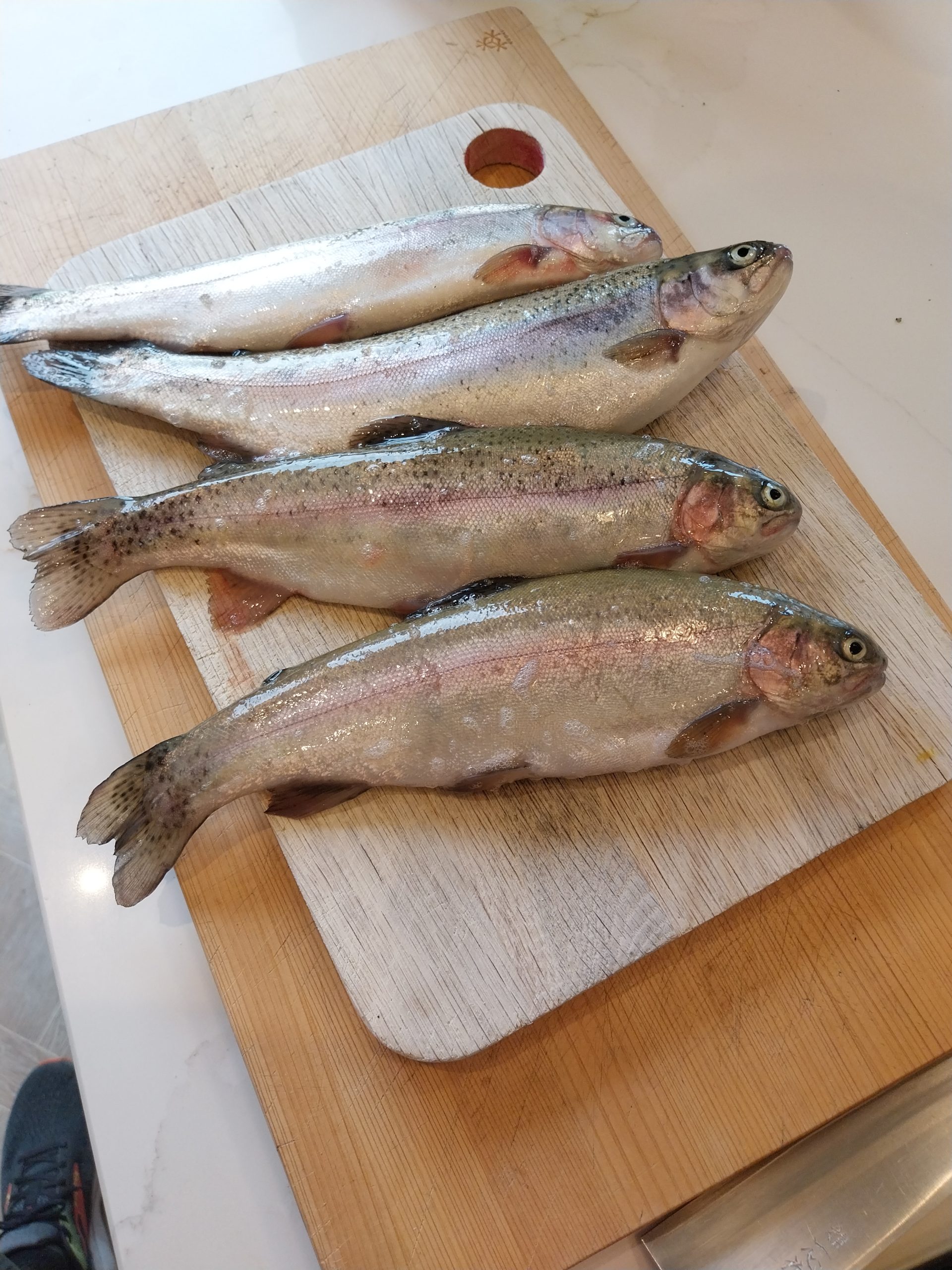
- 4 whole rainbow trout, around 300-400g each, gutted and cleaned. I caught mine at Tillingbourne Farm in Surrey on the Friday before the cook — a stocked trout fishery where you pay per fish caught, with barbless hooks and sweetcorn as the standard bait. Family-friendly enough that I took my son. Otherwise any UK supermarket (Sainsbury’s, Waitrose, M&S all stock them) or fishmonger sells whole trout — ask the counter to gut and clean them if you don’t want to do it yourself. If the catch-to-cook gap is more than a day, freeze the fish whole (gutted and cleaned) and defrost in the fridge the day before the cook.
- A small handful of fresh dill — straight from the garden if you have it, otherwise the supermarket pot will do. Roughly four sprigs per fish, torn or roughly chopped.
- 2 lemons — one sliced into rounds for the cavities (half a lemon’s worth of slices per fish), one cut into wedges for the table.
- Sea salt and freshly cracked black pepper — generous inside the cavity, lighter on the skin.
- 2-3 tablespoons of olive or rapeseed oil — for rubbing the skin just before the fish go on the grate. Cold-pressed rapeseed gives a slightly nuttier note than olive; either works.
That’s it — no brine, no overnight marinade, no fancy cure. Fresh fish doesn’t need any of that.
The cook method
1. Stuff the cavity
Pat each trout dry with kitchen paper inside and out — wet skin steams instead of crisping. Inside the cavity, lay two or three lemon slices, a small handful of dill, a generous pinch of sea salt and a few grinds of black pepper per fish. Close the cavity — no need to tie or skewer it, the fish holds its shape on the grate without help.
2. Oil the skin
Rub a thin film of oil over the outside of each fish — both sides, the dorsal fin line, the head and tail. The oil does two things: it stops the skin sticking to the grate, and it gives the skin somewhere to start crisping from the moment it hits the heat. Don’t drown the fish in oil; a glossy film is enough.
3. Confirm the kamado is at 200°C dome, direct
Pull the ConvEGGtor off the kamado if it’s still in from an earlier indirect cook. Drop the grid down to the standard cook position. Close the lid and let the dome settle at 200°C. If you’re starting cold rather than riding the back of an earlier cook — and a cook like the bone-in pork loin on a Sunday morning gives you a kamado that’s been running indirect for hours and is ready to switch to direct exactly when you want it — light the lump as usual and give the kamado 20 minutes to reach temperature with the lid closed. You want the grate hot enough that the trout’s oiled skin sears the moment it lands; that’s what stops it sticking.
4. Lay the trout on the grate
Open the lid, lay each fish on the grate with the long tongs. Space them so they’re not touching; air needs to circulate around each one. On a BGE Large you can comfortably fit four 400g fish, plus a small joint like the lamb rump alongside if the kit is doing double duty. Close the lid.
5. Four to five minutes each side, no peeking
Set a timer. The cook is fast and the temptation to lift the lid every minute is real — resist it. After four minutes (or five if your fish are at the larger end of 400g) open the lid, lift one fish at the head and tail with the tongs, and flip. The skin should release cleanly from the bars by now — if it sticks, give it another 30 seconds and try again. Close the lid; cook the second side for another four to five minutes.
6. Check for doneness — eyes, skin, spine
Three cues, in this order: the trout’s eye should be opaque white (not glassy clear); the skin should be golden bronze with darker char lines where the bars touched; the flesh near the spine, at the thickest part behind the head, should flake when pressed gently with a fork. If all three line up, the fish is done. If the eye is still clear, give it another minute; the eye is the slowest indicator to land.
7. Off the grate, brief rest
Lift each fish off the grate with the tongs (head and tail) and onto a board. Let the fish rest two to three minutes — long enough for the flesh to settle, not long enough for the skin to lose its crispness. Don’t tent under foil; the residual heat is plenty and foil softens the skin you just earned.
8. Carve away from the table, check for bones, plate
Carve off the kamado, away from the table — it’s fiddly enough that you don’t want a kid’s hand in the middle of it, especially with hot fish skin involved. On a board with a normal cutlery knife (no specialist fish knife needed), ease the top fillet off the spine from head to tail; lift the spine and tail off in one motion to reveal the bottom fillet. Check each fillet for stray bones before plating — the bones in farmed trout are small but worth catching, especially when serving to children. If the skeleton fights the knife, the fish was slightly undercooked — back onto the kamado for another two minutes and try again. Plate the bone-free fillets and bring them out to the table.
What to serve it with
The 31 May cook served the trout as part of a wider table: the bone-in pork loin sliced thin on a board, the lamb rump carved across the grain, smoky-mayo potato salad in a foil packet that had cooked indirect under the deflector during the pork phase, and rainbow chard plus kale from the garden, lightly wilted in the pan the trout had finished. Lemon wedges on the board for anyone who wanted them.
If the trout is the standalone main rather than part of a wider spread, I’d serve it with:
- Boiled new potatoes with butter, dill, and a squeeze of lemon — the same flavour profile as the cavity, doubled up.
- A simple green salad — watercress, lambs lettuce, a sharp vinaigrette.
- Bread to mop the juices — sourdough toasted on the kamado’s residual heat after the trout came off, rubbed with garlic.
Wine match: a crisp dry white. Picpoul de Pinet, Albariño, or English sparkling rosé all work; the wine has to handle the lemon-and-dill profile without bullying the trout’s mild flesh.
What I learned, and what I’d do differently next time
Two corrections from the 31 May cook, both small, neither stopping the fish from being good.
One: six minutes each side was too long. I was working off domestic-oven instincts and gave the trout twelve minutes total on a kamado that was sitting comfortably at 200°C dome. The cooked flesh was edible but a touch dry at the thinner end (the tail), and the skin had tipped past golden into too-dark in patches. Next time I’d pull at four to five minutes each side and check the spine-flake cue earlier. Whole farmed trout at 300-400g cook quickly; the catch-and-cook beats the method if your fish are at the larger end of the size range.
Two: I’d add a wood chunk earlier if I want a smoke note. The kamado had been running 2.5 hours with two oak chunks for the pork loin’s indirect cook, and by the time the trout went on those chunks had burned down. The residual smoke note in the kit was background only — not a “smoked trout” finish. Next time, if I want the trout to carry actual smoke, I’d add a small fruitwood chunk (apple, cherry — softer than oak for a delicate fish) to the lump just before the trout go on. Or I’d accept it as a clean direct-grilled fish and not pretend otherwise.
I’d take my son back to Tillingbourne the next weekend and run the same cook with the timing correction. The catch is the recipe; the cook is just what gets the fish from the bucket to the table.
Variations
On a Weber kettle or a charcoal kettle. The principle is the same — direct heat at 200°C over a half-and-half lump bed, fish on the cooler side first to get the cavity warming, then slide over the hotter side for the skin finish. A Weber Master-Touch GBS or any 57cm kettle does this comfortably. I haven’t tested the kettle pattern on whole trout specifically; I’ll update this section when I do.
On a gas grill. Two-zone setup — one burner on, one off — at the closest you can get to 200°C grate temperature (gas grills run hotter than they read; use an external thermometer on the grate). Cook over the cooler zone first, slide over the hot side for the final two minutes per side. You’ll lose the residual lump-smoke note entirely; consider a smoke box with a fruitwood chip to compensate.
In a domestic oven. 200°C fan, 12 minutes total on a foil-lined tray, no flipping needed. The skin won’t crisp the way it does on a kamado grate — too much heat on the top, not enough on the bottom. If you want skin-on, finish under the grill for the last two minutes. The oven works if you don’t have the kamado running.
With sea trout instead of rainbow. Same method, same timing, slightly oilier flesh that takes the smoke note better if you add a chunk. Sea trout is harder to come by in UK supermarkets — try a fishmonger or order from The Cornish Fishmonger or a similar online supplier. Don’t expect to catch a sea trout at a stocked freshwater fishery; sea trout is a wild-water river fish that needs a licence and a different approach.
With brown trout. Same method but smaller fish run quicker — pull at three to four minutes each side for a 250-300g brown trout. Brown trout has a more pronounced flavour than rainbow; the dill and lemon cavity remains the right move.
With larger trout (500g+). Add two minutes per side, but check the spine flake earlier — large fish vary more in how the heat reaches the deepest point. A 500g fish at 200°C dome direct is around six to seven minutes per side.
Related
- Bone-in pork loin on the BGE Large — the main protein that ran on the kamado earlier in the day; the indirect cook that set up the direct phase for the trout and the lamb
- Lamb rump on the BGE Large — the cut that shared the direct-grill grate with the trout on the same 31 May cook; same kit pattern (direct after indirect)
- Smoky-mayo potato salad on a kamado — the side that cooked indirect in a foil packet under the deflector during the pork phase, ready when the trout came off
- Big Green Egg Large — Tested by Ben review — the kamado all of these cooks happen on
- About Ben — who’s behind this
Frequently asked questions
Can I cook whole trout on a kamado?
Yes — direct heat at 200°C dome with the ConvEGGtor pulled off cooks a 400g whole trout in about 10 minutes total (four to five each side). The kamado does the same work as a hot grill pan plus, depending on what wood the kit was running earlier, a hint of background smoke. The advantage over a domestic oven is the skin crisping properly on the grate where direct heat from below meets the dome heat from above. The fish doesn’t need anything more elaborate than a stuffed cavity, an oiled skin, and the kit at temperature.
What size trout should I cook?
Whole farmed rainbow trout in the 300-400g size range is the sweet spot for the kamado — small enough to cook quickly, big enough to feed one person as a main or two as a course on a wider table. Larger fish (500g+) need an extra minute or two per side but follow the same pattern. Smaller fish (200g — common in supermarket multi-packs) cook in three to four minutes per side; check the eye and spine flake earlier.
Do I need to gut and clean the fish myself?
No — your fishmonger or supermarket counter will do it for you at the point of sale, and most stocked trout fisheries (like Tillingbourne in Surrey, where I caught mine) will gut and clean your catch for a small fee if you’d rather not do it yourself. If you do it at home, kitchen scissors and a spoon for scaling get the job done in about five minutes per fish. Do it the day of the catch, not the day of the cook.
Does the trout pick up smoke from the kamado?
Only a background hint if there’s been smoke wood on the lump earlier in the cook session. The cook this recipe is sourced from didn’t add fresh smoke wood for the trout — the two oak chunks that had run the pork loin’s 2.5-hour indirect cook had burned down by the time the fish went on. If you want a stronger smoke note, add a small chunk of fruitwood (apple or cherry — softer than oak for a delicate fish) to the lump before the trout go on. Or accept it as a clean direct-grilled fish.
Why a barbless hook?
Stocked trout fisheries use barbless hooks for two reasons: it makes catch-and-release humane on fish you’re not going to keep, and it makes the hook safer for kids handling fish at the bank. The barb on a normal hook is what makes a fish difficult to unhook — and difficult to remove safely from a child’s hand if the cast goes wrong. Tillingbourne, the Surrey fishery I took my son to, uses barbless throughout. If you’re going to a trout fishery to catch food (not catch-and-release), you can still use barbless — the fish are landed quickly enough that the barb isn’t doing the work of holding the fish on the line.
How long can I keep the cleaned fish before cooking?
If you’re cooking within 24 hours of the catch, the bottom shelf of the fridge between sheets of kitchen paper is fine. Beyond that, freeze the fish — fresh trout doesn’t keep well past a day, the flesh softens and the flavour dulls. I caught mine on the Friday for a Sunday cook, gutted and cleaned the same Friday evening, then froze them overnight and defrosted in the fridge on the Saturday ready for Sunday morning. The freeze-and-defrost approach is the honest move on any catch-to-cook gap longer than a day.
Provenance and disclosure
This recipe is sourced from a single cook on my own Big Green Egg Large — Sunday 31 May 2026, as part of a multi-protein Sunday spread that also included the bone-in pork loin (indirect, 2.5 hours, 140°C dome over two oak chunks) and the lamb rump (direct, 18 minutes, 220°C dome). The trout went on alongside the lamb rump after the pork loin had come off and the kamado had been switched from indirect to direct at 200°C.
The trout themselves came from Tillingbourne Farm in Surrey — a stocked rainbow trout fishery where I took my son on Friday 29 May 2026. Sweetcorn on a barbless hook, four fish in the bucket, gutted and cleaned at home that evening, then frozen overnight and defrosted in the fridge on the Saturday ready for the Sunday cook. Tillingbourne is a customer-recommendation reference, not a commercial relationship: I paid the standard per-fish rate for what I caught and have no other connection with the fishery. The same goes for the supermarket and fishmonger alternatives mentioned in the ingredients section — these are pointers to where you might get whole trout, not affiliate links.
The BGE Large was a Christmas 2025 gift from my sister, originally supplied to her by Big Green Egg as part of a paid content partnership that has since ended. I own the unit outright. Smoke and Lump has no commercial relationship with Big Green Egg, and no commission, payment, or other consideration was received in connection with this recipe. The full chain of supply and our standing affiliate-network disclosures are on the Disclosures page.
This is a one-cook recipe. The correction I’d make next time — pulling the fish at four to five minutes each side rather than six — would tighten the finish without changing anything else about the method. When the second cook happens this piece gets updated with the new findings.
Sourced from the 31 May 2026 cook log — the multi-protein Sunday cook on the BGE Large (bone-in pork loin indirect, lamb rump direct, four whole trout direct alongside, smoky-mayo potato salad in the foil packet under the deflector, garden chard and kale wilted in the trout pan).