Big Green Egg Large UK Review — Tested by Ben

Big Green Egg Large
Published 8 May 2026 · Last updated 8 May 2026 · Tested by Ben Austen · Affiliate disclosure
Disclosure: this BBQ was a gift; Smoke and Lump has no commercial relationship with Big Green Egg. Full chain of supply ↓
The short version
A verdict I didn’t expect to be writing: twenty cooks in, the Big Green Egg Large is actually value for money — and I’m as surprised as you are, even at £1,500. If you’ve outgrown a gas grill and you know it, and a Weber kettle can’t hold low-and-slow the way you want it to, this is the upgrade and you won’t regret it. If you’re new to BBQ and not yet sure it’ll stick, start smaller — a Weber kettle is the right unit for that stage; if you’re already weighing this against a Kamado Joe Classic III or a Monolith Classic, the Egg’s top of the established kamado market, but I haven’t cooked on those yet, so I can’t yet tell you it beats them — only that twenty cooks in, mine has delivered proper work.
Key takeaways
- At £1,495 the Big Green Egg Large is value for money — if you’ve outgrown a gas grill
- Build quality flawless after 20 cooks across five months
- Holds 110–130°C for 12-hour low-and-slow cooks on a single fuel load
- The felt-gasket horror stories haven’t matched my unit
- Lifetime warranty on the ceramic body to the original purchaser
- Verdict: 9/10
BGE Large at a glance
| Spec | Detail |
|---|---|
| Cooking area | 1,688 cm² (46 cm grid) |
| Maximum temperature | 400°C (sear-grade) |
| Build material | Ceramic body, stainless metalwork |
| Lid mechanism | Kamado-style hinged dome |
| Gasket | Felt (Nomex upgrade available, £20–30) |
| UK price | £1,495 (includes ConvEGGtor + Stainless Steel Grid + free 1-week delivery) |
| Warranty | Lifetime ceramic body to original purchaser; 1 year felt gasket; 5 years metal components |
| Where to buy | biggreenegg.co.uk (UK direct) |
Contents
- The short version
- Who this is for
- What I’ve done with it
- Sunday 3 May 2026 (the cook)
- Setup and first impressions
- Temperature control and fuel performance
- Build quality and the gasket truth
- Comparison with the obvious alternatives
- UK retailer routing
- Accessories
- What I’d do differently
- Disclosure
- Final verdict and rating
Who this is for, and who this isn’t
If you’ve cooked on a gas grill for years and you’re starting to want the cooks gas can’t do — long-and-slow brisket, proper smoke, American-BBQ flavour — this is where you go next. There’s a whole category of cooking gas can’t reach. This is how you reach it.
If you’re new to BBQ and not yet sure it’ll stick, you wouldn’t buy a £10,000 Tour de France bike before you’d ridden a hill. Get a Weber Master-Touch, learn what you love cooking outside, and come back to this in a year if you’re still hungry.
If you’re already weighing this against a Kamado Joe Classic III or a Monolith Classic, I haven’t cooked on either yet — so I can’t tell you the BGE beats them, only that twenty cooks in, mine earns its asking price. Cost might push you toward an alternative; that’s a fair call.
What I’ve done with it
As of 4 May 2026.
I’ve owned this Big Green Egg Large since Christmas 2025 — five months. The first cook was New Year’s Eve, eight people round; I’ve done at least one cook a week since. Approximately twenty cooks at the time of writing.
The mix has split deliberately between low-and-slow and direct-heat — to learn what the unit actually does, in both modes. Low-and-slow: pork belly, pork loin twice (including 3 May 2026), whole chicken on a vertical roaster (3 May 2026), boneless pulled pork shoulder three or four times, short ribs four or five times. Direct-heat without the deflector: chicken thighs, sausages, veg, burgers, koftas, hot dogs.
Short ribs have been the sustained low-and-slow project I keep coming back to. They’re the king of the low-and-slow castle if a brisket isn’t on the cards.
I’ve got three notable gaps in my cook history, and all three are on the list: a brisket (the long-cook benchmark — twelve to sixteen hours of held temperature, which is the test for whether the unit really earns the kamado claim); a pizza (one of the kamado’s most-cited strengths — pizza stone is on my upcoming kit list); and a proper steak on the cast-iron grid at full sear temperature. I’ll update this review as each one lands.
I’ve cooked through winter into spring in my London garden — UK ambient from December single-digits to mild May warmth. No controller, no electric ignition. I run lump charcoal, three firelighters, and the daisy-wheel-and-bottom-vent control the unit ships with.
What I’m running alongside the unit: heat deflector, ash basket, heat-resistant gloves, full-metal tongs, an ash tool, BBQ cover — plus lump charcoal and natural firelighters as consumables. Full breakdown of what’s essential vs optional in Section 11 — Accessories.
I keep the cook count and observations current — this review is a living document, and I update it as new cooks happen.
What it cooks well — and where a Weber kettle does the job
- Short ribs (4–5 cooks, 6+ hours each) — the Egg’s ceramic insulation holds 110–120°C with minimal fuel attention. Where the unit earns its price tag.
- Pork belly slow — same logic as short ribs. The unit’s natural home.
- Whole chicken on a vertical roaster — the Egg’s tall dome has more vertical space than a Weber kettle. Edges it.
- Pulled pork shoulder (3–4 cooks) — the Egg shades a Weber on consistency. Honest caveat: I haven’t nailed pulled pork yet, mostly because I’ve been using a handheld probe rather than a leave-in wireless one — that’s a kit gap on my end, not the unit’s. Updates pending.
- Pork loin (twice, including 3 May 2026) — short cook, under two hours. A Weber kettle does this just as well. Draw.
- Burgers, sausages, chicken thighs, koftas, hot dogs, BBQ veg (6–8 cooks of standard weekend rotation) — these cook fine on a Weber kettle; the Egg isn’t measurably better. If your weekend is mostly burgers and sausages, you don’t need a £1,500 unit.
Where the Egg is less good than the alternatives:
- Weeknight cooks under 30 minutes — the Egg needs 20–30 minutes from lighting to a settled cooking temperature, and longer if you’re learning the vents. Edge the temperature up slowly: an overshoot is genuinely hard to bring back down on a kamado, because the ceramic holds heat. Gas grills win on weeknight convenience for that reason.
- Cooking for crowds of 20+ — the BGE Large grid is 46cm and the right size for a family Sunday cook, but tight when catering for big numbers. The BGE EGG Expander accessory adds a second tier of grid space and would help here (I haven’t bought one yet). Without it — and for the 100-burger end of the scale — a flat gas grill or a commercial setup is the better tool.
Sunday 3 May 2026: pork loin, whole chicken, smoky-mayo potato salad

May bank holiday Sunday. Friends coming over. I wanted to try something new.
Friday afternoon I brined a whole chicken and a pork loin in a 3% salt solution. Saturday afternoon they came out of the brine, onto a rack in the fridge uncovered overnight to dry-finish — the move that gets crispy skin on the chicken and a clean surface on the pork.
Sunday morning. I lit the BGE early — about an hour before I’d planned to put food on — because I was using a charcoal I hadn’t tested before, Fuel Express Restaurant Grade lump (12kg bag), and I wanted to make sure I could control it. Vents pretty closed. You don’t want a kamado overshooting on the way up; once it’s at 250°C and you wanted 140°C, you’re waiting forty minutes for it to come back down. Edge it up slow. The Egg settled at 140°C and held there.

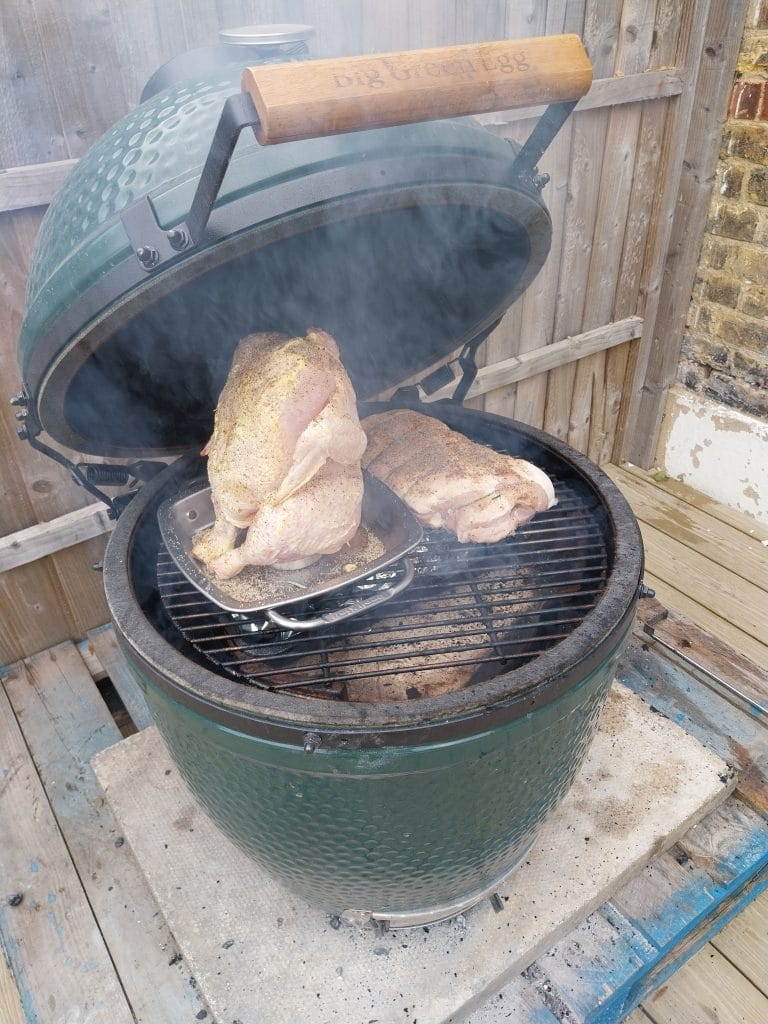
Everything on at 10:00 — chicken on the Broil King vertical roaster, pork loin on the grid. The foil-packet potato confit went underneath the deflector — the BGE Large grid is tight with a vertical chicken AND a roast on it, and the underneath spot turns out to give the oil more smoke exposure. Space-saving move, accidentally better for flavour.
Then I walked away — played in the garden with the kids for an hour, came back to find the pork at ~52°C and the chicken just behind. Plenty of time.
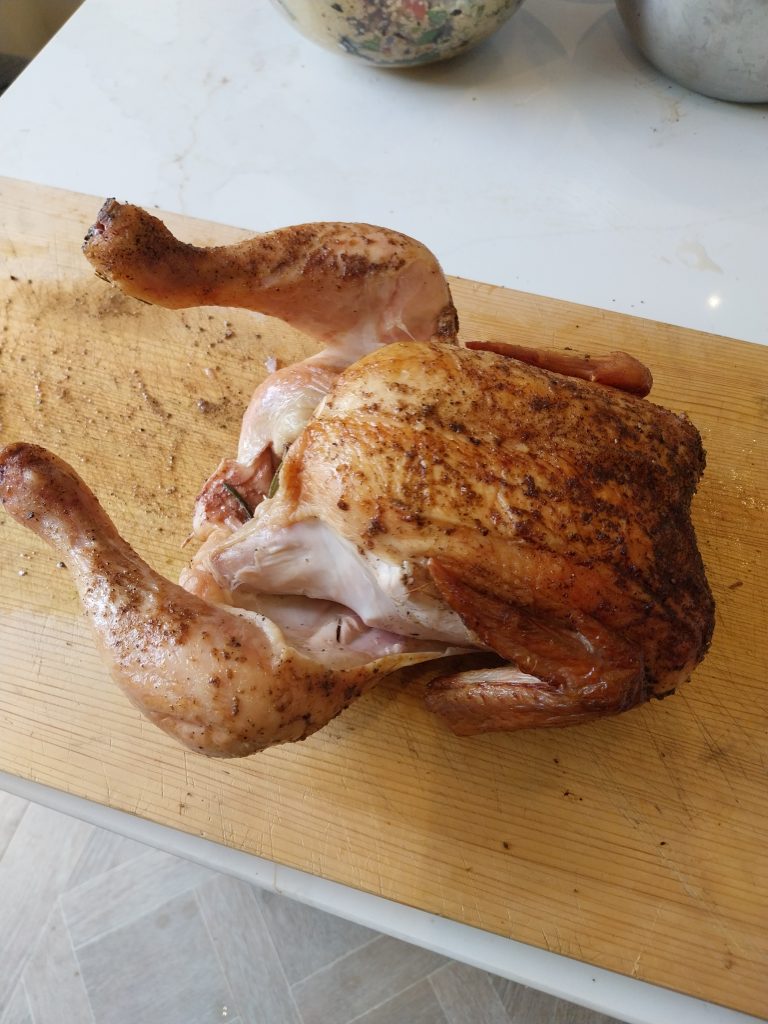
At 11:30 the foil packet came off, smoky oil drained into a jug — properly smoky, the herbs and garlic gone soft and sweet, set aside to cool. Pork hit 63.4°C and went into a cold oven, foil-wrapped with a tea towel on top to rest. Chicken stayed on for the reverse-finish: vents wide, climb to 220°C, crispy skin.


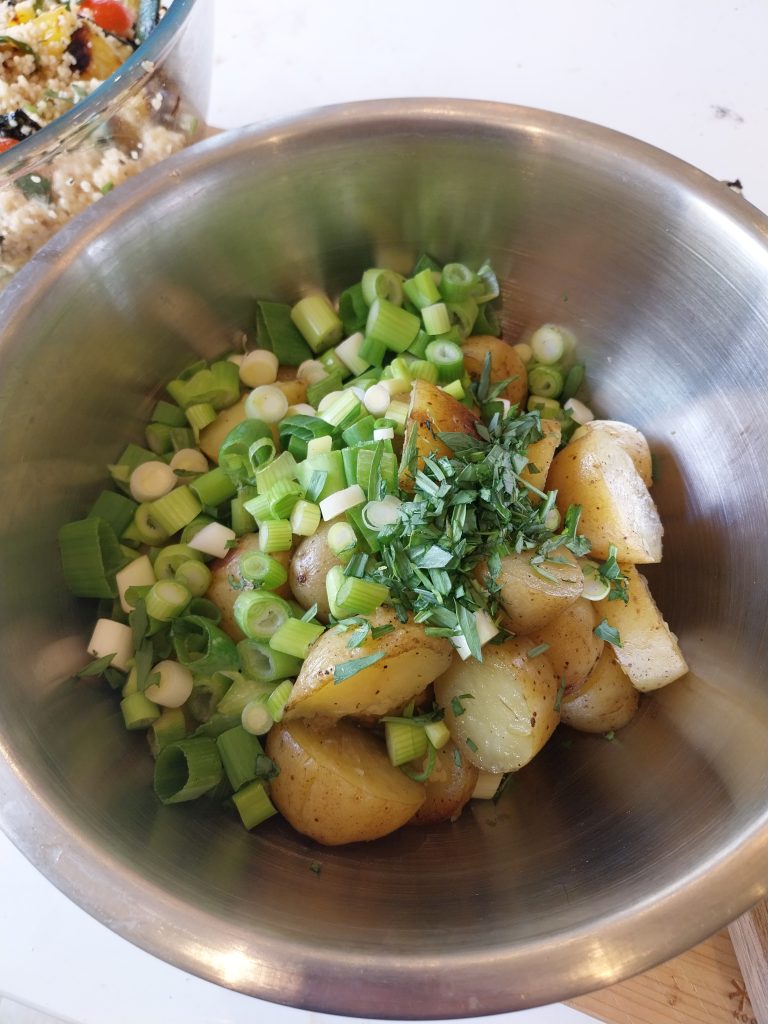
While the chicken was crisping, I pulled the deflector and grilled peppers, courgettes and a tomato direct on the hot grid. Five minutes a side, hard char. The smoky oil had cooled enough by then to whisk into two egg yolks — the emulsion came together properly. Confit garlic mashed in. Folded the whole thing back through the still-warm potatoes. The kind of side dish that ends up being the thing everyone remembers.


Resting ran longer than planned. Guests had arrived, kids were running about, no one was in a rush. Pork rested over an hour, chicken just over forty minutes — both still warm. We sat down at half-one. I carved the pork on the island. The chicken was juicy with crispy skin and properly tasted of BBQ smoke. The smoky-mayo potatoes made everyone go quiet for a beat.

It was the kind of cook that doesn’t feel like work. The Egg held it for me. I planned the morning, lit it early, didn’t panic on the temperatures, and walked away.

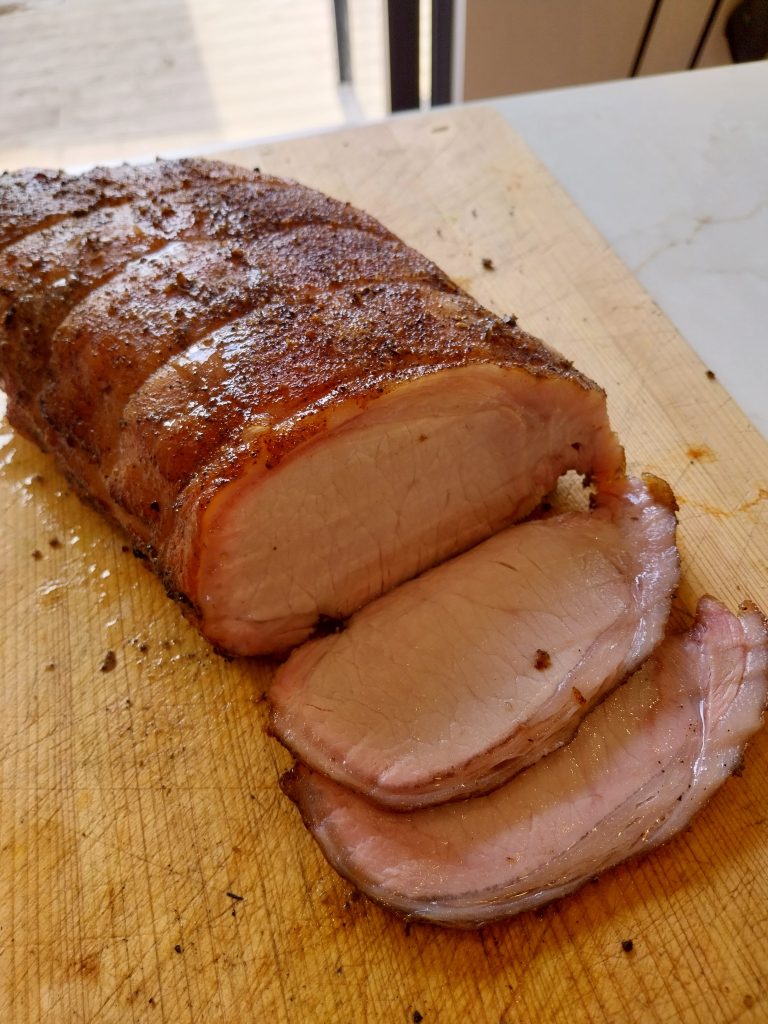
Monday morning we sliced cold pork loin for sandwiches. The smoke ring is visible — subtler than brisket but unmistakeably there. Visual receipt for the cook protocol: BGE held its temperature, Fuel Express produced real smoke, the dry-finish gave the surface what it needed.
That’s the cook this launch review earned its Tested badge on.
Setup and first impressions
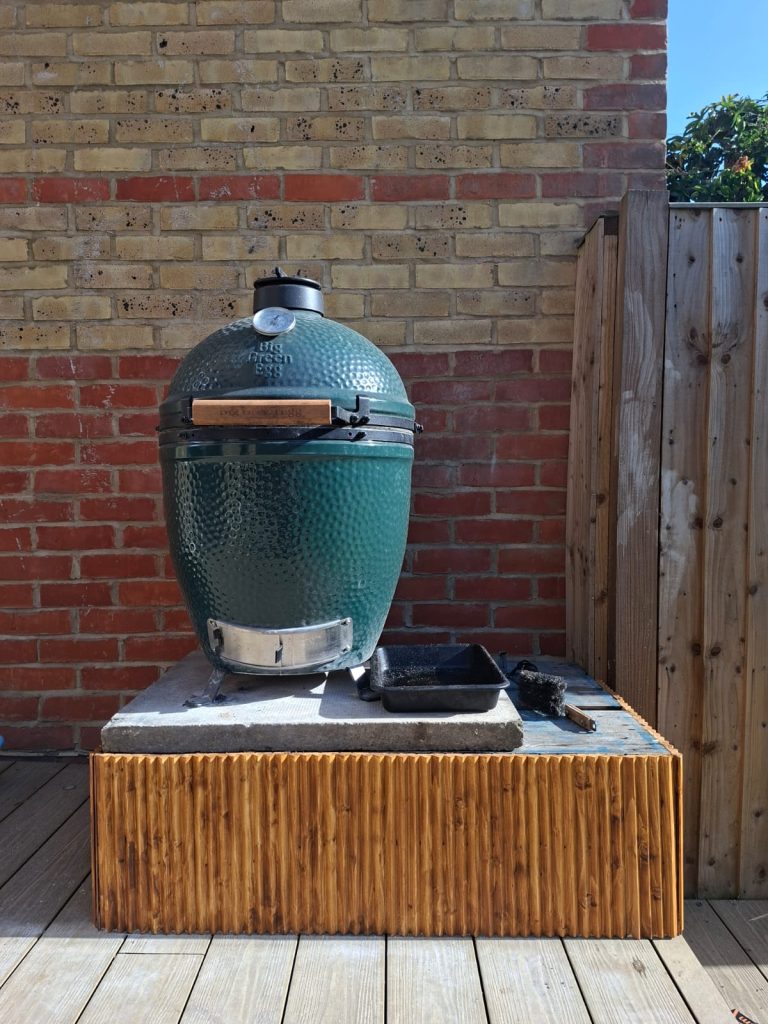
It arrived just before Christmas 2025, kerbside on a pallet. Heavy is an understatement — the BGE Large is around 70kg of ceramic and you don’t move it across a garden in one piece on your own. I took it apart, walked the components through, and reassembled on the far side. I didn’t have a stand, so I winged it: paving slab on top of the delivery pallet, reused as the base. The first thing to know about ceramic is that if you crack it, you’re cooked — it’s broken. There’s no fixing it, no warranty miracle. So you handle it like it owes you money.
The hinge fitting was the fiddliest bit of the build. The band runs on tight tolerances around the lid, and tightening the nuts on it is the kind of job where the instructions don’t quite tell you which order to go in. Beyond that, the kit was simpler than I’d expected for the money. There isn’t much to it — a ceramic body, a fire ring, a fire box, a grid, vents top and bottom. That’s the unit.
One change worth making on day one: swap the ash grate for an ash basket. The grate ships as standard; the basket is an aftermarket lift-out that turns ash clearance from a fiddle into a thirty-second job. Highly recommend, and I’d order one before your first cook rather than after.
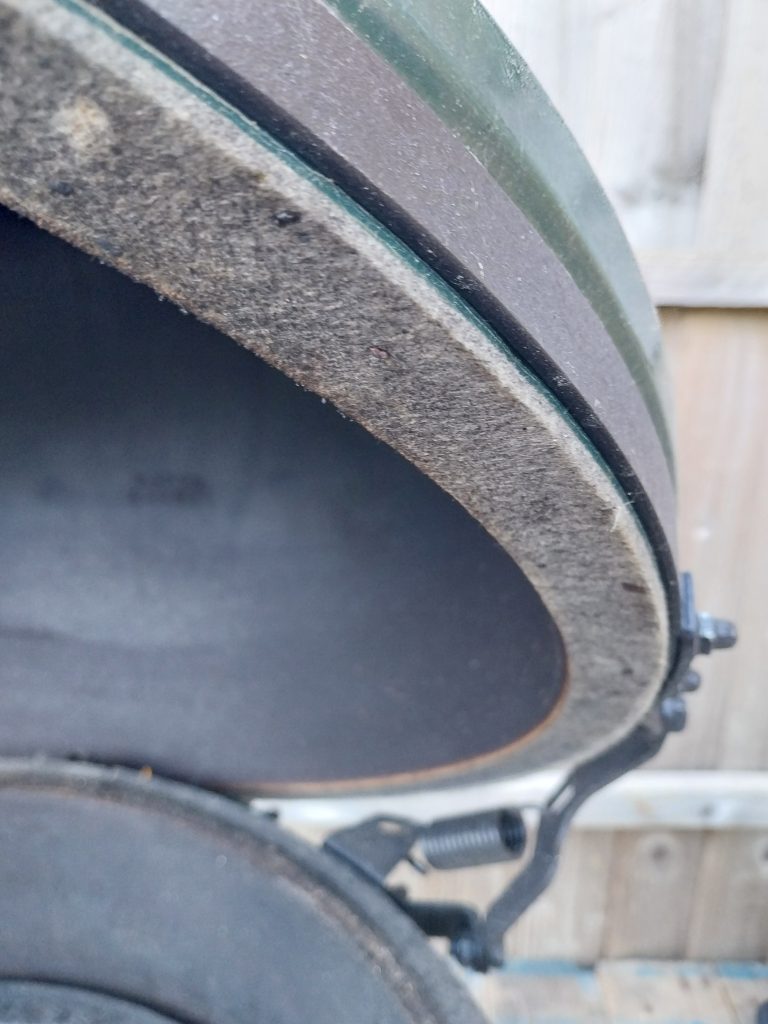
After twenty cooks the gasket is absolutely perfect — no charring, no peeling, no visible wear. There’s a story circulating online that the felt gasket on older BGE units degraded fast; I haven’t seen that on this unit. Full disclosure on that, plus what the felt-vs-fibreglass spec change was, in Section 8 — gasket truth.
Aesthetics — how it looks in the garden
The BGE-branded stand and table options are expensive — easily another £400–£700 on top of the unit, and at current timber prices a DIY wooden cradle isn’t far behind. Mine still sits on the original blue delivery pallet with a paving slab on top of it. It works, it’s stable, and it looks exactly as you’d expect: a £1,500 piece of green ceramic on a knackered blue pallet.
What I didn’t expect is that guests like it. The slightly-ghetto setup paired with an obviously expensive cooker reads as un-precious — more shed-and-fire-pit than showroom. People ask about the Egg before they’ve eaten anything off it, and once I serve short ribs that’s the cook that lands, because most guests have never had them and know they can’t do them at home.
(If you want to do better than a pallet without spending stand money: see Mounting a 70kg ceramic kamado on a budget — the dedicated companion piece, with a wooden-cradle plan and timber pricing as of May 2026.)
Temperature control and fuel performance
Lighting. Three firelighters, lump charcoal, a match. The only thing worth flagging on firelighters: avoid the cheap white paraffin ones — they’ll ruin the flavour of whatever you’re cooking. Use proper natural firelighters.
There’s a technique I read about and have been experimenting with: for a low-and-slow cook, sit the firelighters on top of the charcoal pile so the burn travels downward slowly; for a hotter cook, bury them deeper so the whole pile catches faster. I haven’t yet seen a definitive difference in my own cooks — it’s something I want to test more deliberately.
Vents. Conventional kamado advice is to keep the top vent (the daisy wheel) open and modulate temperature with the bottom slider. That’s not how mine has settled.
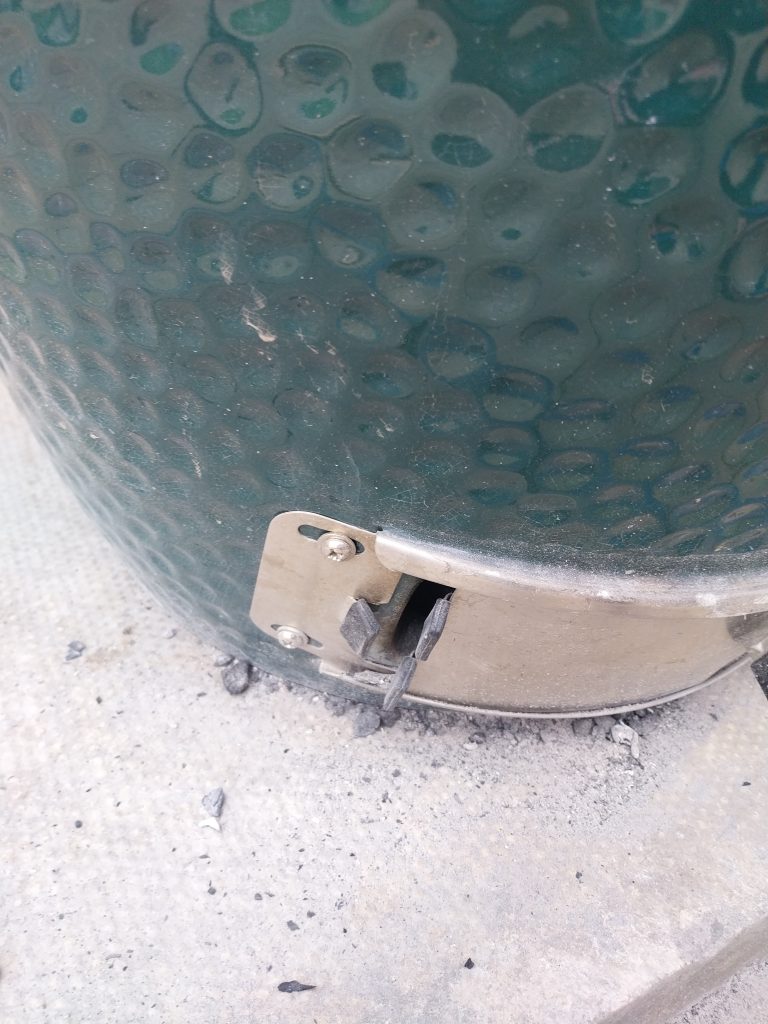
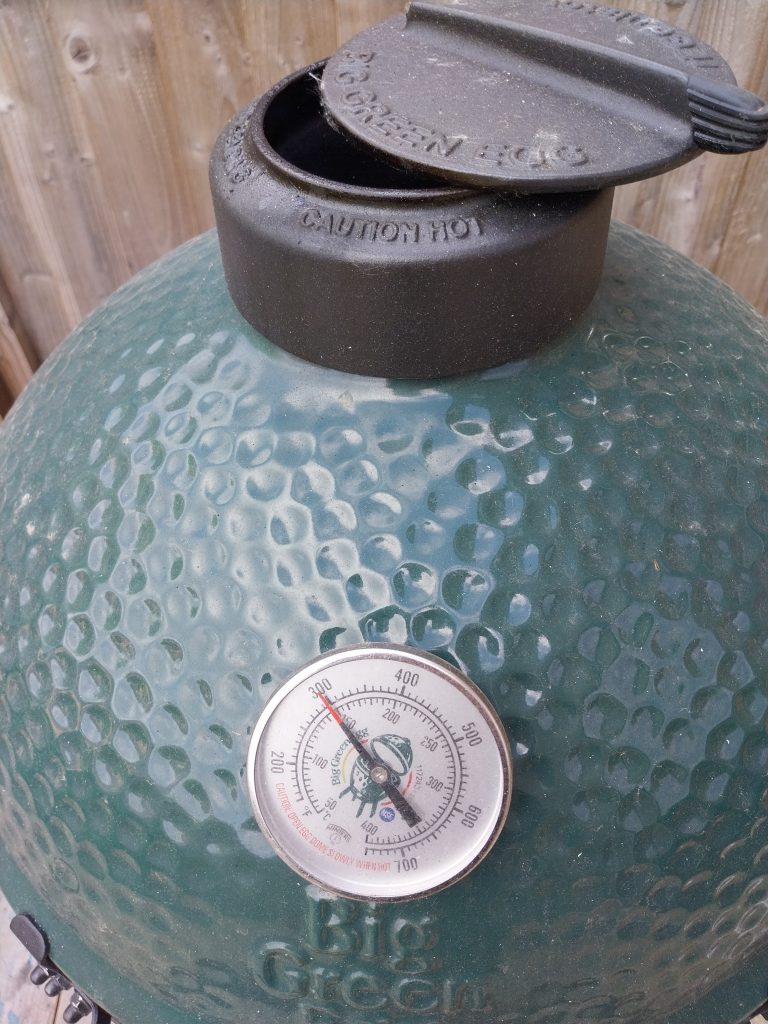
For low-and-slow at 110–130°C, I run the bottom slider on a sliver and the top vent closed 60–80%. That’s the position that holds. At higher temperatures — 220°C and up for direct heat — the conventional advice works fine: top open, bottom does the work. At the low end, the unit wants both vents tighter than the textbook says.
Holding temperature. This is what the Egg is built for, and the headline kamado claim is real on this unit: I have never topped up fuel mid-cook. The longest cook I’ve run is around twelve hours; the basket was loaded at the start and I never opened the dome to add fuel.
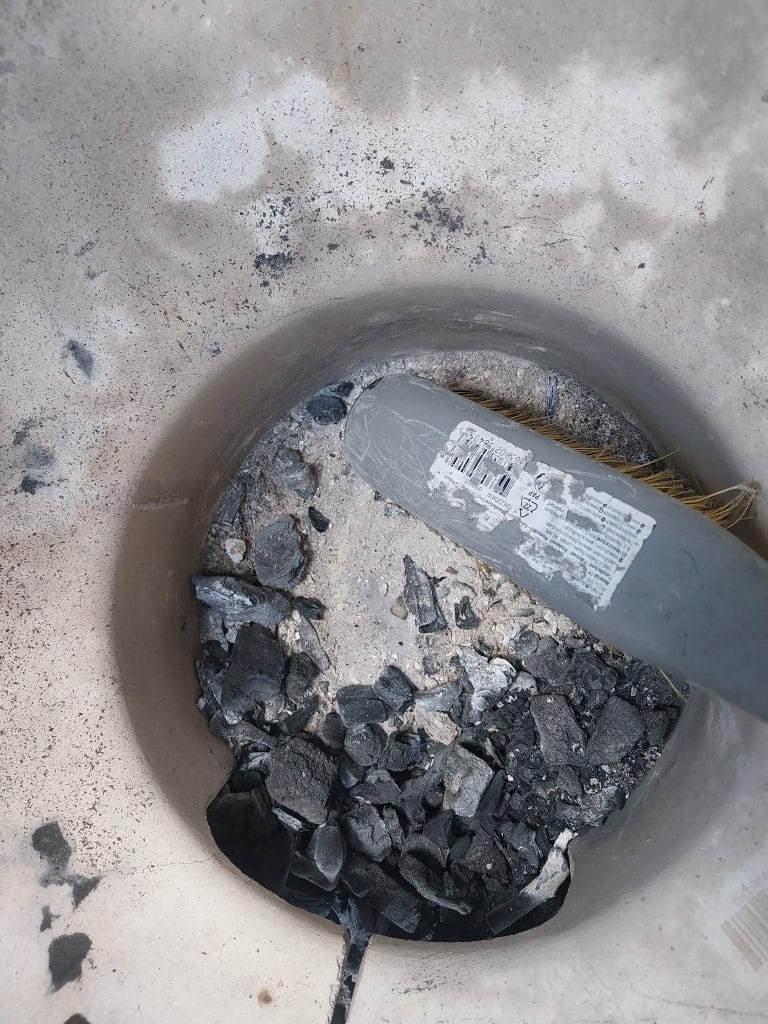
The other half of that story is the ash-basket reuse trick. Fill the basket properly on day one — a huge amount, more than you think you need — and at the end of the cook, close both vents. The Egg will be out in about fifteen minutes. The next day, lift the basket out and shake it over the garden-waste bin: the ash drops straight through the basket’s gaps, and the still-usable lump stays behind. Top the basket back up, drop it in, and you’re ready for the next cook. Properly zero waste on the fuel side.

Cold weather. I’ve cooked through London winter into spring and haven’t noticed a difference between cold and warmer ambient. Some kamado users will tell you a strong wind makes the unit cook hotter — I haven’t found that either yet, but I’ll update if I do.
Running cost honesty
A 12kg bag of lump runs me about 8–10 cooks, depending on what I’m doing — short ribs over twelve hours obviously eat more than a thirty-minute thigh cook. Beyond firelighters and charcoal, there is no running cost on this unit at all. No electric ignition, no gas canister to remember to refill, swap or store. The cost profile is much closer to a Weber kettle than to a high-end gas grill.
Build quality and what it’s like to live with — including the gasket truth
Build quality. Five months in, twenty cooks, and the build is absolutely flawless. Nothing has loosened, nothing has rattled, no glaze chips, no surprises. The ceramic body, the metal band, the bottom slider, the daisy wheel — all of it has held up exactly as you’d want a £1,500 unit to.
The dome. Opens and closes cleanly. The hinges were fiddly to fit on day one (covered in Section 6), but in normal use they’re smooth and there’s nothing to complain about. I haven’t yet had any of the heat-blowback issues some kamado users describe — the “burp”, where you crack the lid an inch or two before fully opening to prevent the rush of oxygen igniting the hot dome air violently. That’s most associated with high-temperature pizza cooks, and I haven’t run a pizza yet.
Fire components. Fire ring, fire box, grid — all in original condition. No movement, no expansion cracks, no warping.
Cleaning. Beyond the ash-basket reuse routine in Section 7, there isn’t much to do. Standard kettle-grill move: wire-brush the grid while it’s still up to temperature from the previous cook. The only other job is sweeping out the ash that drops out of the basket and pools in the bottom of the unit — a dustpan and brush through the bottom vent does it. There’s apparently an ash-hoover accessory for this; I haven’t looked into one. The Egg has been the lowest-maintenance piece of kit I own outside.
Living outside in UK weather. I keep it under a BBQ cover when it’s not in use — same cover I had on the gas grill it replaced. Hand-me-down kit, doing a job. The British winter hasn’t done the unit any harm.
The gasket truth
The internet rumour worth engaging directly: there’s a long-running story that the felt gasket on Big Green Egg units degrades quickly — chars, peels, loses its seal — and that’s the issue you’ll see flagged most often in older kamado forum threads.
Mine’s got the felt gasket. After twenty cooks across five months — including multiple twelve-hour low-and-slow runs at 110–130°C and direct-heat sessions at 220°C+ — it’s in absolutely original condition. No charring. No peeling. No visible wear.

A note on BGE’s own gasket terms: their official warranty covers the gasket for one year to the original purchaser, even though the ceramic body itself is covered for life. That tells you something about how BGE classifies the part — it’s a wear item, not a permanent component. Public sources don’t pin down a specific date when BGE moved (or partially moved) from the original wool/polyester felt to a higher-temperature spec. The third-party Nomex replacement market (Smokeware, LavaLock, JJ George, High-Que) is well-established, which suggests the felt-degrades-faster story has been a real experience for some buyers — even if it hasn’t been mine at twenty cooks.
My honest read on the most-cited BGE durability concern: the rumour exists for a reason, but it hasn’t matched my unit’s behaviour. If yours does start to fail, a Nomex upgrade kit is a £20–£30 fix.
Comparison with the obvious alternatives
| Compared with | BGE Large strengths | Where the alternative wins | My take |
|---|---|---|---|
| Weber kettle (e.g. Master-Touch) | Long-hold low-and-slow with minimal fuel attention; ceramic insulation | Lower price, easier first cooks, more forgiving on temperature | The kettle is the right unit for someone starting out; the Egg is the upgrade once you’ve outgrown it |
| Kamado Joe Classic III | Established UK presence, third-party accessory market, premium ceramic build | Possibly stronger accessory ecosystem out of the box (SlöRoller, Divide & Conquer) | I haven’t cooked on one, so the call is on accessory ecosystem and total cost over five years |
| Monolith Classic | Same kamado category, premium build | Often quieter price point; some say easier vent control | I haven’t cooked on one. Worth comparing on price and stand options if budget matters |
| Gas grill | Real BBQ smoke flavour, long cook capability | 10-minute weeknight cooks; lower learning curve | Different tools for different jobs. Gas wins for weeknight feeding-the-kids |
| Offset smoker | Versatile beyond pure smoking (direct heat, roasts, pizza) | Dedicated smokers do brisket-style heavy-smoke cooks better | If your priority is smoking, get a smoker. The Egg is excellent at low-and-slow but not a true smoker |
The short version above carries a caveat I want to honour here: I’ve cooked extensively on the BGE Large and on Weber kettles. I have not cooked on a Kamado Joe Classic III, a Monolith, an offset smoker or a pellet smoker. Where I’m working from cooked experience, I’ll say so. Where I’m working from research and judgment, I’ll flag it.
For the within-BGE comparison — Large vs XL vs Medium — that’s a different question, and the right place to answer it is the Which Big Green Egg should you buy? buying guide (forthcoming in our BGE cluster). This section sticks to BGE Large vs the obvious alternative units in the UK kamado / kettle / smoker space.
vs Weber Master-Touch and the kettle category
For someone weighing the Egg against a Weber kettle, the honest answer is that they’re doing a lot of the same things at the easy-Sunday end of the cooking range. Sausages, chicken thighs, burgers, koftas, BBQ veg — a Weber kettle does that work properly, and arguably the Weber is slightly easier: temperature control is more forgiving, the unit is far less intimidating to a first-time charcoal cook, and people are simply more used to looking at a kettle than at a ceramic dome.
Where the Egg pulls away from the kettle is in the long-hold low-and-slow stuff, where ceramic insulation lets the unit sit at 110–130°C with almost zero fuel attention. A standard Weber kettle can hold low-and-slow if you know what you’re doing, but it asks more of you. The kettle is the right unit for someone starting out; the Egg is the right unit for someone who’s already done the cooks the kettle does well and wants the cooks it doesn’t.
vs Kamado Joe Classic III and Monolith Classic
I’d put both of these in the same bucket, and I’ll say upfront: I haven’t cooked on either, so I can’t tell you the BGE outperforms them. What I’d expect is that all three are good products at this price point. The questions I’d be asking if I were buying today are about the accessory ecosystem: what’s the catalogue look like, what does each unit cost to expand, and — the question that matters most for total cost of ownership — how strong is the third-party market for each?
The BGE’s branded accessories are expensive. The third-party market for Egg accessories exists, but I haven’t yet stress-tested how deep it goes. That’s a piece I’ll come back to as I expand my own kit. (See Section 11 — Accessories for what I’m running today and what I’m planning to add.)
vs Aldi and Lidl budget ceramic kamados
The new question on UK BBQ shelves in May 2026 is whether the Aldi Kamado (£244.99) and Lidl Medium Ceramic Egg Grill (£249) are good enough to make the BGE Large look ridiculous. The honest answer is buyer-conditional — occasional cooks should buy the budget unit and not feel like they’ve compromised; weekly-cook decade-plus owners get more out of the BGE because the seal, the accessory ecosystem and the resale value all earn the premium back. I worked the five-year ownership maths and the buyer-fit verdict in detail in the Aldi and Lidl ceramic kamados vs the Big Green Egg Large buying guide.
vs gas grill
Gas wins, absolutely, if your need is feeding the kids in ten minutes. No argument. Gas is also the right tool if you just want simple cooking quickly and you’re not particularly invested in BBQ as a hobby — there’s an honest case for that, and a £1,500 ceramic kamado is the wrong unit for that situation. Gas has a place. The Egg is the wrong product for that place.
Where gas falls short is everything covered in Section 4 — what it cooks well: long, slow, smoke-driven cooks that the BGE is built for and that gas physically cannot do.
vs offset smoker
If your priority is proper smoking — heavy smoke, long brisket-style cooks — a dedicated offset smoker will beat the Egg at the smoking job specifically. The Egg is an excellent low-and-slow cooker, but it isn’t a true smoker.
The other category the Egg can’t really touch is cold smoking: salmon, fish, anything that needs smoke without significant heat. There are setups online involving two Eggs daisy-chained to funnel cooler smoke between them, and in my view that’s a bit ridiculous. If cold-smoked salmon is your headline output, you don’t want a kamado.
UK retailer routing
Pricing and routing as of May 2026. We disclose every affiliate relationship — see Disclosures.
Where to buy
The straightforward answer: buy a BGE Large from Big Green Egg’s UK channel or from a major UK BBQ specialist. Either route gives you the warranty, the after-service, and the assurance you’re getting the current spec. BGE is a premium brand; the support side of the experience is part of what you’re paying for.
biggreenegg.co.uk — Big Green Egg UK direct. Sold by Alfresco Concepts Ltd, the official UK distributor. £1,495 for the Large with ConvEGGtor (ceramic deflector) and Stainless Steel Grid included; free standard delivery within one week, with the option to nominate a delivery day. The cleanest no-doubt-of-warranty route, and where I’d point a first-time buyer. Editorial note: we don’t earn a commission on this link — we send you here because it’s the most credible source.
BBQ World Major UK BBQ specialist that stocks the BGE Large and the accessory range. Worth checking against the direct price for delivery terms, bundle composition and stock availability.
What about secondhand?
The realistic alternative is the Facebook Marketplace / Gumtree route. My honest read: don’t, unless you can inspect in person. You lose the warranty entirely — BGE’s lifetime ceramic warranty applies to the original purchaser only and is explicitly non-transferable per Alfresco Concepts Ltd’s published terms. Worse: BGE’s terms specifically void warranty coverage for any unit bought from an unauthorised seller, full stop. Ceramic damage also isn’t always visible in listing photos, and a hairline crack is a unit-killer. And these things are 70kg of awkward, so you don’t want to discover the seller hasn’t disassembled it for transport. There aren’t many on the secondhand market anyway. People who own them tend to keep them.
Price and discounting
The BGE Large is £1,495 on biggreenegg.co.uk at time of writing (May 2026), with the ConvEGGtor (ceramic deflector) and Stainless Steel Grid included and free standard delivery within one week. This is not a product that discounts. If you wait for a sale on the unit itself, you’ll be waiting a long time. Accessories, on the other hand, do sometimes go on offer — and that’s where to look for value if you want to spread the spend.
Bundles vs unit-only — what I’d add
The BGE direct purchase gets you the ceramic body, ConvEGGtor (deflector), firebox, fire ring, fire grate, stainless steel cooking grid, rEGGulator (daisy-wheel vent) and Tel-Tru dome thermometer — basically everything you need to run a cook on day one. To make the unit do the work I do with mine, three additions I’d put on the order at the same time:
- Ash basket — replaces the standard ash grate. Turns ash management into a thirty-second job. Covered in Section 7.
- Hands-free meat thermometer — wireless, leave-in, dual-probe (one in the meat, one in the dome). The kit gap I called out in Section 4: most of my “I haven’t nailed pulled pork yet” pain has been a probe issue, not the unit. Specifics in Section 11.
- EGG Expander (or equivalent second-tier) — the BGE Large grid is 46cm. Adding a second tier roughly doubles your usable cooking space and is what makes the Egg viable for cooking for more than a family Sunday lunch.
If you’re buying anywhere other than BGE direct, confirm the ConvEGGtor (ceramic deflector) is in your order. Without it there is no low-and-slow on the Egg, and that’s the cook the unit is built for.
Delivery and assembly
Two practical points:
- Kerbside delivery is the norm. If the unit cannot be delivered to exactly where you want it to live, the move is to disassemble it (top dome, base, internals) and walk the components through. Single-piece moves of 70kg of ceramic are how units get cracked.
- Inspect the box on arrival. Ceramic damage in transit is rare but not unknown. If the outer packaging looks bashed-up or repackaged, photograph everything before signing.
Before you click buy
- If buying secondhand, inspect in person. A hairline crack in the ceramic isn’t always visible in listing photos and it ends the unit. The warranty doesn’t transfer in the way it does to a new buyer.
- If buying anywhere other than BGE direct, confirm the ConvEGGtor (ceramic deflector) is in your order. Without it you can’t run low-and-slow on the Egg — and that’s the cook the unit is built for.
Accessories: what you actually need vs what BGE sells
The accessory market around the BGE is large, expensive, and easy to overspend on. Here’s what I run today, what’s coming next, and what I’d skip.
What I actually use today
- Heat deflector — non-negotiable. There is no low-and-slow without one. Most starter bundles include it; if yours doesn’t, it’s the first thing you order.
- Ash basket — the upgrade I’d make on day one (covered in Section 7). Turns ash management from a chore into a thirty-second job.
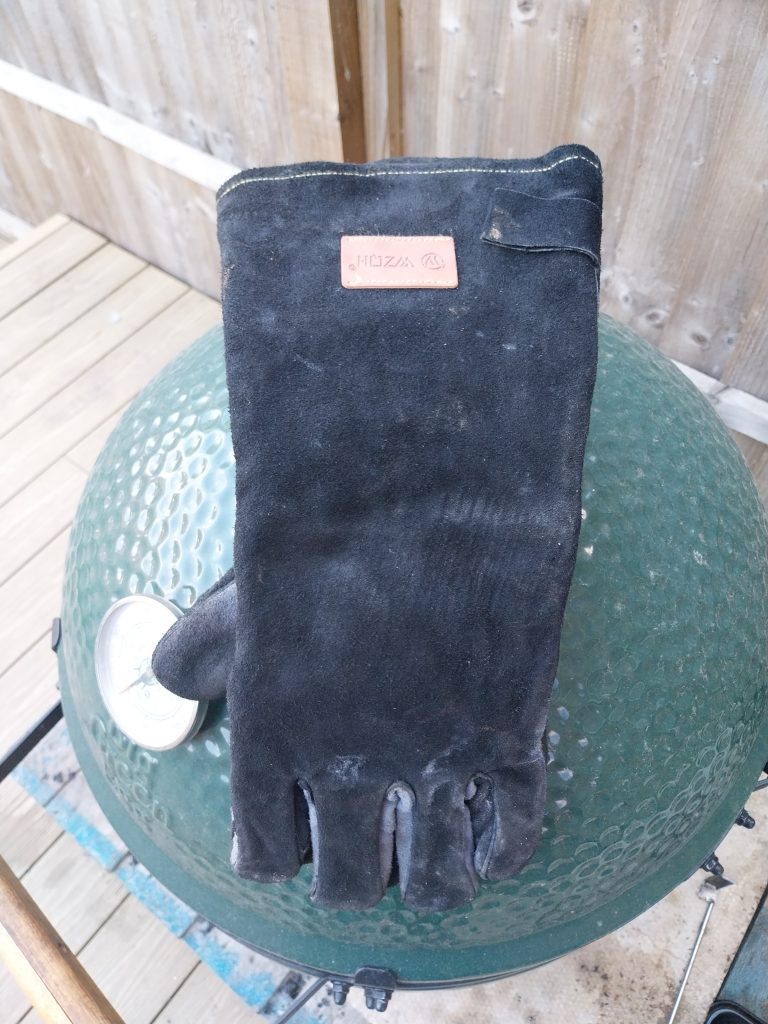
- Heat-resistant gloves — mandatory. The BGE runs hot. Don’t try to manage a cook with kitchen oven gloves. Mine: WZQH 16in Leather BBQ Gloves.
- Tongs — metal, not silicone. Worth saying explicitly: don’t bring kitchen tongs with silicone tips anywhere near the Egg. The dome air gets hot enough to soften them. Use proper full-metal BBQ tongs.
- Ash tool — but I use it as a grid lifter. BGE sells this for ash management; in practice, hooking it under the grid to lift it out is what mine does for me. Mid-cook, when I want to add smoking wood or slip something under the deflector, I can lift the grid one-handed without putting the gloves on. The ash side of the job is handled by the basket plus a dustpan and brush (Section 8).
- Vertical roaster — for whole birds. Mine is a Broil King vertical roaster, used for the chicken cook in Section 5. Not a daily-driver accessory, but worth flagging if whole birds are part of your rotation: the Egg’s tall dome has more vertical headroom than a Weber kettle, which is what makes the vertical-roast move work here.
- Lump charcoal and natural firelighters — I started with Big K lump charcoal and Weber firelighters. More recently I’ve been testing Fuel Express Restaurant Grade lump (see Section 5). The principle holds: lump, not briquettes, and natural firelighters, not paraffin (Section 7).
- BBQ cover — keeps the unit out of the elements. I run a hand-me-down from my old gas grill. Anything weatherproof and roughly the right size will do — no need for the branded one.
What’s on the upcoming kit list
- Hands-free meat thermometer — wireless, leave-in, dual-probe (one in the meat, one in the dome). The kit gap I called out in Section 4 — most of my “I haven’t nailed pulled pork yet” pain has been a probe issue, not the unit. UK-available options worth a look: MEATER, ThermoPro, ThermoWorks Smoke X4, Inkbird.
- EGG Expander — second-tier grid that roughly doubles your usable cooking space. The fix for the BGE Large’s family-Sunday-vs-feeding-a-crowd ceiling (see Section 4).
- Pizza stone — kamado pizza is one of the unit’s headline strengths and I haven’t run one yet. Branded BGE stone vs cheaper alternatives — undecided; will report when tested.
What I’d skip
Automated temperature controllers (BGE EGG Genius and similar — fan-driven units that adjust the vents to hold a target temp). My honest read: this is the kind of accessory that defeats the point of a kamado. The Egg holds temperature beautifully on its own, and learning the vents is part of the craft. £200–£400 is a lot of money to add a battery-powered failure point to a unit that already works. Reserving the right to change my mind once I’ve tested one properly.
The branded stand and table options are the other category I’d think hard about. £400–£700 on top of the unit gets you handsome timberwork, but a paving slab on a pallet does the structural job (see Section 6). The companion piece — Mounting a 70kg ceramic kamado on a budget — covers the wood-stand DIY route at current timber prices.
What I’d do differently if I were buying today
The cleanest answer first: I didn’t buy this Egg. As covered in Section 1, it came to me as a Christmas 2025 gift from my sister Kate, originally supplied to her by Big Green Egg as part of a paid content partnership that has since ended. I own it outright. If I lost it tomorrow, I’d buy a replacement at full RRP. That’s the most honest version of the verdict I can give.
Same size? Same spec?
The BGE Large is the right size. With four people at home and regular weekend entertaining, the 46cm grid covers the standard cook, and the EGG Expander (second-tier grid, on the upcoming kit list) handles the bigger occasions. I wouldn’t size down, and I haven’t felt a pull to size up either. With the Expander coming, the Large does the range I need it to do.
What I’d put in the order at the same time
Everything in Section 11 — Accessories. The four hindsight items I’d insist on at checkout if I were starting fresh: ceramic deflector (most starter bundles include it; confirm), ash basket (day-one quality-of-life upgrade), proper full-metal tongs, and heat-resistant leather gloves. Have lump charcoal and natural firelighters ready to go for the first cook. The hands-free thermometer and the Expander can come later — they’re upgrades, not necessities.
The mistake I’d warn first-time kamado cooks against
The single biggest learning, and the one most people get wrong on their first couple of cooks: don’t underestimate how quickly the temperature responds to airflow. Your first cooks will run too hot. Edge the vents up slowly from a fully-closed start; an overshoot at 250°C when you wanted 140°C is a forty-minute recovery on a kamado, because the ceramic holds heat. The temperature-control craft is in Section 7, but the headline learning is: start tighter than you think you need to.
What I’d push BGE to improve
Honestly, not much. The unit does what it’s built to do, the build quality has been flawless, and the accessory pricing — while expensive — is consistent with where this unit sits in the market: top of the established kamado category. The only minor flag from my own assembly experience is that the band-tightening on initial setup is fiddly, but that’s a one-off pain point that doesn’t recur once the unit’s built. Nothing here is a reason not to buy.
Disclosure box
This Big Green Egg Large was originally supplied to my sister, Kate Austen, by Big Green Egg as part of a paid content partnership in which Kate created cooking content for them. That partnership has since ended. Kate gave me the unit as a Christmas gift in December 2025. I own it outright. Smoke and Lump has no commercial relationship with Big Green Egg, and no commission, payment, or other consideration has been received in connection with this review. The full chain of supply, and our standing affiliate-network disclosures, is on our Disclosures page.
Final verdict and rating
Verdict
The Big Green Egg Large is everything — and more — than you thought it would be. Twenty cooks in, it has done the job the marketing said it would do, and I’d buy a replacement at full RRP tomorrow.
If you’ve outgrown a gas grill and you know it — if you’ve started wanting cooks gas can’t physically do, and a Weber kettle isn’t holding low-and-slow the way you want it to — this is the upgrade. You won’t regret it.
Overall rating: 9/10
Dimensional ratings
| Dimension | Score | Note |
|---|---|---|
| Build quality | 10/10 | Five months, twenty cooks, zero issues. |
| Cooking versatility | 9/10 | Excellent across low-and-slow, direct-heat, roasts, smoke. The only category it can’t reach is cold smoking. |
| Temperature control & heat-holding | 9/10 | Holds 110–130°C for twelve-hour cooks on a single fuel load. There’s a real learning curve on the vents in the first few cooks. |
| Value for money | 8/10 | £1,500 is a lot, and the unit doesn’t discount. Twenty cooks in, it earns the price tag. Accessory pricing is the drag, not the unit. |
| Ease of use | 7/10 | The kamado method takes time to learn, and overshoots are punishing. Not the right tool for casual weekend cooks. |
Who should buy it
- You’ve outgrown a gas grill and you want the cooks gas can’t reach.
- You’re already comfortable on a Weber kettle and want a unit that holds low-and-slow without working for it.
- You entertain regularly and want the Sunday-cook-as-event experience.
Who shouldn’t
- New to BBQ and not yet sure it’ll stick. Get a Weber Master-Touch, learn what you love, and come back to this in a year.
- Most weekends are sausages, burgers and chicken thighs. A Weber kettle does that work properly and saves you £1,000+.
- You need to feed kids in ten minutes on a weeknight. Gas wins. No argument.
- Your headline output is cold-smoked salmon. Wrong tool — get a dedicated cold-smoker.
- You’re weighing this against a Kamado Joe Classic III or a Monolith Classic. I haven’t cooked on either, so I can’t tell you the BGE wins. Read Section 9 and decide on accessory ecosystem and price rather than my verdict.
Frequently asked questions
How much is a Big Green Egg Large in the UK? £1,495 direct from biggreenegg.co.uk as of May 2026, including the ConvEGGtor (ceramic deflector) and Stainless Steel Grid, with free standard delivery within one week. The unit doesn’t typically discount; accessories occasionally do.
How long does a Big Green Egg last? Big Green Egg’s published warranty covers the ceramic body for life (Base, Dome, Firebox, Fire Ring) to the original purchaser, with metal components covered for five years and the ConvEGGtor for three. Owner reports across forum threads commonly span 15–20+ years of regular use. My own unit is five months and twenty cooks in with zero issues — anecdotally consistent with the lifetime claim, but not yet personally tested across decades.
Do Big Green Egg gaskets need replacing? The factory felt gasket carries a one-year warranty even though the ceramic body is covered for life — BGE classifies it as a wear item. The internet rumour about felt gaskets degrading quickly under high heat has been a real experience for some buyers, but my unit’s gasket is in absolutely original condition after twenty cooks. If yours fails, a third-party Nomex replacement kit costs £20–30 and is a straightforward DIY fix. See the gasket truth for the full treatment.
Big Green Egg Large vs Kamado Joe Classic III — which is better? I haven’t cooked on the Kamado Joe Classic III, so I can’t give you a first-hand verdict. Both units sit at the top of the established kamado market and review well. The questions worth asking are: how strong is the third-party accessory market for each (BGE’s own accessories are expensive; the third-party market exists but I haven’t yet stress-tested it), and total cost of ownership over five years. See our comparison with the obvious alternatives for what I can say from research today.
What size Big Green Egg should I buy? The Large (46cm grid) is the right size for a family of four with regular weekend entertaining — it covers a Sunday cook, takes a vertical-roaster chicken plus a roast, and scales to bigger occasions with the EGG Expander accessory. The Medium can feel tight for serious entertaining; the XL adds weight, fuel cost, and money without commensurate gains for most UK gardens. Full size-by-size guidance is in our forthcoming buying guide.
Can you leave a Big Green Egg outside? Yes. The ceramic body is rated for outdoor use year-round; a BBQ cover keeps moisture and dust off but isn’t strictly required. Mine has lived in a London garden through the 2025–26 winter under a hand-me-down cover from my old gas grill — no rust on the band, no ceramic damage, no ill effects. The British winter hasn’t done it any harm.
What’s next
I keep updating this review with each cook — brisket, pizza, and a proper steak benchmark are all in the pipeline.
If you want the next Tested-by-Ben review and the cooks that come from it, join the newsletter — no spam, no sponsored garbage, just the next piece when it’s ready.