S’mores on a kamado — with homemade blackberry marshmallow
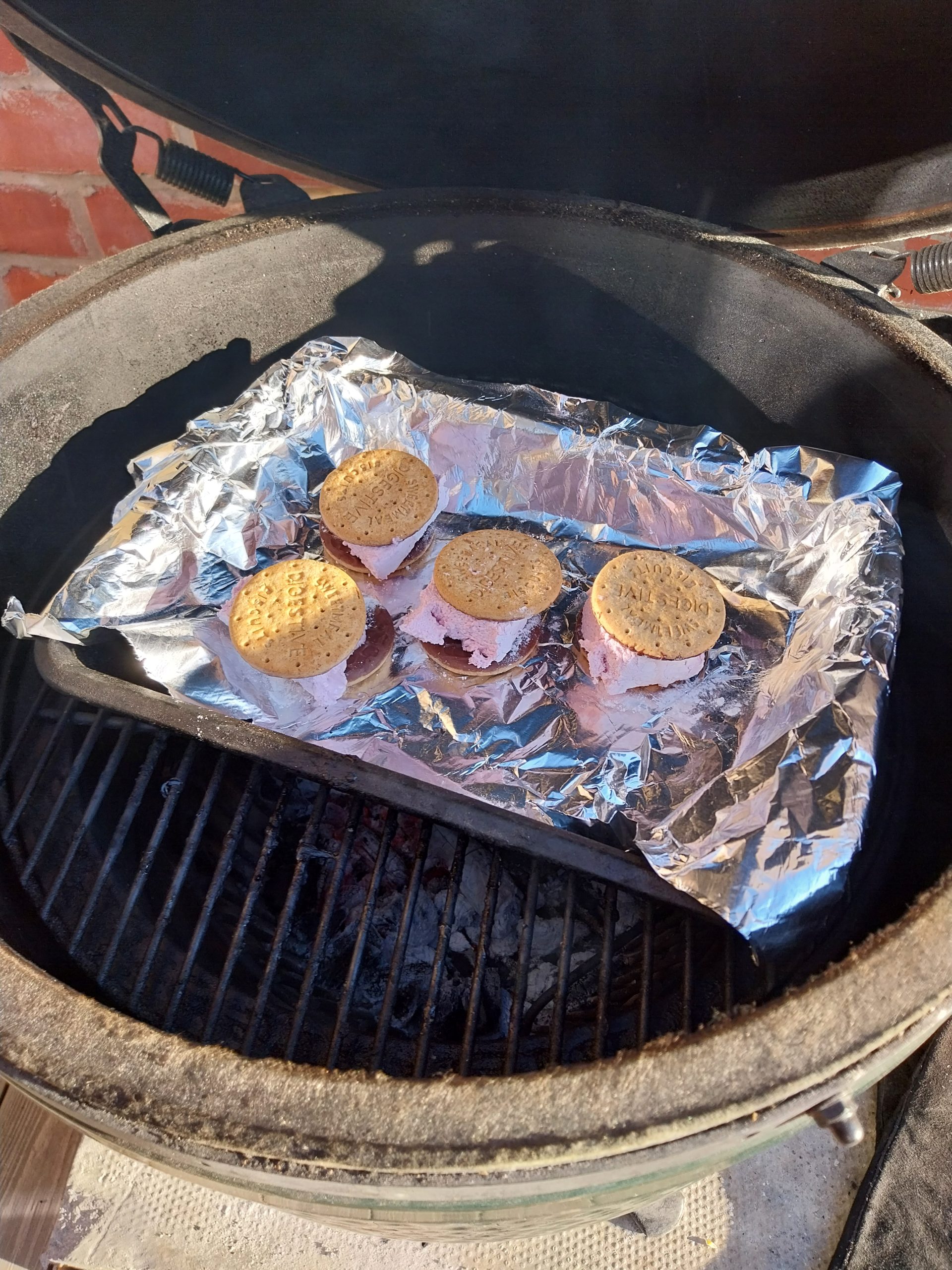
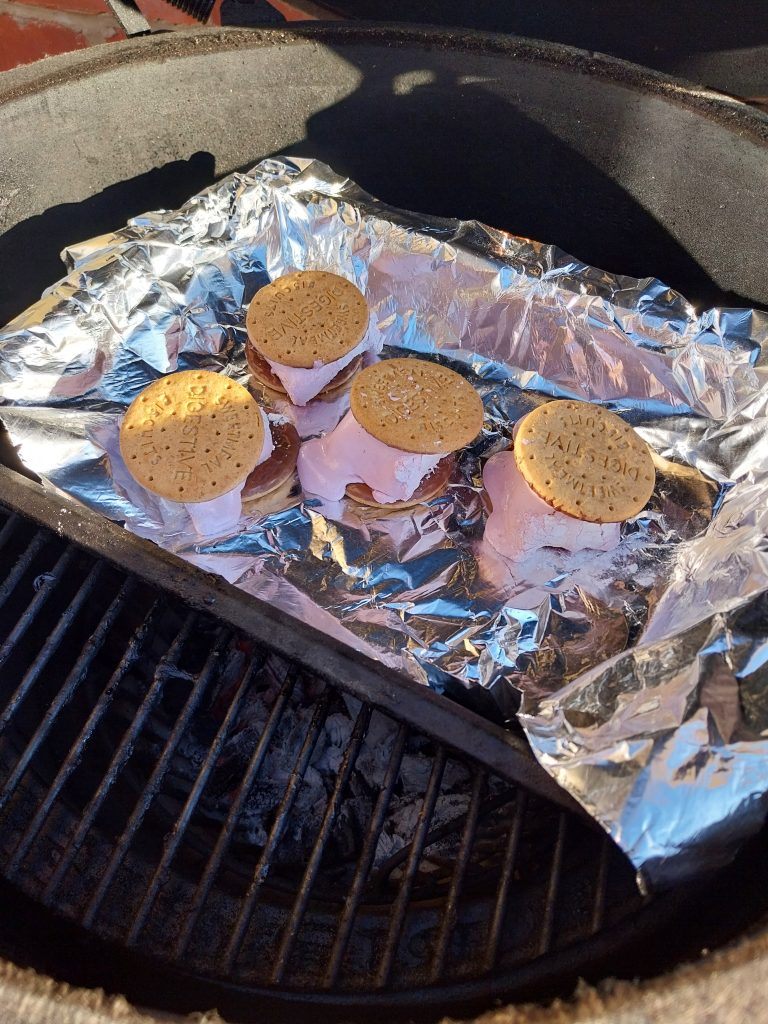
Four s'mores on foil on the cooking grid of a Big Green Egg Large, the blackberry marshmallow starting to slump out of the sides, with spent grey ash and live coals visible through the grid bars below them

S’mores on a kamado — with homemade blackberry marshmallow

Published 24 August 2026 · Last updated 24 August 2026 · Tested by Ben Austen · Affiliate disclosure

We’d been camping earlier in the summer and never got our s’mores — the drought had fire bans in force, so there was no campfire to make them over. When friends came round in August with four children between them and the Egg was already lit for a long cook, that seemed like the moment to make up for it.

Dark chocolate digestives, chocolate-side up, a slab of blackberry marshmallow I’d made that afternoon, then a second biscuit on top with its chocolate turned down to face the marshmallow. Four of them built on foil in a black metal baking tray, and the children doing their own. We had been out earlier looking for mallow — the plant marshmallow is named after, whose root was what the original sweet was set with — and the same drought meant there was none to find, so we used the last of the blackberries instead. The tray of s’mores went on at 19:09, about fifty minutes after my own cook had come off, on a fire that had been running since the afternoon. The ConvEGGtor (ceramic deflector) was out, so this is direct over what was left of the lump — spent grey ash with live coals still down in it, dome reading 220°C. Two and a half minutes and the marshmallow had gone from a firm pink slab to spreading out of the sides. I don’t much like s’mores; I’m not a marshmallow person, and I made these for the children. The chocolate digestive is just the UK way of doing it — instead of a Graham cracker and a separate square of chocolate, the chocolate is already on the biscuit, which makes it a much easier thing to put together.

Key takeaways

  • Make a single batch of marshmallow, not a double. I made double and it went wrong twice over: our KitchenAid was struggling to turn that much mixture, and we ended up with more marshmallow than the children could get through. One batch is more than enough for a table.
  • The marshmallow is the job. The s’mores are two and a half minutes. Set aside an afternoon for the sweet — half an hour of work and at least two hours to set — and the barbecue part is over before you’ve put the lid down properly.
  • This is a dessert for the end of a cook, not a reason to light one. The fire had been going since the afternoon and my own food had come off fifty minutes earlier. Spent ash with live coals still in it is exactly right for this — you are not lighting the kamado for a dessert, you are getting a second use out of a fire that is already dying down.
  • Building them in a tray means you lose the toasted skin, and that is a real trade. No char, no blackened crust — the marshmallow just softens and spreads. I did it in a tray because there were a lot of us and everyone could build their own; the children not minding the missing char was a bonus rather than the reason. If you want the toasted version, hold them over the coals on skewers and build them afterwards.
  • Homemade marshmallow is far stickier than the shop-bought kind. Cut it and every face wants dusting in the icing sugar and cornflour mix again, or it welds itself to the next piece. You will use more icing sugar than you think.

At a glance

Prep time~30 minutes for the marshmallow, plus a few minutes building the s’mores
Setting timeAt least 2 hours for the marshmallow. Mine was made in the early afternoon and cut at 15:47
Cook time2½ minutes
Total timeAbout 3 hours, nearly all of it the marshmallow setting
ServingsFour s’mores per tray on the grid. A single marshmallow batch makes far more than one sitting needs
MethodKamado, direct — ConvEGGtor out
Temperature220°C dome
DifficultyMedium. The s’mores are as easy as it gets; the marshmallow means boiled sugar at 125°C
EquipmentKamado, sugar thermometer, stand mixer, heavy-bottomed pan, 20cm x 30cm dish, sieve, foil, a metal baking tray
CuisineBritish

What you’ll need

Equipment

  • A barbecue that will sit around 220°C with the lid down and run direct — nothing under the grid. I cook on my Big Green Egg Large, with the ConvEGGtor out. A kettle does this perfectly well, and so does a pellet grill that will get to temperature. What the cook needs is moderate heat from below and a closed lid above; it is not a kamado-only job.
  • A metal baking tray, and foil to line it. Mine is a black metal one that lives in the kitchen. With the deflector out, the tray is the only thing between the biscuits and the coals.
  • A sugar thermometer. For the marshmallow, not the barbecue. You are taking sugar to 125°C and guessing is not worth it.
  • A stand mixer, or an electric hand whisk and a willing arm. This is where my cook came unstuck.
  • A heavy-bottomed pan, a 20cm x 30cm dish, and a sieve for the blackberries.

Ingredients

For the marshmallow — this is a single batch, which is what I would make next time.

  • 450g granulated sugar
  • 1 tbsp liquid glucose
  • 200ml water, for the syrup
  • 9 sheets gelatine
  • 150ml hot water, for the gelatine
  • 2 large egg whites
  • 1 tsp vanilla extract
  • 140g blackberries
  • 50g icing sugar and 50g cornflour, mixed, for dusting

For the s’mores

  • Dark chocolate digestives — two per s’more
  • The marshmallow, cut into squares

The method

Making the marshmallow

This is adapted from BBC Good Food’s bramble marshmallows, which is where the quantities and the shape of the method come from — the blackberries included; it is a bramble recipe to start with. I changed two things. I cooked the berries down into a purée and sieved it, and put that in with the vanilla so it went through the whole mix rather than sitting as whole fruit between two layers, which is why mine came out pink all the way through. And I made a double batch, which was a mistake for reasons I will come to.

  1. I cook the blackberries down and sieve them. Into a pan over a low heat until they collapse, then through a sieve to take the pips out, and I let it cool.
  2. I get everything else ready before the sugar goes on. I mix the icing sugar and the cornflour together in a bowl, and that mixture does all the dusting from here on. I dust the inside of the dish with some of it — I do not line it with parchment, and I think the dusting on its own works better. Then the gelatine goes into 150ml of hot water in a jug. All of it before the sugar goes anywhere near the heat.
  3. I boil the syrup to 125°C. Granulated sugar, liquid glucose and 200ml of water into the heavy pan, on a low heat until the sugar has gone completely, then I turn it up and let it come to 125°C on the thermometer — firm ball. It takes ten to fifteen minutes.
  4. I whisk the egg whites while the sugar boils. Stiff peaks, ready for when the syrup hits temperature.
  5. I combine them, and the purée goes in here. The syrup goes into the jug of gelatine water and I stand well back, because it bubbles up and it is extremely hot. Then that goes onto the whisking egg whites in a steady stream, with the vanilla and the blackberry purée in together. It turns glossy and starts to thicken, and it takes ten minutes or so of whisking to get very stiff. Putting the purée in at this point, while the mixture is still whipping, is what colours the whole batch evenly instead of leaving a layer of fruit.
  6. It goes into the dish, and then I leave it alone. I level it off and put it somewhere cool and dry for at least two hours, until it is firm. Mine went into a glass dish, dusted and not lined. The original calls for a lined tin and I would still skip the parchment. I made mine in the early afternoon and cut it at quarter to four.
  7. I turn it out and cut it — then dust it again. Onto a board dusted with the sugar and cornflour mix, into squares, and every square rolled in the mix. I would not skip that second dusting. Homemade marshmallow is far stickier than the shop-bought kind and the cut faces will weld themselves together if you leave them bare.
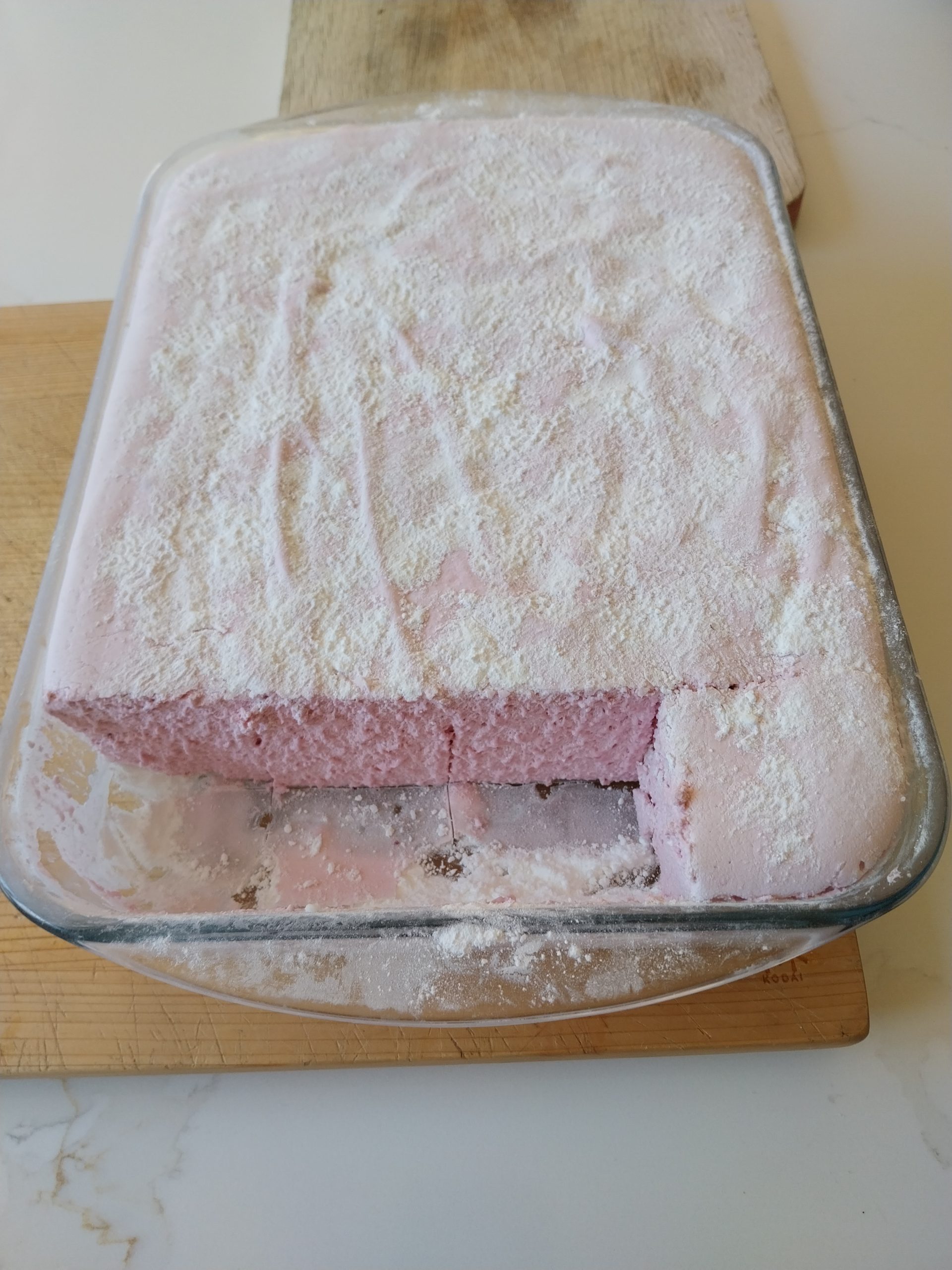
A slab of pale pink blackberry marshmallow set in a clear glass dish, heavily dusted with the icing sugar and cornflour mix, with one corner cut away showing an even aerated crumb right through
Cut at quarter to four. The dish is glass and there is no parchment under it — and the colour goes all the way through, which is the purée rather than whole berries.

The s’mores

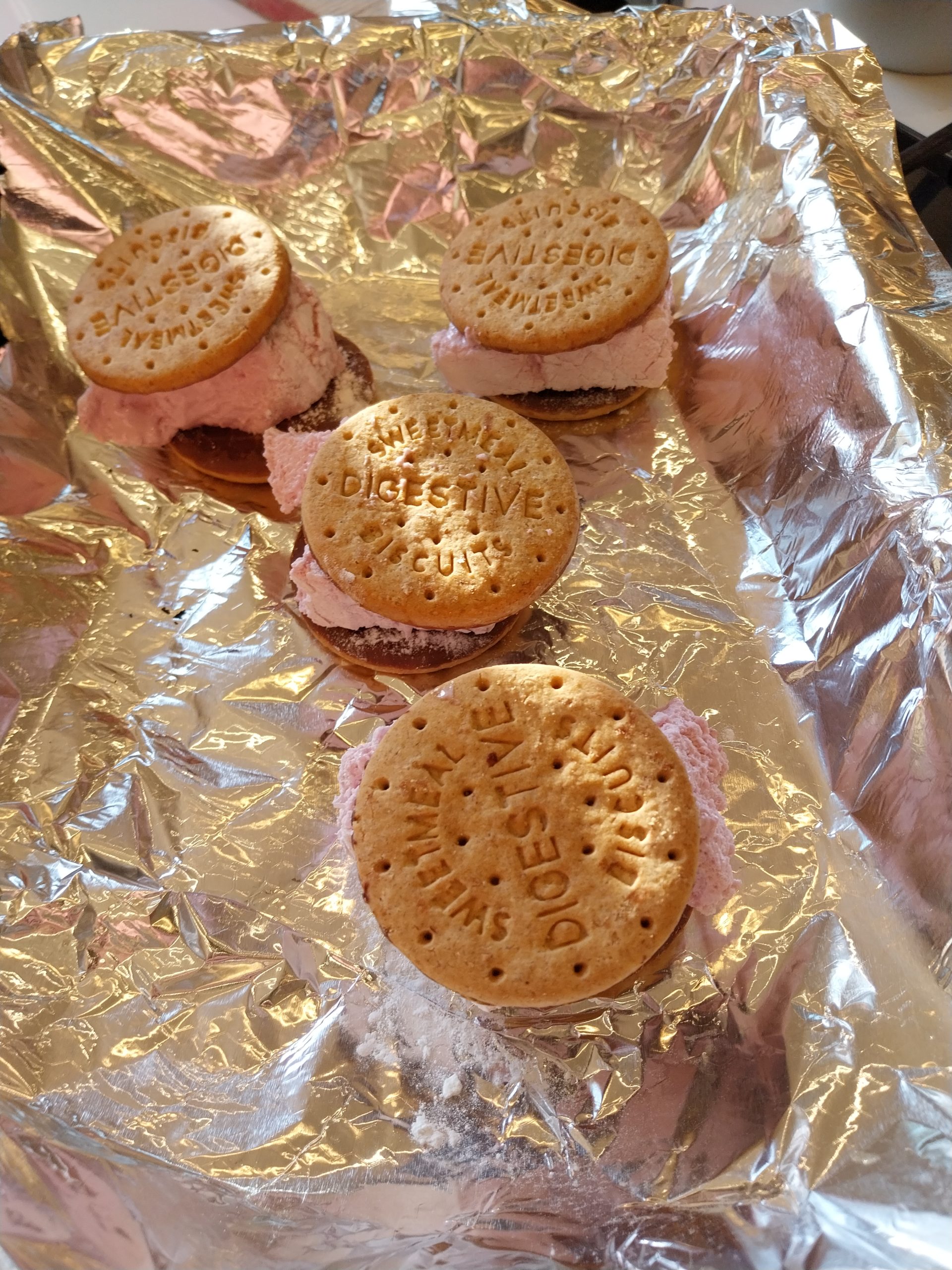
  1. I let the children build them. A chocolate digestive chocolate-side up, a square of marshmallow on top, then a second digestive with its chocolate turned down to meet it, so the chocolate faces the marshmallow from both sides. They sit on foil in the metal tray, four to a tray.
  2. I put the tray on the fire, lid down, for two and a half minutes. The deflector is out and this is direct over what is left of the lump — mine was spent grey ash with live coals still down in it, dome reading 220°C. Two and a half minutes with the lid down and the marshmallow goes from a firm square to spreading out of the sides. Mine went on at 19:09 and the second photograph is at 19:11. I would not walk away from it. Nineteen seconds separate the photograph of them built and waiting from the first one on the grid, and in that second frame the marshmallow is already going soft.
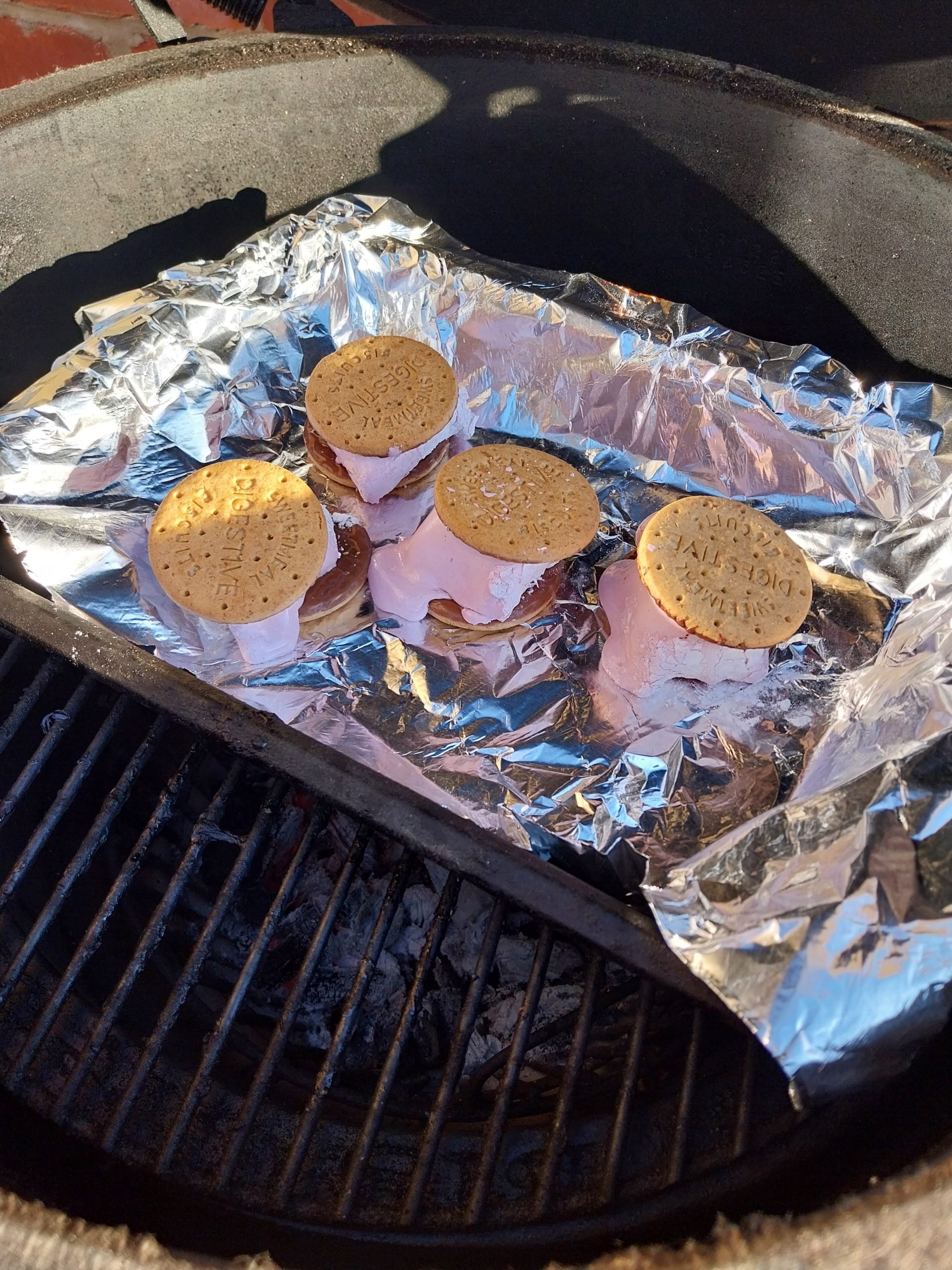
The same four s'mores two and a half minutes later, the marshmallow spread flat out from between the biscuits across the foil
Two and a half minutes later, with the marshmallow spread right out from between the biscuits.

What to serve them with

Nothing. They are the end of an evening rather than a course, and they get eaten straight off the tray.

There will be marshmallow left over. Mine kept for a few days under a cloth, so it is less of a problem than I expected.

What I learned, and what I’d do differently

I made a double batch and I should not have. That is the one thing I would change, and it went wrong in two directions. Our KitchenAid was visibly struggling to turn that much mixture. And we ended up with far more marshmallow than the children could eat. A single batch is plenty.

You need much more icing sugar than you expect. Between dusting the dish, dusting the board, and rolling the cut squares, the 50g icing sugar and 50g cornflour goes quickly. Have more than the recipe asks for standing by.

Cut homemade marshmallow is stickier than anything you buy. The squares are squidgier and they stick to each other, to the board, and to your hands in a way a bag of shop marshmallows never does. I think that is my own variation coming back at me — cooking the blackberries down to a purée puts water into the mix that the original recipe does not have. The fix is the second dusting, done properly rather than as a token roll.

And it softens on the fire almost the moment it goes on. There are fewer additives in homemade marshmallow than in a bag from the supermarket, so it is softer to start with. That is why two and a half minutes was enough, and why you cannot leave it.

The tray costs you the toasted skin, and it is worth knowing that going in. Held over the coals on a skewer, a marshmallow blisters and blackens and that char is half the point for a lot of people. In a tray it just softens and spreads. I used a tray because there were several of us and it let everyone build their own, and my children do not mind the char being missing — but if the toasted version is what you are after, the tray is the wrong method and I would not pretend otherwise.

Variations

  • The toasted version. Marshmallows on skewers, held over the coals with the lid up until they blister, then pressed between the biscuits by hand. It is the version that gets you the char. I have not run it on the Egg, so treat it as the obvious alternative rather than something I have tested.
  • On a kettle. Nothing here needs a kamado. Direct heat, lid down, moderate temperature — a kettle does that as well as anything. If your fire is cooler than 220°C give it longer and keep looking.
  • Other fruit. Blackberries are what the original recipe is built around, so they are not a substitution. Raspberries or strawberries would presumably purée and sieve the same way, though I have not tried either. Anything wetter than that would need thinking about, given how sticky this already got.
  • Shop-bought marshmallow. Entirely reasonable, and it turns a three-hour job into a five-minute one. You lose the thing that made this cook worth writing up, but the s’more itself will be fine.
  • A note on the gelatine. Nine sheets of gelatine means this is not vegetarian. There are vegetarian marshmallow recipes built on other setting agents; I have not made one and cannot tell you how they behave in a tray on a fire.

Frequently asked questions

Do you need a deflector for s’mores on a kamado?

No, and mine was out. The s’mores sat in a foil-lined metal tray straight on the grid, direct over what was left of the lump, dome reading 220°C. The tray is what protects the biscuits. I have not run it with the deflector in, so watch them rather than copying my clock.

How long do s’mores take on a barbecue?

Two and a half minutes at 220°C with the lid down, direct. Mine went on at 19:09 and were spreading out of the sides by 19:11. The temperature and the time are the same fact stated twice — a cooler fire needs longer, and at 220°C you should not walk away.

Can you use chocolate digestives instead of Graham crackers?

Yes, and in the UK it is the easier way to do it. Using a chocolate digestive means the chocolate is already on the biscuit rather than being a separate square you have to add. Put the chocolate side inwards on both biscuits and the marshmallow has chocolate against both faces.

Can I make this with shop-bought marshmallow?

Yes. The barbecue part of this recipe does not care where the marshmallow came from. Making your own is a good afternoon with children, and it is why I bothered, but it is not a requirement for a decent s’more.

Do I need a sugar thermometer to make marshmallow?

I used one and I would recommend it. The original recipe offers a cold-water test instead — drop a little of the syrup into very cold water and see whether it sets into a squidgy ball — which works, but 125°C is a specific target and a thermometer takes the guessing out.

How long does homemade marshmallow keep?

Longer than the recipe it came from suggests. BBC Good Food says an airtight container, eaten on the day. Mine sat in a dish with a cloth over it, nothing airtight about it, and it was fine for a few days. Keeping it was never the problem — the double batch was.

Provenance and disclosure

This recipe comes from a single cook on my own Big Green Egg Large, on Friday 7 August 2026, with friends and their children round. The s’mores went on at the end of the evening on a fire that had been running since the afternoon — my own cook came off at 18:17 and the tray went on at 19:09.

The marshmallow is adapted from BBC Good Food’s bramble marshmallows. The quantities and the shape of the method are theirs. What is mine is the blackberry purée folded through instead of whole berries scattered between layers, the double batch and everything I learned from it, and the cook itself.

What the photographs establish, and what they do not. The direct setup is photographed: frames taken at 19:09 and 19:11 show the grid with spent ash and live coals visible through the bars, and no deflector in place. The two-and-a-half-minute cook is timestamped between those two frames rather than remembered. The 220°C dome reading is my own recollection — there is no thermometer frame from that evening, and I have not tried to dress it up as anything firmer.

The marshmallow being named after the marsh mallow plant is well documented: Britannica records the confection as having been made from the root sap of Althaea officinalis with sugar and egg white. We did go out looking for the plant, and the drought meant there was none to find — so no mallow was used in this, and nothing here should be read as a method for making marshmallow from the root.

The BGE Large was a Christmas 2025 gift from my sister, originally supplied to her by Big Green Egg as part of a paid content partnership that has since ended. I own the unit outright. Smoke and Lump has no commercial relationship with Big Green Egg or with BBC Good Food, and no commission, payment, or other consideration was received in connection with this recipe. The full chain of supply and our standing affiliate-network disclosures are on the Disclosures page.

This is a one-cook recipe. Making a single batch of marshmallow instead of a double is the change I would make next time. When that cook happens this recipe will be updated additive-style per the living-review pattern in STYLE_GUIDE.md § 11 — same URL, new H2 inserted, original cook data preserved.

Sourced from the 7 August 2026 cook log — s’mores with homemade blackberry marshmallow, cooked at the end of a mixed grill evening on the BGE Large.