Published 30 July 2026 · By Ben Austen · Provenance
A chimney starter is one of the cheapest tools that meaningfully changes how a charcoal cook starts. Two handles, a fistful of scrunched-up newspaper or a firelighter cube underneath, twenty minutes of nothing to do, and you have a chimney of glowing coals to tip into the grate. No lighter fluid taste. No standing over the kettle willing it to catch. I’ve been lighting family barbecues with a chimney for more than fifteen years — on my parents’ kettle first, then on my own — and if I were still cooking on a kettle it’s the tool I’d buy again first, before an ash tool, before a probe, before anything.
The bigger reason it matters, especially if you’re new to charcoal: most people light the barbecue too late and end up cooking sausages over flames rather than coals. The chimney gets your fire from cold to “ready” reliably and quickly, which is the single biggest change to whether a barbecue meal ends well or badly.
The category has three practical price bands in the UK. Under £15 gets you a functional galvanised-steel budget chimney that lights charcoal just as well as anything else — they last fine with normal weekend use. Around £23–£24 gets you the Weber Rapidfire, the volume leader, with a cone-shaped bottom grate and a dual-handle design that make it the tidiest tool in the category. Around £30 gets you a safety-focused mid-tier (LIVIVO’s Deluxe with a stay-cool handle). Anything much above £35 is over-buying for what a chimney needs to do.
This piece is Tested-leaning: I’ve used a chimney starter for more than fifteen years across family barbecues and my own — almost certainly a Weber Rapidfire on my own kettle, though I couldn’t swear to the exact box that landed in the garden. Real cooks over that time were the standard weekend charcoal-cook rota: sausages, chicken thighs, kebabs, burgers, direct-heat fifteen-to-twenty-five minute stuff, not low-and-slow. The specific six picks below are Consensus — sourced from the UK product SERP, from named third-party reviews, and from customer-rating data. I no longer use a chimney because my current cooker is a Big Green Egg Large where the ignition works differently — firelighter tucked in with a small pile of lump, close the dome, done.
Our six picks at a glance
Key takeaways
- The Weber Rapidfire at £23.99 is still the default buy. Aluminized steel, sturdy dual handles, cone-shaped bottom grate, 6L capacity that fills a 57cm kettle in one load. At around £20 there’s no strong reason to save money on this — just buy the branded product.
- The chimney gets you cooking on coals, not flames. The single most common beginner mistake is lighting the barbecue too late and then cooking on flames instead of glowing coals. A chimney takes fifteen to twenty minutes reliably every time, which fixes that mistake before it happens.
- BLOSTM’s Extra Large is the budget pick at £12.65. Galvanised steel, larger capacity, half the price of the Weber and lights charcoal every bit as reliably.
- You don’t need one on a kamado. The ceramic-kamado ignition method (firelighter cube tucked directly into a small pile of lump) works better than a chimney because you’re lighting exactly the fuel you need, exactly where you need it. If you have a Big Green Egg, Kamado Joe, Monolith, or an Aldi/Lidl ceramic egg, skip this whole category.
- Capacity should match your grill, not exceed it. A large-capacity chimney on a small kettle is wasted metal. Weber’s Rapidfire (~2.5 kg / 6L capacity) fills a 57cm kettle in one load. If you have a smaller Weber Compact kettle or a portable, the Rapidfire Compact (7447) at £23.31 is the more sensible size.
At-a-glance
| Chimney starter | Price | Capacity | Material | Best for |
|---|---|---|---|---|
| Weber Rapidfire (7416) | £23.99 | 6L / ~2.5 kg briquettes | Aluminized steel | Best overall — the default buy |
| Weber Rapidfire Compact (7447) | £23.31 | Sized for 47cm kettles | Aluminized steel | Best for a smaller kettle or a portable |
| BLOSTM Extra Large | £12.65 | Extra-large | Galvanised steel | Best budget — half the price of the Rapidfire |
| LIVIVO Deluxe | £29.99 | Heavy-duty | Galvanised steel + thermoplastic wooden handle | Best safety-first pick |
| Woodside Chimney Starter | ~£23.31 | Standard | Galvanised steel | Best mid-tier alternative to Weber |
| Weber Rapidfire Set | £34.97 | 6L + 2 kg briquettes + 2 lighter cubes | Aluminized steel | Skip — buy the chimney and lump separately |
Prices verified against Amazon UK product pages on 29 July 2026. Weber Rapidfire matches Weber UK direct at £23.99. Availability and pricing changes frequently on Amazon UK — verify at point of purchase.
Is a chimney starter worth £24 if you’re new to charcoal?
Yes, and here’s the short answer: a chimney starter turns “will the fire catch?” into “the fire has caught, it’s ready when the timer goes.” At £23.99 for a Weber Rapidfire that lasts years of regular use, you also stop paying for lighter fluid, stop tasting the residue in your food, and stop standing over the kettle poking at a smouldering pile of half-lit charcoal. The tool pays for itself in avoided firelighters inside its first summer of regular use. The only reason to skip it is if you cook on a ceramic kamado — that category lights differently and doesn’t need one.
How a chimney starter works
A chimney starter is a metal cylinder with a grate inside and two handles outside. You put charcoal on top of the grate, put a few sheets of scrunched-up newspaper or a firelighter cube underneath the grate, and light the paper or cube through the bottom vents. Hot air rises through the fuel, oxygen feeds the fire from the bottom, and the chimney effect pulls the flame up through the charcoal from below. In fifteen to twenty minutes the top layer of coals is glowing white-orange and ready to pour into the kettle.
The reason it works better than lighter fluid or scattered firelighter cubes is fire dynamics. Lighter fluid burns off the fuel it soaked into the charcoal — the coals are lit on the surface, not through, and they die back as you shift them. Scattered firelighters have the same problem: you get patchy lighting, hot in one spot and cold in another. A chimney concentrates the flame path vertically so every coal gets exposed to the fire above and below it. When you tip the chimney out, every coal is ready.
Newspaper or firelighter cube — which to use underneath? My honest habit is a couple of sheets of newspaper, scrunched-up, because my parents always had newspapers around and it just worked. The other reason I stuck with paper is that back when I started, the only firelighters you could buy were paraffin ones, and I didn’t want paraffin taste anywhere near the food. The modern natural firelighters (Flamers, Ecoblaze, Weber’s own) don’t have the paraffin issue — they’re wood wool dipped in wax and burn cleanly. Either works. Newspaper is free if you have it around; a natural firelighter cube burns hotter and longer, so it’s the more reliable option if the newspaper you’ve got is glossy magazine stock rather than proper thin newsprint. Avoid the old paraffin firelighters (the white waxy blocks) — they’ll flavour the food.
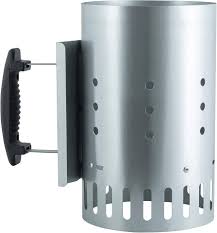
The two features that separate a well-made chimney starter from a cheap one are the shape of the bottom grate and the durability of the handles. A cone-shaped bottom grate (like the Weber Rapidfire has) exposes more coal surface area to the flame at the start, so ignition is faster. A flat bottom grate works but takes a few more minutes. The handles are the failure mode: cheap chimneys use a single riveted metal handle that transfers heat fast enough to force gloves; better chimneys have a heat shield or a thermoplastic grip on the primary handle, and a flip-up helper handle on the far side so you can two-hand the pour without burning yourself.
One more thing worth naming, because it’s the single biggest beginner mistake. People routinely light the barbecue too late, panic when guests arrive, tip the coals out before they’re properly ready, and end up cooking the first round of food over flames rather than glowing coals. That’s how sausages come out charred outside and raw inside. The chimney fixes this by making “ready” easy to see: when the top layer of coals shows solid grey ash with orange glowing underneath, they’re ready, not before. Coals with black patches on top aren’t ready — give them another five minutes. Cooking on coals not flames is the whole game for a kettle barbecue, and the chimney is the tool that gets you there reliably every time.
The six picks
Weber Rapidfire (7416) — the default buy for kettle owners
Price: £23.99. Also sold direct at weber.com/GB at the same price.
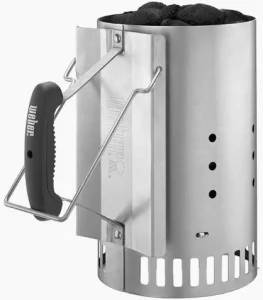
This is the chimney starter I’ve used across family barbecues for the better part of fifteen years — first on my parents’ kit, later on my own kettle. I couldn’t swear that every chimney in that timeline was Weber-branded, but the one I bought myself almost certainly was. Aluminized steel construction. Cone-shaped bottom grate that gets the fire going fast. Sturdy side handle with a heat shield between the metal and your hand, plus a flip-up helper handle on the far side for two-handed pours. 6L capacity that comfortably fills a 57cm kettle in one load.
The honest observation from fifteen years of use is that everything about the design just works — very simple, very good. The chimney itself basically doesn’t fail. When barbecues go wrong on a kettle, it’s almost always a rubbish briquette, or the cook lifting the chimney out before the coals are properly ready, or lighting the whole thing too late. The chimney gets you from “cold” to “ready” in the same fifteen to twenty minutes every time, which is the point. Weber UK’s own listing has it at 4.9/5 from 142 reviews; Amazon UK’s rating trends the same.
At £23.99, the Rapidfire is not the cheapest chimney you can buy — a BLOSTM at £12.65 lights charcoal just as well. What the £11 premium buys you is the branded product done tidily: cone bottom grate, heat-shielded handle, flip-up helper handle, quality control that makes the tool feel right in the hand. My friend-rings-up-tonight advice is simple: at £20-ish, just buy the branded product. The saving isn’t enough to matter for a tool you’ll use every time you cook on charcoal.
Ships fresh from Weber UK direct or via Amazon UK. Both routes to the same product; Amazon typically wins on delivery speed if you have Prime.
Weber Rapidfire Compact (7447) — the smaller-kettle pick
Price: £23.31.
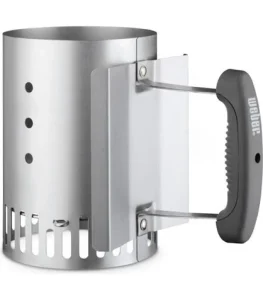
Same aluminized steel, same handle design, smaller cylinder. A noticeably shorter tool than the standard Rapidfire’s 32 cm height — sized for a 47cm Weber kettle, a Weber Compact kettle, or a portable Smokey Joe. Weber’s spec sheet on Amazon UK confirms it’s rated for 47cm+ grills; check the exact capacity on the current listing before ordering.
The oddity here is the price. £23.31 for the Compact is only sixty-eight pence less than the standard Rapidfire at £23.99. That’s not a “budget size” price gap — it’s a “which one fits my kettle” choice. Buy the Compact if you have a small kettle. Buy the standard if you have a 57cm.
Weber UK’s direct site doesn’t stock the Compact at time of writing — you’ll only find it on Amazon UK or via third-party retailers. Not a quality signal, just a distribution quirk.
BLOSTM Extra Large — the budget pick
Price: £12.65.
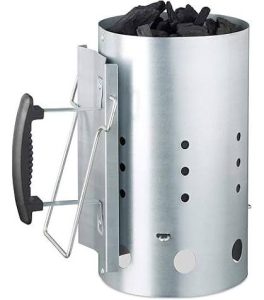
At £12.65 the BLOSTM is a genuine budget winner — meaningfully cheaper than the Rapidfire, made from galvanised steel, and with the extra-large capacity that suits either a big kettle or a household that lights charcoal a lot and would rather do one large load than two smaller ones. The heat-insulated safety handles and larger-than-average vent holes for faster ignition are both there. UK owners on Amazon report the same 20-minute-to-hot performance the Weber promises.
The Weber’s £11 premium buys you the branded product with a cone-shaped bottom grate, a heat-shielded main handle, and a flip-up helper handle for two-handed pours — small design details that add up to a slightly tidier tool. Whether that’s worth the extra depends on how much you cook on charcoal and how much you care about brand-name kit for something this simple. Either chimney will last.
LIVIVO Deluxe — the safety-first pick
Price: £29.99.
The LIVIVO Deluxe is the priciest chimney of the six, and what you’re paying for is the handle. A thermoplastic wooden grip on the main handle keeps your palm cool enough that you can lift and pour without gloves — a real advantage if you often start the fire single-handed while doing something else. Heavy-duty galvanised iron body; the extra weight is noticeable versus the Weber Rapidfire but not a problem in use.
At £29.99 the LIVIVO is £6 more than the Rapidfire for a handle upgrade. Whether that’s worth it depends on how often you’ll be lifting a hot chimney one-handed. If you always wear gloves at the barbecue anyway, save the £6 and buy the Rapidfire. If you’re the sort of cook who forgets gloves half the time, LIVIVO’s the safer buy.
Woodside Chimney Starter — the mid-tier alternative
Price: ~£23.31.
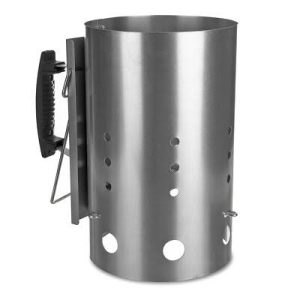
The Woodside is a solid mid-tier chimney: galvanised steel, dual handles, protective cool-touch grip, standard capacity, roughly the same 20-minute ignition claim as everyone else. UK-brand, positioned as the more affordable alternative to Weber. Its FindThisBest FTB score is 9.2 (the lowest of the chimney entries but still respectable). No standout feature versus the Weber Rapidfire; no strong reason to pick it over BLOSTM at £11 less either.
Woodside fills the “at Weber price but not Weber brand” slot for buyers who specifically don’t want to buy from Weber. If that describes you, this is the pick. If you don’t have that preference, either the Rapidfire (Weber) or the BLOSTM (budget) will serve you better.
Weber Rapidfire Set — skip the bundle, buy the chimney and lump separately
Price: £34.97.
The Rapidfire Set is Weber’s chimney bundled with a 2 kg bag of Weber briquettes and two lighter cubes. On the box it looks like the tidy first-cook gift buy — one Amazon order, everything a new Weber owner needs.
I wouldn’t buy it. I don’t recommend briquettes on a kettle — I’d rather cook on lump every time. For the same £35-ish spend, buy the plain Weber Rapidfire (7416) at £23.99 and pair it with a bag of decent UK lump charcoal from my Best UK BBQ Charcoal 2026 guide. Same tidy first-cook parcel, better cook.
If you’re gifting to someone who won’t cook charcoal unless it arrives as one bundle, the Set does what it says on the box — but they’ll be better served by the plain chimney plus a small bag of lump and a couple of natural firelighter cubes, put together yourself.
When you DON’T need a chimney starter — the kamado ignition method
If you’re cooking on a ceramic kamado — a Big Green Egg, a Kamado Joe, a Monolith, an Aldi Gardenline egg, a Lidl Grillmeister, a B&Q GoodHome Sagami, or any of the other 47-57cm ceramic charcoal grills — you probably don’t need a chimney starter. Kamados ignite differently to kettles, and the honest surprise when I moved from a Weber kettle to a Big Green Egg Large was how well it actually works.
On a kettle, you’re lighting a full grate of charcoal at once, spread across a wide flat area. The chimney concentrates the fire so every coal is glowing before you tip them out. That works because a kettle needs a consistent bed of hot coals for direct grilling.
On a kamado, you’re not lighting a full grate. You’re lighting a fistful of lump charcoal — maybe six or eight pieces — piled slightly at the top of the firebox. You put a firelighter cube on top of that small pile (or tuck it into a little dip you’ve made in the lump), light the cube, close the dome after a couple of minutes with the vents wide open, and wait fifteen to twenty minutes. It feels like it shouldn’t work — you’re lighting the fuel from the top, which is not what any barbecue instinct expects — but with the kamado’s chimney effect drawing air up through the bottom vent, past the ignited fuel and out the top vent, it works reliably. The fire spreads outward from the ignition point into the surrounding fuel and settles at whatever temperature the vents allow. Cook temperatures then hold for eight to twelve hours without intervention.
Most of what I actually do on the BGE is a version of the minion method — light one small pile at the top or side of the lump so the fire spreads slowly through the rest of the fuel across a long cook, rather than lighting the whole load at once. That’s the low-and-slow trick. You barely need any firelighter — one cube is enough — because the point is to seed the fire, not to force it.
Using a chimney starter on a kamado works, but it defeats the point. You end up with far more lit charcoal than the cook needs, which burns hot and fast and fights the kamado’s efficiency. Ceramic kamados were designed to be lit with a firelighter cube and a match. If you own one, skip this category and put the £24 towards a good probe thermometer instead.
How to spot a chimney starter that isn’t worth buying
Every SERP for “cheap BBQ tools” has products that look like the ones in this list but aren’t the same tool. Categorical signs that a chimney starter isn’t worth your money:
Thin-metal construction — if the cylinder feels flimsy in the hand or bends under light pressure, that’s the tell. Aluminized steel and galvanised steel both work perfectly well; what matters is that the metal has some heft to it. The reputable chimneys in this list all do. Very cheap unbranded chimneys at end-of-aisle bins tend not to — the metal is noticeably thinner in the hand, and the weight in the box is the giveaway.
A single handle with no heat shield — cheap chimneys skip the flip-up helper handle and use a single riveted metal handle with no shielding. The metal handle heats up in the first cook and stays hot enough to scorch your palm through a normal glove. If the product photography shows only one handle and no shielding, keep scrolling.
No bottom-grate detail in the product page — Weber and the reputable brands feature the cone-shaped bottom grate prominently because it’s the feature that matters for ignition speed. Chimneys that gloss over the bottom design usually have a flat grate or a low-quality cone that doesn’t concentrate the flame properly. You’ll notice — the fire takes half an hour instead of fifteen minutes and you’ll be back to standing over the kettle wondering why.
“Universal” or unclear capacity — a good chimney starter tells you what it holds in litres or kilograms of briquettes, and what size grill it fits. A vague “large” or “extra-large” without a size specification is a warning sign that the capacity was never designed against a specific kettle.
None of these signs are brand-specific. The Weber Rapidfire is the SERP’s default answer for a reason — it hits all four right things — but a well-made BLOSTM or LIVIVO or a supermarket own-brand that ticks the same boxes will serve you just as well. The failure mode is buying the £5 chimney at the checkout counter, not buying the wrong brand.
Frequently asked questions
How long does a chimney starter take to light charcoal?
Fifteen to twenty minutes for standard briquettes. Briquettes often have a light accelerant coating that helps them catch, so they tend to light fastest. Lump charcoal takes roughly the same window — sometimes slightly longer because there’s no accelerant on it — but the visual cue is the same either way. You’ll know it’s ready when the top layer of coals shows a solid grey ash coating on the outside with orange glow underneath. Coals with black patches still on top aren’t ready; give them another five minutes.
Do I need a chimney starter for a kamado?
No. Ceramic kamados (Big Green Egg, Kamado Joe, Monolith, Aldi’s egg, Lidl’s egg, B&Q’s Sagami) ignite differently. Put a firelighter cube directly into a fistful of lump charcoal in the firebox, light it, close the dome with vents wide open, wait fifteen to twenty minutes. The kamado’s chimney effect does the same job as a dedicated chimney starter, without the extra kit or the wasted fuel.
How much charcoal does a Weber Rapidfire hold?
The standard Rapidfire (7416) has a 6L capacity, which is about 2.5 kg of standard briquettes or a bit less of lump charcoal. That’s enough to fill a 57cm Weber kettle for a direct grilling cook. The smaller Rapidfire Compact (7447) is sized for a 47cm kettle or a Weber Compact — check the exact capacity on the current Amazon UK listing.
Can I use lump charcoal in a chimney starter?
Yes. Give it roughly the same fifteen-to-twenty minute window as briquettes — briquettes usually catch a touch faster because they carry a light accelerant coating, but the difference is small. The one thing to watch is that lump pieces are irregular; a very large piece can block airflow through the chimney. If ignition seems slow, tip the chimney gently to let smaller pieces settle at the bottom for better air circulation.
Newspaper or firelighter — what should I use to light the chimney?
Both work. My honest habit for years was a few sheets of scrunched-up newspaper underneath the grate — free if you have papers around, no residue, no flavour issue. The one thing to avoid is the old paraffin firelighter blocks (white waxy squares) — the paraffin taste carries into the food. The modern natural firelighters (Flamers, Ecoblaze, Weber’s own wood-wool cubes) burn cleanly and are the better choice if newspaper’s hard to come by.
Chimney starter versus a Looftlighter — which should I buy?
For most cooks a chimney starter is the more useful tool. It costs less (£24 versus £70+ for a Looftlighter electric starter), lasts longer with no moving parts to fail, doesn’t need a mains socket in the garden, and works with any charcoal or briquette. The Looftlighter’s advantage is speed — five minutes to hot coals versus fifteen for a chimney — and the theatre of the fan-forced ignition. If you cook charcoal several times a week and hate waiting, the Looftlighter earns its price. If you cook fortnightly, the chimney is the sensible buy.
Provenance
This piece is Tested-leaning: I used a chimney starter on my previous Weber kettle for a good while, so the mechanics and handle preferences come from real use. The six specific picks are Consensus — sourced from the UK product SERP, FindThisBest UK’s category analysis, and Weber UK’s own product listing. I don’t currently use a chimney starter; my Big Green Egg Large lights differently, which the kamado section above covers.
Final verdict
Buy the Weber Rapidfire (7416) at £23.99 unless you have a specific reason not to. After fifteen-plus years of using chimneys across family and own kit, my friend-rings-up-tonight advice is simple: at £20-ish, just buy the branded product. The £11 gap between the Weber and the BLOSTM isn’t enough to matter, and the Weber’s the tidier tool — cone grate, heat-shielded handle, flip-up helper handle.
If you want to save eleven pounds, BLOSTM’s Extra Large at £12.65 does the same job. If you have a smaller kettle, Weber’s Rapidfire Compact at £23.31. If you sometimes forget gloves and want a stay-cool handle, LIVIVO’s Deluxe at £29.99.
The Weber Rapidfire Set at £34.97 is the one to skip — the chimney inside is the same £23.99 Rapidfire, and I wouldn’t recommend the bundled briquettes. If you’re gifting, buy the plain chimney and pair it with a bag of decent lump from the Best UK BBQ Charcoal 2026 guide.
The one buying mistake to avoid is the very cheap unbranded chimney at the end-of-aisle bin — thin metal, single handle, no heat shield. The BLOSTM at £12.65 is only a few pounds more and is a properly-made tool.
If you’ve moved to a ceramic kamado, don’t buy a chimney at all. Skip to the kamado section above and use a firelighter cube directly in the firebox instead.
Published 30 July 2026. Prices verified against Amazon UK product pages and Weber UK direct on 29 July 2026.